Is art a store of value? An honest comparison with cash and gold
No, not in the strict economic sense. Art lacks the liquidity, standardized pricing, and low transaction costs that make cash and gold reliable stores of value — the global art market itself shrank from an estimated $67.8 billion in 2022 to $59.6 billion in 2025, while gold's LBMA average price rose roughly 91% over the same three years.
What economists actually mean by a store of value
A store of value is an asset that preserves purchasing power over time without the owner having to do anything active to maintain it. The textbook examples — cash, gold — share three properties: liquidity (you can convert the asset to spendable money quickly, at a known price), standardized pricing (any two units of the same asset, in the same condition, sell for close to the same amount), and low transaction costs (buying and selling doesn't consume a large share of the asset's value).
An original painting fails all three tests structurally, not by accident. It is a single, non-fungible object — there is no second unit of a specific canvas to check a going rate against. Selling one typically takes weeks to years, not minutes. And the cost of transacting is real: Sotheby's raised its buyer's premium on lower-value lots to 28% of the hammer price, effective February 2026 — close to a third added on top of whatever a work fetches, before any seller's commission is even counted.
The global art market has shrunk since 2022, not grown
The clearest test of art as a store of value at scale is what happened to the market itself. According to the Art Basel and UBS Global Art Market Report 2026, compiled by Arts Economics, global art sales rose 4% year-on-year to an estimated $59.6 billion in 2025 — a real recovery, but one that followed two consecutive years of decline. The report's 2023 edition put total global sales for 2022 at $67.8 billion. Measured across that three-year span, the market contracted by roughly 12% even as the cost of nearly everything else rose.
That is not proof that any individual painting lost value — aggregate sales figures track total transaction volume across dealers, fairs, and auction houses, not the price of a specific work. But it does undercut the assumption that art, as an asset class, simply compounds upward. The market that is supposed to be storing value here is smaller in dollar terms than it was three years earlier.
Why art price indices overstate what a typical purchase actually does
Most of what gets quoted as "the art market's return" comes from repeat-sales price indices, the best known being the Sotheby's Mei Moses Indices, built from works that sold, then sold again, at public auction. That method has a structural limitation that analyses of art-index methodology point to directly: because the index depends on the same object changing hands twice, it can only be built from the minority of works that get resold at all — and resold works tend to be the ones that performed unusually well or unusually badly the first time, which several breakdowns of this methodology describe as selection and survivorship bias built into the data, not a rounding error in it.
The Mei Moses data is also narrower than the label suggests: it draws only on public auction results from Sotheby's, Christie's, and Phillips, and excludes private sales, gallery sales, and — by definition — every work that has only changed hands once. A painting bought directly from a working artist's studio and never yet resold at auction isn't represented in that index at all. Whatever figure gets attached to "the art market" in a given year, it describes a specific, auction-heavy slice of it, not the purchase most collectors actually make.
Cash and gold, measured over the same three years
Cash and gold are simpler to measure precisely because they don't have this data problem — one is tracked continuously by a central statistics office, the other trades against a public, standardized benchmark. Over the same span the art market contracted, the U.S. Consumer Price Index rose 2.7% in the twelve months to December 2025, per Bureau of Labor Statistics data — a small, predictable erosion that is exactly what economists mean when they call cash a poor store of value on its own: it reliably loses ground to inflation, just slowly. Brazil's IPCA, the country's official index, accumulated 4.26% over 2025 alone, according to IBGE — a reminder that the erosion rate for cash depends entirely on which currency is being held.
Gold moved the opposite direction. The LBMA annual average gold price rose from roughly $1,800 per troy ounce in 2022 to about $3,432 in 2025 — an increase of close to 91% over the same three years the art market contracted. That run is unusually strong even by gold's own history, and it's worth being honest about what it means: gold's reputation as a store of value rests on centuries of preserving purchasing power in aggregate, not on a guarantee that any given three-year window will be this favorable. What gold does offer reliably, and art structurally cannot, is a known price, quoted continuously, that lets an owner convert to cash in minutes rather than months.
What buying art honestly offers instead
None of this means buying art is a mistake — it means the purchase is answering a different question than "where do I park money." A painting bought directly from a working artist's studio is a single object you can see, live with, and pass on, backed by documentation — a certificate of authenticity, a curatorial dossier, a unique Archive ID — that establishes what it is and when it was made, which matters far more to a future buyer or an estate than to any short-term resale.
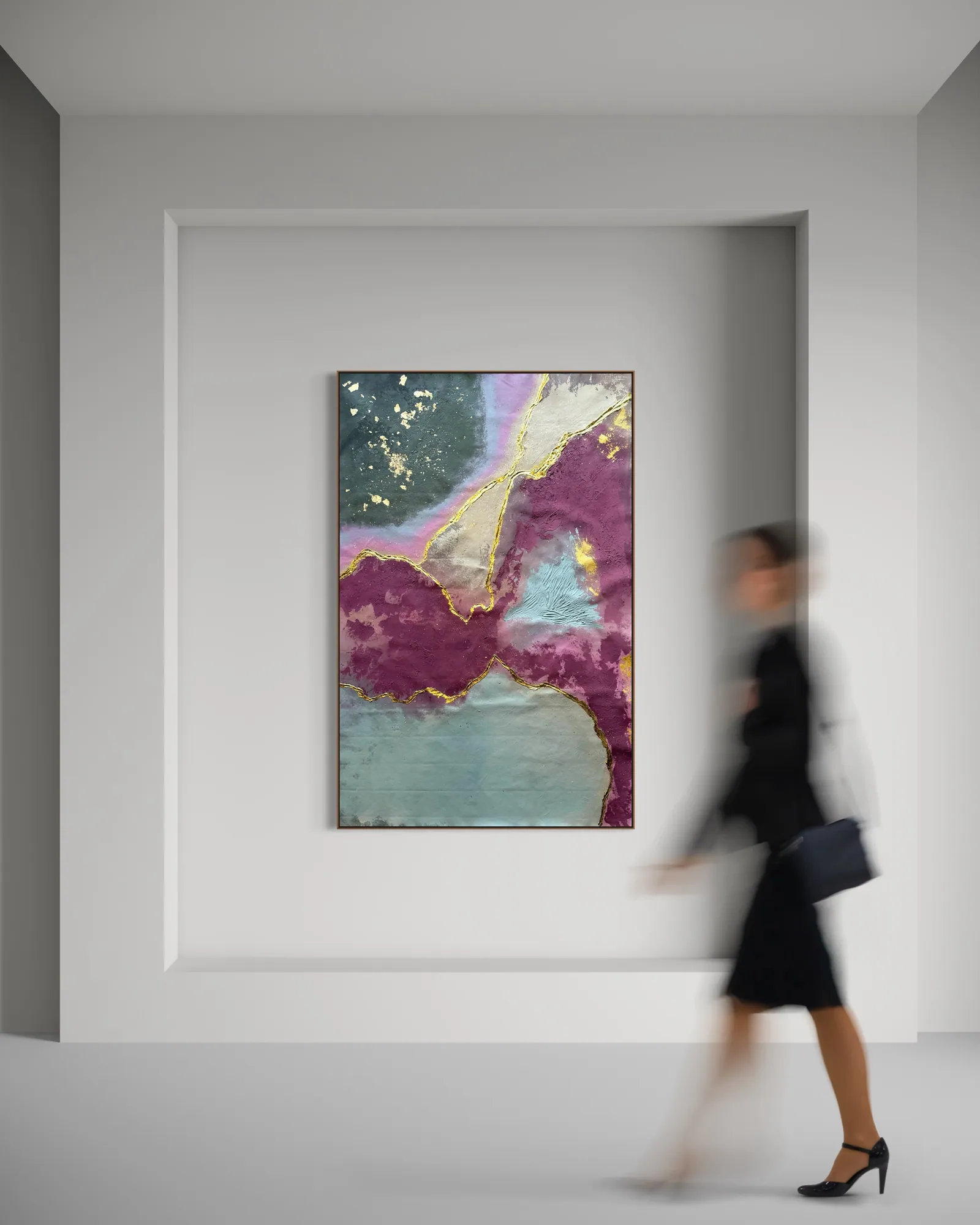
Quartz Seam, a mixed-media composition with acrylic and gold leaf from the Terra & Ether series, is a literal illustration of the distinction this page is making: the gold leaf in its surface has a spot price you could look up today, and the painting around it does not — its worth is set by whoever wants it enough to buy it, which is a fundamentally different mechanism from an ounce of bullion changing hands on an exchange.
From the studio
From the studio
Collectors sometimes ask, gently, whether a piece will "hold its value" the way they've heard gold or property does. I try to answer that honestly rather than reassuringly: no painting, mine included, behaves like a commodity with a quoted price, and I would rather a piece be bought because someone wants to live with it than as a bet on what it converts back to later. What I can control, and do, has nothing to do with market forecasting — every work leaves the studio with a signed certificate of authenticity, its own Archive ID, and a dossier documenting the materials and process, including pieces like Quartz Seam where actual gold leaf sits in the surface. That paperwork won't make a painting liquid. It's what a future owner, or your own estate, will actually need if the piece is ever sold, insured, or passed on — the honest, unglamorous half of what "value" means for a piece that isn't traded on an exchange.
Frequently asked
Is art a good hedge against inflation?
Not reliably, and not in a way that can be measured the way cash or gold can be measured against inflation. Individual paintings can outpace inflation or badly underperform it, but there is no broad, unbiased dataset tracking what a typical purchase does over time — the indices that exist are built mostly from resold auction works, which are not representative of most art purchases. Cash, by contrast, is guaranteed to lose purchasing power at a known, published rate. Gold has a continuously quoted price you can track daily. Art offers neither that guarantee nor that transparency.
How does buying art compare to buying gold?
Gold is standardized, liquid, and priced continuously against a public benchmark, so an owner always knows what an ounce is worth and can typically sell it within minutes. A painting is a single, non-fungible object with no equivalent unit to price it against, and selling one usually takes weeks to years through a dealer or auction house, often with a substantial commission on top — auction buyer's premiums alone can run close to 28% of the hammer price at a major house. The two assets solve different problems for an owner.
Why did the global art market shrink between 2022 and 2025?
According to the Art Basel and UBS Global Art Market Report 2026, global sales reached an estimated $59.6 billion in 2025, up 4% from 2024 but still below the $67.8 billion recorded for 2022, following two consecutive years of decline in between. The report describes 2025 as a moderate recovery rather than a return to the earlier level — the market is growing again, but from a smaller base than it had three years before.
Are art market price indices reliable?
They're useful for tracking a specific segment of the market, not a substitute for what art in general is worth. Repeat-sales indices like the Sotheby's Mei Moses Indices are built only from works that sold twice at public auction, mainly at Sotheby's, Christie's, and Phillips — a structure that several analyses of the methodology describe as introducing selection and survivorship bias, since resold works are not a random sample of everything bought and sold. A newly acquired piece that hasn't been resold at auction isn't captured by these indices at all.
What happens if I need to sell an artwork quickly?
Expect it to take time and cost money. Unlike cash or gold, there is no exchange where a painting has a continuously quoted price, so a quick sale usually means accepting a lower offer than a patient one would fetch, whether through a dealer, a private sale, or a lower-visibility auction slot. This illiquidity is one of the clearest structural differences between art and the assets usually called stores of value, and it's worth weighing honestly before buying with resale speed in mind.
Is it better to buy art directly from the artist instead of a gallery or auction house?
It depends on what a buyer is optimizing for, not on which path is universally better. Buying directly removes a gallery's markup and an auction house's buyer's premium, and puts a collector in direct contact with the person who made the work for questions about materials and process. It does not remove the illiquidity or pricing uncertainty discussed on this page — those are properties of art itself. A serious direct purchase should still come with real documentation: a certificate of authenticity, a dossier, and a clear acquisition record, the same paperwork a gallery or advisor would be expected to provide.
Considering a piece for what it is, not what it might return?
Ask Alyne directly about a specific work — materials, dimensions, and the documentation that comes with it, including pieces like Quartz Seam.
Sources
- Art Basel and UBS Global Art Market Report 2026 (Arts Economics), via Art Basel — 2026-08-30
- Art Basel and UBS Global Art Market Report 2023 (Arts Economics), via Art Basel — 2026-08-30
- MADE IN BED Magazine — 2026-08-30
- MyArtBroker — 2026-08-30
- USInflationCalculator.com, compiling U.S. Bureau of Labor Statistics CPI-U data — 2026-08-30
- Agência Brasil, citing IBGE — 2026-08-30
- metalcharts.org (LBMA annual average data) — 2026-08-30
- metalcharts.org (LBMA annual average data) — 2026-08-30
- THE VALUE — 2026-08-30
Published on