Where to hang a gold leaf painting, and how light changes it
Gold leaf reflects light in one mirror-like direction instead of scattering it the way matte paint does — conservation sources call this specular reflection. Hang it somewhere it catches light from more than one direction across the day, and keep it out of direct sun, which affects the paint and canvas more than the gold itself.
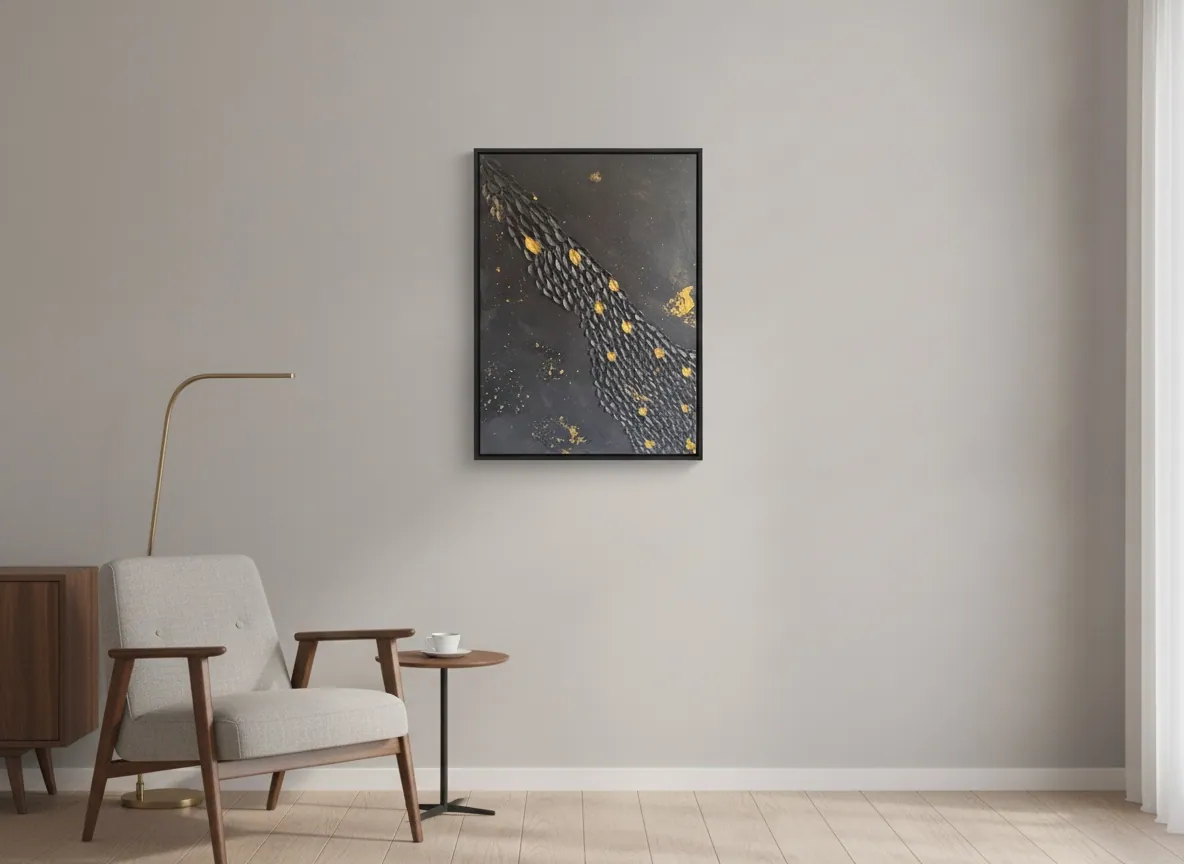
Reflective vs. matte: why gold leaf isn't just another color
Most of a painting's surface — the acrylic, the texture paste, the canvas ground — reflects light diffusely: light hits the surface and scatters in many directions, which is why a matte painting looks roughly the same from almost anywhere in the room. Gold leaf behaves differently. Because it's a burnished metal surface, it produces what conservation sources call specular reflection, where light arriving from one direction bounces back in a single corresponding direction — the angle of incidence equals the angle of reflection, the same physics as a mirror.
That's the mechanical reason a gold leaf panel can look flat and dark bronze from one spot in a room and switch to a bright, almost liquid gold from a few steps to the side: the viewer has moved into the path of the reflected beam, or out of it. Matte paint doesn't do this. It's also why photographing gold leaf accurately is harder than photographing a matte painting — the camera has to sit in the right relationship to the light source to catch the reflection at all.
Where the light source sits matters more than how bright it is
Because the reflection is directional rather than diffuse, the position of a piece relative to its light sources decides how much of the gold "activates" at any given moment — brightness alone doesn't. A single point source aimed directly at a gold leaf piece can wash the effect out into one uniform hot spot, while light arriving at an angle, or from more than one direction across the day (a window earlier, a lamp or sconce later), lets different sections of the leaf catch the reflection at different times.
General lighting guidance for paintings treats controlling the beam angle and directionality as part of getting even, useful light on a piece, rather than pointing a single bright source straight on. For a wall holding a gold leaf piece, that means placing lamps or ceiling spots slightly off-axis rather than dead-center, and, where the room allows it, giving the piece more than one light source so it doesn't go flat when only one is on.
UV and fading: the leaf isn't the fragile part
Conservation guidelines that group museum objects by how light-sensitive their material is place metal in the least sensitive category — allowed up to roughly 300 lux, with continuous exhibition considered acceptable — compared with oil paintings, grouped as less sensitive but still capped around 150 lux with rotation built in, and paper or textiles restricted to roughly 50 lux. The gold leaf itself, being a metal, isn't the part of a mixed-media piece that ordinary light damages.
What follows the standard rules for a painting is everything the gold sits on and beside: the acrylic, the texture paste, and the canvas. Those materials are what general UV caution protects, and guidance on filtering ultraviolet from gallery or living-room lighting — either by choosing light sources that emit little to no UV or by using UV-filtering glazing — applies to a gold leaf piece exactly as it would to any painted canvas.
Placement: bright enough to catch the gold, out of direct sun
The practical version of the two sections above is a single placement rule: keep a gold leaf piece out of direct, unfiltered sunlight — the same caution given to any painting, because of the paint and canvas underneath — while still giving it real light to reflect. A wall that gets only indirect daylight, or artificial light from more than one fixture, tends to work better than either full sun exposure or a dim corner where the leaf never catches anything.
LED lighting is generally the safer modern choice for the fixture itself, since LED sources emit markedly less UV and infrared than incandescent, halogen, or older fluorescent bulbs — though not all LEDs are equal, and older LEDs made before roughly 2018 are worth checking rather than assuming are UV-safe. A hallway with sconces on both sides, a mantel with a picture light angled slightly off the surface, or a dining or living room wall that catches lamp light from two directions in the evening are all settings where a gold leaf piece can do what it's built to do: change through the day instead of sitting flat.
From the studio
From the atelier
Gold leaf is the last thing that goes on a piece, never the first, and I apply it sparingly — as fragments, not as a field. In a piece like Golden Passage, the gold sits inside a mostly dark, textured surface, and I place it where I want the eye to land rather than spreading it evenly across the canvas, because I know from the studio floor how differently it will read once it's on someone's wall instead of under my work lights.
When a collector tells me where a piece is going to hang, the light in that room is part of what I picture, not an afterthought. A piece with gold positioned across from a window that gets soft daylight is going to move and shift through the day in a way the same piece under one fixed downlight won't. I can't control a collector's room, but when they ask, I tell them the gold is doing exactly what it's supposed to when it looks different at 10am than it does at 6pm — that's not a flaw to fix with more light, it's the material behaving the way burnished metal behaves.
Frequently asked
Does gold leaf fade in sunlight the way a painted surface can?
Not in the same way. Conservation guidelines place metal in the least light-sensitive category used for museum display — up to roughly 300 lux, with continuous exhibition considered acceptable — while oil paintings are treated as more sensitive and capped lower. The gold itself isn't what's at risk from ordinary room light; the acrylic, texture paste, and canvas around it are what standard picture-safety rules, like avoiding direct sun and filtering UV, are protecting.
What's the best kind of light for a gold leaf painting?
Light arriving from more than one direction and angle, rather than a single bright source pointed straight at the surface. Because gold leaf reflects specularly — like a mirror, not like matte paint — a single head-on light source tends to create one flat hot spot instead of letting the piece shift and catch light naturally through the day. LED fixtures are generally a safer modern choice, since they emit markedly less UV and infrared than incandescent or halogen bulbs.
Should a gold leaf piece hang directly across from a window?
Only if the window doesn't deliver direct, unfiltered sun for extended periods. Indirect daylight is good for a gold leaf piece — it's part of what makes the reflection change through the day — but the same UV and heat caution that applies to any painting on canvas applies here too, since a gold leaf piece is a mixed-media work with paint and canvas underneath, not a solid gold object.
Why does the same gold leaf painting look dark in one spot and bright in another?
Because gold leaf reflects light specularly: light coming from one direction bounces back in a single corresponding direction, the same physics as a mirror, rather than scattering evenly the way a matte painted surface does. Standing in or out of the path of that reflected light, or moving through the room as the light source changes through the day, is what makes a gold leaf piece look flat one moment and bright the next.
Is LED lighting safe to use near a gold leaf painting?
Generally yes, and it's the option most conservation lighting guidance favors, since LED sources emit minimal UV and infrared radiation compared with incandescent, halogen, or older fluorescent bulbs. The caveat is that not all LEDs are equal — quality varies, and older LEDs made before roughly 2018 are worth checking rather than assuming are UV-safe.
Thinking about where a Black & Gold piece would hang?
Send us a photo of the wall and the light it gets through the day, and we'll help you work out if it's a good match for a gold leaf piece.
Sources
- Federal Agencies Digitization Guidelines Initiative — 2026-09-26
- Conservation Center for Art & Historic Artifacts (CCAHA) — 2026-09-26
- Conserv — 2026-09-26
Published on