Should you buy art in person during a trip to Brazil, or order it remotely?
Nothing about the purchase itself requires a trip: buying directly from a working artist's studio is the same transaction whether you're standing in the room or messaging from another country — same invoice, same certificate, same export-law standing. What a trip changes is logistics: you can see the work's true color and texture before deciding, and you can carry it home yourself instead of arranging shipping.
What a trip actually adds to the decision
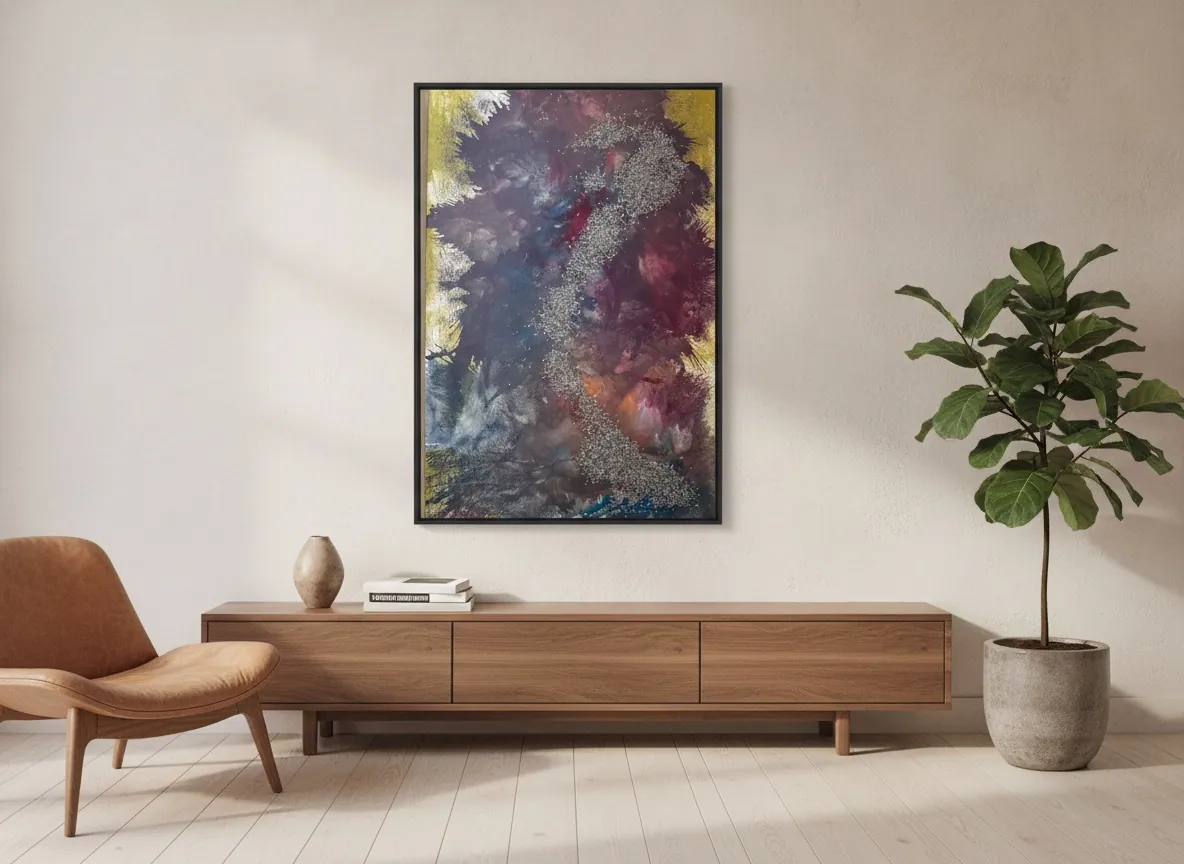
Buying in person changes what you can verify before you commit, not what's legally required to buy at all. Metallic pigment, gold leaf, and sculpted texture — the materials that run through most of the studio's work — read differently under a phone screen's white balance than they do under the light of a room. Standing in front of a piece lets you judge scale against a real wall, check how a high-gloss and matte finish shifts as you move past it, and settle any doubt a photo can't resolve. None of that is available to a buyer ordering from abroad, and it's the honest case for timing a purchase around a visit rather than a case against buying remotely.
What a trip does not add is a different contract, a different price, or a different set of documents. The acquisition process — invoice, Certificate of Authenticity, Archive ID — is identical either way.
What stays exactly the same either way
A painting finished in 2025 or 2026, bought directly from the artist, is not covered by Brazil's export-restriction law for cultural goods, Lei 4.845/1965, which applies only to art produced or brought into Brazil up through the end of the monarchical period in 1889. IPHAN's other three export restrictions — heritage-listed (tombado) objects, pre-historic archaeological items, and 16th-to-19th-century Brazilian books and manuscripts — likewise have nothing to do with a contemporary canvas. That standing doesn't change depending on whether you carried the piece out in your own luggage or had it shipped after the fact; the law looks at the object's age and category, not at who was in the room when it was bought.
The paperwork is the same for the same reason: every acquisition ships with a signed invoice and a Certificate of Authenticity carrying the work's Archive ID, whether you collect the piece in person in Brasília or have it packed and sent. Payment terms are aligned to the buyer either way — domestic purchases in BRL, international purchases in USD.
Carrying it home yourself vs. having it shipped
If you're already traveling, taking the piece with you avoids a shipping quote and a wait, and the studio's professional packaging is available for a collector doing exactly that. The trade-off is that you become responsible for declaring it and, if you're a US buyer, that responsibility falls under ordinary import rules for artwork rather than any Brazil-specific one: US Customs and Border Protection treats fine art as a matter of documentation and origin, not a blanket duty exemption — travelers are expected to carry the seller's invoice and, for anything that could be mistaken for a culturally protected antiquity, documentation of where and when it was made. A signed invoice naming the artist, title, medium, and year, plus the studio's Certificate, is exactly the kind of record that question is asking for.
Ordering remotely shifts that work to the studio: international shipping is quoted per destination, professional packaging is included, and the same invoice and certificate travel with the crate instead of your carry-on. Neither route requires a customs broker for a single painting bought for a private home — that layer exists for commercial shipments, not for one collector's piece — but a customs broker or your own carrier can confirm specifics for your destination if you want it in writing before you fly or before the crate ships. This is general information about how each route works, not legal, customs, or tax advice for your specific trip or shipment.
How to decide, in practice
If a trip to Brasília is already on the calendar for other reasons, timing the purchase around it costs nothing extra and lets you see the piece before deciding — reserve the work in advance by message so it's confirmed when you arrive, rather than hoping it's still available. If no trip is planned, there's no reason to manufacture one: detailed photographs, video, and a video call before purchase cover most of what standing in the room would tell you, and the studio ships internationally as a matter of course. The one case where a visit genuinely matters more than usual is a large, heavily textured piece meant for a specific wall — scale and finish are harder to judge remotely the bigger and more physical the surface gets.
From the studio
From the studio
I get asked, more than almost anything else, whether someone should wait for a trip to Brasília before buying. My honest answer depends on the piece. For work built in flat acrylic fields, a good photograph carries almost everything — color, edge, proportion. For anything with texture paste, gold leaf, or a mixed high-gloss and matte finish, the surface has a dimension a screen simply can't render, and I'll say so plainly rather than sell around it.
What I won't do is make the paperwork depend on which route someone takes. Whether a collector is standing in front of the canvas or messaging me from an airport lounge on the other side of the world, the same invoice, the same Certificate, and the same Archive ID go out with the piece — because the thing that actually protects a buyer years from now has nothing to do with how the sale happened, and everything to do with what's documented.
Frequently asked
Should you buy art in person during a trip to Brazil, or order it remotely?
Either works, because the transaction is identical: same invoice, same Certificate of Authenticity, same export-law standing. A trip adds the ability to see color, texture, and scale in person before deciding, which matters more for heavily textured or metallic-finish pieces than for flat acrylic work. If no trip is planned, ordering remotely with detailed photos and a video call covers most of what an in-person visit would tell you, and the studio ships internationally as standard.
What should a foreign buyer know before acting on this?
That buying directly from the artist is a private acquisition, not a commercial export — the paperwork (invoice, Certificate of Authenticity, Archive ID) is the same whether you carry the piece home yourself or have it shipped. Payment is aligned to the buyer's side, domestic in BRL or international in USD, and international shipping is quoted per destination with professional packaging included.
Does this differ for a US buyer vs a European buyer?
The Brazil side of the transaction doesn't differ by nationality — the same invoice and certificate apply either way. What can differ is the receiving country's own import treatment. US Customs and Border Protection, for example, does not exempt fine art from documentation requirements; travelers and shippers are expected to carry the seller's invoice and, where relevant, evidence of the work's origin. A European buyer should confirm equivalent requirements with their own carrier or customs authority, since this guide covers the Brazilian side, not every destination country's rules.
Who handles this in practice — the artist, a shipper, or the buyer?
The studio issues the invoice and Certificate of Authenticity in every case. From there, a buyer carrying the piece home themselves is responsible for declaring it on arrival, while a buyer ordering remotely has the studio arrange professional packaging and a shipping quote for the destination, with the same documents traveling with the crate. Neither route involves a customs broker for a single piece bought for a private home; that layer is built for commercial shipments.
What could go wrong if this step is skipped?
Traveling or shipping without the invoice and Certificate is the main risk on either route — a vague or missing description of what the object is causes more delay at customs than a specific one does. Requesting both documents at the time of purchase, rather than the day before travel or shipping, avoids that gap. Beyond documentation, this is general information, not legal or customs advice for a specific trip or shipment; a customs broker or carrier can confirm requirements for your particular case.
Deciding between a visit and a remote order?
Tell Alyne your timeline — whether you're planning a trip to Brasília or buying from abroad, she'll walk you through what changes and what doesn't.
Sources
- IPHAN (gov.br) — 2026-09-27
- U.S. Customs and Border Protection (cbp.gov) — 2026-09-27
Published on