How to hang a painting on a concrete or masonry wall
Concrete and masonry need an anchor rated for solid mineral material, not a drywall anchor, and almost always a hammer drill with a carbide-tipped bit to make the hole. A concrete screw (Tapcon-type) or a wedge anchor, sized to the piece's weight and set to the manufacturer's embedment depth, is the standard route — and a wedge anchor is rated for solid poured concrete only, not for brick or block.
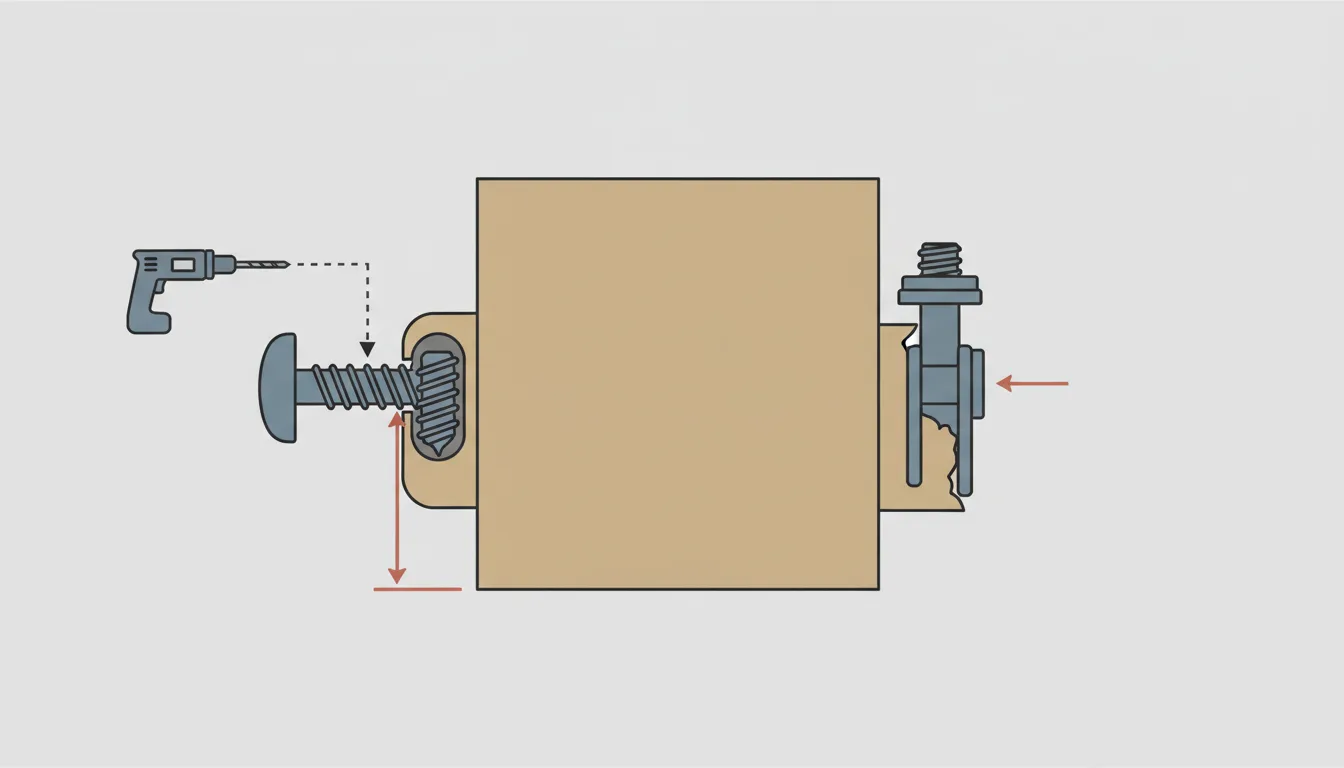
Concrete is not drywall — and brick is not concrete
A poured concrete wall is a solid, dense mineral mass with no hollow cavity and no stud to find. That density is what makes it strong enough to hold real weight, but it also means an anchor has to bite into the material itself rather than spread load across a thin panel the way a drywall toggle does. The two failure modes are opposite problems: drywall fails because the panel is thin, concrete resists precisely because it isn't.
Brick and concrete block are not the same material as poured concrete, even though people often group them together as "masonry." A standard wedge anchor, one of the most common heavy-duty concrete fasteners, is built specifically for that density: manufacturer specifications for the wedge anchor state it "can only be used in solid concrete, and not in brick or block base material," because brick and block don't have the uniform solid mass the anchor's expansion mechanism relies on. Hollow block or a soft, older brick joint calls for a different anchor system (often a sleeve-style or chemical anchor set into the mortar joint), not the same hardware used for poured concrete.
Two anchor types that actually work in concrete
For hanging a painting, two mainstream options cover almost every case: the concrete screw and the wedge anchor.
- Concrete screw (Tapcon-type): a self-tapping screw driven into a pre-drilled pilot hole, no separate sleeve or plug required. Manufacturer data for the standard 1/4" size lists an ultimate pull-out capacity of roughly 750 lbs and a shear capacity of roughly 900 lbs in 2,000 PSI concrete, with a recommended embedment depth between 1" and 1-3/4". It's the simpler install for lighter and mid-weight framed pieces, and it can be removed and reused in the same hole if a painting is later swapped.
- Wedge anchor: a bolt with an expansion clip at the embedded end that flares open against the concrete as the nut is tightened, giving it more permanent, higher-load holding power. Manufacturer specifications for a 1/2" wedge anchor list an ultimate pull-out capacity of roughly 2,999 lbs in 2,000 PSI concrete, with embedment increasing the holding value: as the same source puts it, "the deeper the embedment, the better the holding values." This is the anchor to reach for on a large-format or unusually heavy original, or when the mounting point also needs to resist sideways pull from a French cleat.
Both figures above are ultimate load ratings, not the number to plan around directly. A standard 4:1 safety margin — the same convention cited in the manufacturer specifications for both anchor types — turns the wedge anchor's roughly 2,999 lb ultimate rating into a safe working load closer to 750 lbs, still far beyond what any single framed painting weighs.
Why a hammer drill, not a regular drill
Drilling into concrete or masonry is the one part of this job that genuinely needs a different tool, not just a different bit. A standard rotary drill only spins; a hammer drill adds a rapid back-and-forth striking motion along the axis of the bit, thousands of times per minute, on top of the rotation. As a general technical description of the mechanism puts it, that combination means "each blow is of relatively low force," but the sheer number of blows per minute is "more than adequate to break up concrete or brick, using the masonry drill bit's carbide wedge to pulverize it" — the bit doesn't cut concrete the way a twist bit cuts wood, it chips and crushes it, and the hammering action is what makes that efficient.
A standard high-speed steel bit, the kind sold for wood and metal, will not survive concrete — it dulls almost immediately and glazes the hole instead of cutting it. A carbide-tipped masonry bit, driven by a hammer drill (or a heavier rotary hammer for large or repeated holes), is the standard, expected combination for this job. For a single small anchor hole in older or softer masonry, a sharp carbide bit in a standard drill can sometimes get through, but for poured concrete specifically, hammer action is the practical default.
Matching the anchor to the piece
Three things decide the anchor, in order: the wall material (poured concrete versus brick or block), the approximate weight of the finished piece — frame, stretcher, and canvas together, not just the canvas — and how the piece will be mounted (a single wire versus two D-rings or a French cleat, which spreads load across two or more points).
For most framed paintings up to a modest weight, a properly installed concrete screw at the correct embedment depth is enough, on a wire with two points rather than one. For a large-format or texture-heavy piece — sculpted relief, layered mixed media, or anything approaching gallery scale — a wedge anchor, or two anchors on a cleat system, gives a wider safety margin and a more permanent fixing. Either way, the manufacturer's published embedment depth for the specific anchor size is the number that matters, not a rule of thumb — going shallower cuts directly into the holding values quoted above.
From the studio
The atelier's view
Most of what leaves the studio travels internationally, into homes and offices built in poured concrete or masonry far more often than in the wood-framed drywall common in the US — it's the default wall in a lot of contemporary architecture outside North America, and it comes up constantly with collectors abroad. The pieces that make concrete anchoring worth thinking through carefully are the heavier ones: sculpted texture and metallic fragment work, like the layered surfaces in the Terra & Ether and Matter & Silence series, carries more real weight than a flat acrylic canvas of the same size suggests. We default to recommending two mounting points rather than one for anything in that range, and installation guidance — anchor type, hanging height, where to drill — is on request with every acquisition, not an afterthought once the piece has already shipped.
Frequently asked
Can you drill into concrete to hang a painting?
Yes. Poured concrete accepts a properly sized anchor — a concrete screw or a wedge anchor are the two standard options — but it needs a hammer drill with a carbide-tipped masonry bit, not a regular drill and a wood or metal bit. Drilling depth should match the anchor manufacturer's recommended embedment, since holding power increases with how deep the anchor is set.
What anchors are needed for a concrete wall?
A concrete screw (Tapcon-type) for most framed paintings, or a wedge anchor for larger or heavier pieces. Manufacturer specifications list an ultimate pull-out capacity of roughly 750 lbs for a standard 1/4-inch concrete screw and roughly 2,999 lbs for a 1/2-inch wedge anchor in 2,000 PSI concrete — both far above what a single painting weighs once a standard safety margin is applied.
Do you need a hammer drill for concrete?
For poured concrete, yes, in practice. A hammer drill adds a rapid striking motion to the rotation of the bit, which is what lets a carbide-tipped bit chip and pulverize concrete efficiently rather than dulling against it. A standard drill and bit can sometimes manage a very small hole in older or softer masonry, but a hammer drill is the standard tool for this job.
How much weight can a concrete-wall anchor hold?
It depends on the anchor size and the concrete's strength, and manufacturer figures are ultimate loads, not safe working loads. As a reference point, a 1/2-inch wedge anchor is rated for roughly 2,999 lbs of ultimate pull-out in 2,000 PSI concrete; applying the standard 4:1 safety margin used across the industry puts the safe working load in the hundreds of pounds — well beyond any single framed painting.
Is it different from hanging on brick?
Yes. Brick and concrete block are not the same material as poured concrete, and a standard wedge anchor is built specifically for solid concrete — manufacturer specifications state it is not for use in brick or block base material. Brick and block generally call for a different anchor system suited to their structure, often set into the mortar joint rather than the brick face itself.
Installing a piece on a concrete or masonry wall?
Every acquisition comes with installation guidance on request — anchor type, hanging height, and mounting points included.
Sources
- Concrete Fastening Systems (ConFast) — 2026-09-27
- Concrete Fastening Systems (ConFast) — 2026-09-27
- Concrete Fastening Systems (ConFast) — 2026-09-27
- Concrete Fastening Systems (ConFast) — 2026-09-27
- Wikipedia — 2026-09-27
Published on