How to hang a heavy canvas on a plaster wall
Plaster walls are older and more brittle than drywall, so the anchor choice is different: a heavy-duty toggle bolt is still the strongest drywall-style option, but on lath-and-plaster it should sit with its wings running vertically so it braces across two strips of lath, not one. Locating a stud or lath strip first, and never overtightening, matters more here than on drywall.
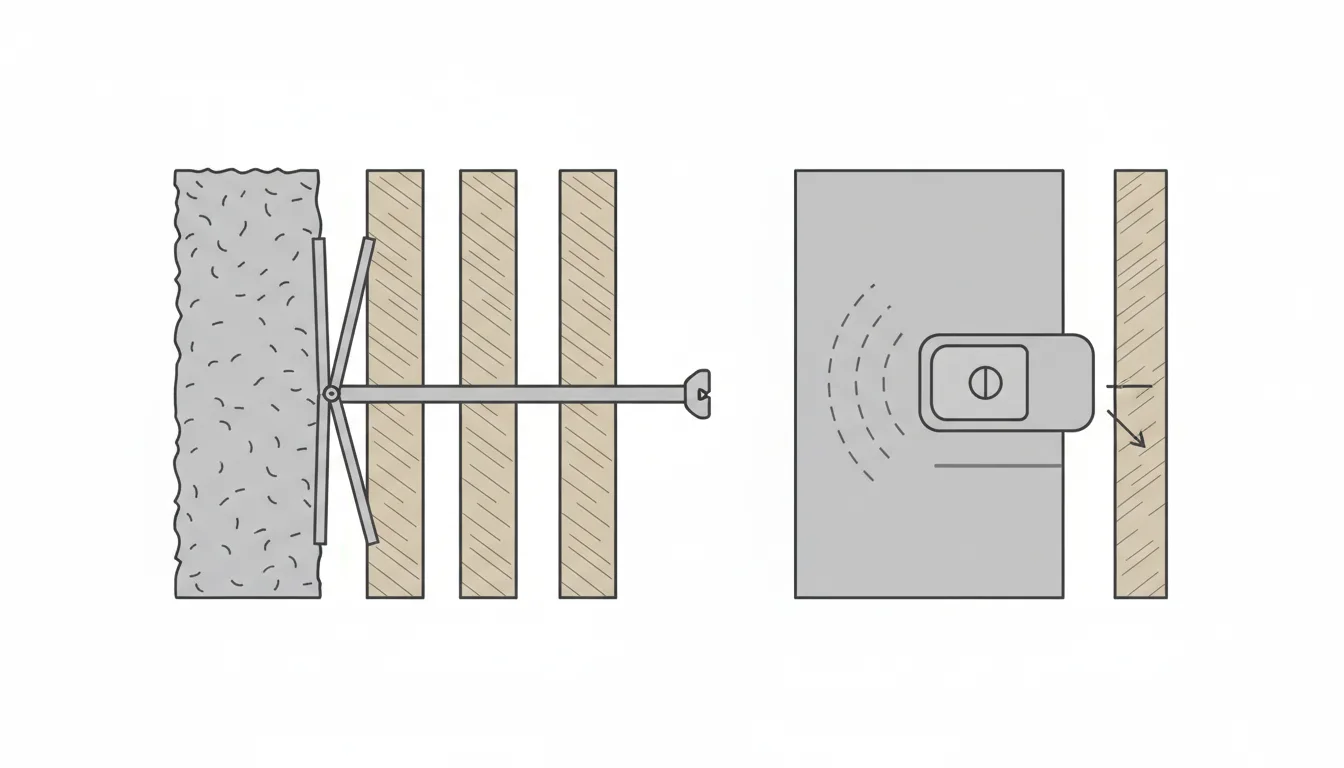
Why plaster is a different problem than drywall
Drywall is a single sheet of gypsum board, uniform from edge to edge. Plaster walls built before roughly the 1950s are a wet-applied material troweled over a lattice of wood strips called lath, spaced with narrow gaps between them, and the plaster itself has had decades to cure, dry out, and become brittle. According to a guide on anchoring into lath-and-plaster construction, "the plaster layer is often brittle, and if you just put a screw into it, it can easily crack or crumble" — a standard plastic drywall anchor, designed for a continuous sheet, can crack the surrounding plaster before it ever grips anything.
Which anchor actually holds in plaster
The same guide ranks anchor types for lath-and-plaster by holding power: a standard spring toggle is rated in the range of 25 to 100+ lb per anchor, a heavy-duty metal toggle 75 to 200+ lb, and a snap-toggle style with plastic or metal arms 30 to 150+ lb, describing toggle bolts overall as "extremely strong" and best suited to "heavy mirrors, large pictures, wall-mounted TVs, or kitchen cabinets." Expanding plaster anchors are listed as adequate only for lighter loads — "pictures, smoke detectors, light fixtures, or small shelves" — with weight limits typically lower than a toggle bolt. For an original canvas of real size and weight, that points toward a toggle bolt, not a plaster-specific screw-in anchor.
Find the stud or lath first, and don't overtighten
A wood stud behind plaster still gives the strongest hold available, the same way it does behind drywall — a screw or bolt driven into solid framing isn't relying on the plaster at all. The lath-and-plaster guide referenced above calls this "the golden ticket" and recommends locating it with a stud finder, by tapping the wall for a denser sound, or with a small test hole near the baseboard before committing to a drywall-style anchor. Once an anchor is in, the other common failure is mechanical, not structural: tightening a toggle or screw past snug can crack old plaster around the hole even when the anchor itself is correctly placed and sized for the load.
When it's not really plaster, or the piece is unusually heavy
Some walls described as "plaster" in older homes are actually a thin plaster skim coat over solid masonry or concrete block, with no lath and no cavity at all — a stud finder will read very differently there, and the anchor question changes to masonry fixings rather than toggle bolts. For a very large or heavy original — well beyond a typical framed print — or any wall where it isn't clear whether lath, masonry, or open cavity sits behind the plaster, hiring a professional installer to open a small inspection point and confirm the structure is the safer step before drilling.
From the studio
The atelier's view
As an architect before a painter, I read a wall before I read a room. A piece from Terra & Ether or Matter & Silence, built up with texture paste or metallic fragment work, carries more weight than its footprint suggests, and I've learned not to assume a wall's age tells you what's behind its surface — a plaster wall in an older building might hide wood lath, or might be a skim coat over solid masonry with no cavity at all. Every piece that leaves the studio ships unframed and gallery-wrapped, which keeps the weight lower than a framed equivalent, but I still ask about the wall before I advise on hardware. Installation guidance is part of what comes with every acquisition, available on request — it's a five-minute conversation that's easier to have before a piece arrives than after a hole is already drilled.
Frequently asked
Can you hang a heavy painting on plaster?
Yes, but plaster needs different handling than drywall. It is more brittle and, if it's an older wall, usually backed by wood lath instead of a continuous panel. A heavy-duty toggle bolt oriented so its wings brace across two lath strips is the standard approach; a lightweight plaster anchor rated only for small pictures or fixtures is not enough for a substantial original canvas.
What anchors work in old plaster walls?
Toggle bolts are the strongest common option: a standard spring toggle is typically rated 25 to 100+ lb, and a heavy-duty metal toggle 75 to 200+ lb, depending on size and manufacturer. Lighter expanding plaster anchors exist but are meant for pictures, light fixtures, or small shelves, not a heavy framed or gallery-wrapped canvas. A screw driven into a located wood stud or lath strip remains the strongest option of all.
Does plaster crack under a heavy frame?
Plaster itself doesn't crack simply from bearing weight if the anchor is sized correctly and seated properly. It cracks when a screw or anchor is overtightened, when the wrong anchor type is forced into brittle material, or when the load concentrates on a single small area instead of being spread across an anchor rated for it or a solid stud.
Should you find the lath or stud behind plaster first?
Yes. A stud or lath strip gives a far stronger, more reliable hold than any drywall-style anchor sunk only into plaster. A stud finder, tapping the wall to listen for a denser sound, or a small test hole near the baseboard are the standard ways to locate it before deciding on hardware.
What weight limit applies to a plaster wall without reinforcement?
There isn't one fixed number — it depends entirely on the anchor used and whether it engages lath or a stud. A lightweight plaster anchor alone is rated for pictures and small fixtures, not a heavy canvas; a properly placed heavy-duty toggle bolt can be rated well over 100 lb per anchor. For anything unusually heavy or a wall of uncertain construction, a professional installer is worth the cost of a visit.
Have a piece and an older wall to hang it on?
Installation guidance — hanging height, hardware, lighting — is available on request with every acquisition.
Sources
- LatheHub — 2026-09-27
Published on