How to choose between two abstract paintings you both like
When two paintings both pull you in, stop hunting for the “better” one and test them against your life instead: which wall you're actually filling, which piece keeps crossing your mind days later, and what your budget genuinely allows. Buying both later is a real plan only if it's realistic — otherwise it's just a way to stall the decision.
Start with the wall, not the painting
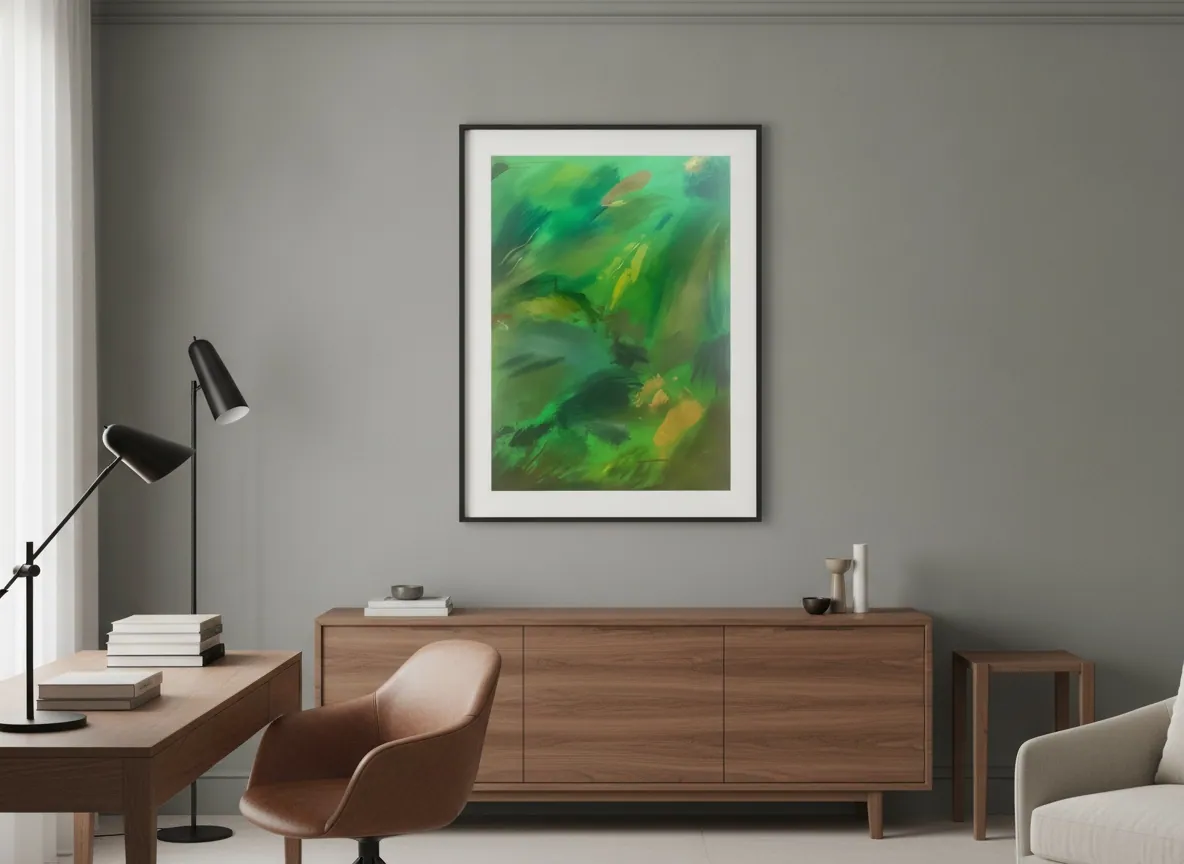
Before you compare the two pieces to each other, compare each one to the actual wall it would live on. Measure the width and height available, including clearance from furniture, doorframes, and light switches — not the wall in general, the exact rectangle the painting will occupy.
Orientation usually decides more than people expect. A tall, narrow wall next to a doorway wants a vertical piece; a square panel over a low console or a wide sofa back wants to read as a block, not a column. Compare, for instance, a vertical piece like Solar Rain (70 x 110 cm) against a square one like Patina Field (100 x 100 cm): on paper both are large-format acquisitions, but they behave completely differently once you place their actual footprint against a real wall. If one of your two candidates simply doesn't fit the proportions of the space you have in mind, the decision is already half made — no matter which one you prefer on screen.
If you're comparing photos rather than the works themselves, tape the exact dimensions to the wall with painter's tape before deciding anything else. A painting that looks similar in size to another in a photo can be dramatically different once you see its real footprint in the room.
Give it three days before you decide
Save both images to your phone and look at them again — not right after seeing them, but the next morning, and again two days later. Note, honestly, which one you open first, and which one you find yourself scrolling past.
This matters because a first reaction and a lasting one are not always the same painting. Some works are immediately striking and then say everything they have to say in the first ten seconds; others take longer to register and reward you every time you look, because there's more happening in the layers, the edges, the way light shifts across the surface. Neither is wrong — a painting can be bought purely for its first-impact punch — but knowing which kind of attraction you're feeling helps you choose the piece you'll actually want on the wall in five years, not just this week.
If, after three days, you still reach for both with equal interest, that's useful information too: it usually means the tie-breaker isn't going to be about the image at all — it's going to be about the wall, the budget, or the room.
Let the budget break the tie honestly
Price differences between two pieces you like are often smaller than they feel. Within a working studio, mid-size and large-format originals typically span a wide range — commonly R$ 2,400 to R$ 8,800 in a collection like this one — and two candidates only a few hundred reais apart shouldn't be treated as a real financial choice; that's a taste choice wearing a budget costume.
Where price should genuinely decide is when the gap is structural — a smaller, entry-tier piece against a large-format one, for example — and one of the two would actually stretch what you're comfortable spending right now. In that case, ask yourself plainly: would I rather own the smaller piece I love without hesitation, or the larger piece I'll always associate slightly with the stretch it took to buy it? Both are legitimate answers. What isn't useful is letting a marginal price difference disguise itself as the deciding factor when the real hesitation is somewhere else.
Is “buy both, later” a real plan — or a way to avoid deciding?
Original, one-of-a-kind paintings are sold once. There's no reprint and no second edition once a piece is acquired, so “I'll get the other one another time” only works if that's genuinely true for your finances and your wall space in the near future — not a hope you're using to avoid choosing today.
A fair way to test this: if the studio confirmed right now that the second piece would very likely still be available in three to six months and your budget would comfortably allow it then, buying one today and planning for the second later is a sound approach. If either condition is shaky — money that depends on something uncertain, or a piece you suspect won't still be around — you're not deferring a decision, you're avoiding one. In that case, it's more honest to decide between the two now, with the information you actually have.
If wall space is the real constraint rather than money, a piece like Vegetal Dawn (80 x 120 cm) is a useful example of a third-option question worth asking a studio directly: whether a different size within the same series or palette could sit in the same room as your first choice, rather than competing with it.
When nothing breaks the tie, trust the stronger physical reaction
Occasionally the wall fits both, the budget allows both, and three days later you're still exactly as drawn to each one. When every practical filter comes back even, it's reasonable to fall back on something less measurable: which painting you find yourself looking at longer when you're not trying to evaluate it — waiting for coffee, on a call, half paying attention. That involuntary attention is a more honest signal than a considered opinion formed while staring hard at two photos side by side.
It's also worth asking a straightforward, unglamorous question: which one would you regret more not owning? Not which one is more impressive to explain to a guest — which one you'd genuinely miss if someone else acquired it first. That question tends to cut through indecision faster than any spec sheet.
From the studio
From the studio
This exact hesitation comes up more than almost any other question I get — someone writing to say they're stuck between two pieces, usually from different series, and asking which one is “right.” I never answer that question directly, because there usually isn't a right one. What I ask instead is what they're picturing when they close their eyes and imagine the room finished: which painting is actually in that picture. People are often surprised by their own answer once they're forced to be specific about the wall instead of the image on a screen.
Training as an architect before I painted full time left me with a habit that shows up in these conversations constantly: I think about the piece in relation to the room's proportions before I think about which one is the stronger painting on its own. A canvas that's extraordinary in isolation can still be the wrong choice for a specific wall, and a quieter piece can be exactly right once you see it in the actual space it has to hold. That's usually the conversation that resolves a two-painting decision faster than anything else — not more looking at the paintings, but a clearer look at the room.
Frequently asked
How do I choose between two abstract paintings I both like equally?
Run each one through four practical filters before relying on preference alone: which fits the actual wall you have in mind (measure width, height, and orientation), which one you keep returning to after living with both images for a few days, what your budget genuinely allows without one purchase feeling like a stretch you'll resent, and whether buying the second piece later is a realistic plan or just a way to avoid deciding today. If all four come back even, trust the painting you find yourself looking at when you're not consciously evaluating either one.
Should I pick the painting I loved instantly, or the one that grew on me?
Neither is automatically the right answer — it depends on what you want from the piece. An instant, striking reaction is often the whole experience up front; a painting that rewards a longer look usually has more happening in its layers and tends to stay interesting for longer. Give both images three days before deciding, checking morning and evening which one you open first. That pattern tells you more about lasting satisfaction than the first ten seconds does.
Does wall size or orientation actually matter that much when choosing between two paintings?
Yes, often more than the image itself. A vertical composition and a square one of similar overall size behave completely differently on the same wall — one reads as a column, the other as a block. Measure the exact space, including furniture clearance, before comparing the two paintings to each other. If one candidate doesn't suit the proportions of the wall you actually have, that fact should weigh more than a marginal preference for its color or composition.
Is it a good idea to buy both paintings, one now and one later?
It can be, but only if the plan is realistic on two fronts: your budget genuinely allows a second purchase later, and the second piece is likely to still be available. Original, one-of-a-kind works sell once — there's no guaranteed second chance. If either your finances or the piece's availability is uncertain, treat "I'll get the other one later" as avoidance rather than a real plan, and decide between the two now instead.
How much should price influence the choice between two paintings I like?
Only when the price gap is structural, not marginal. Two pieces a few hundred reais apart shouldn't be treated as a real financial decision — that's usually taste dressed up as budget. A genuine price gap, such as between an entry-tier and a large-format piece, deserves an honest question: would you rather own the smaller piece without hesitation, or the larger one knowing it stretched your budget to get it? Both are valid choices; the point is being honest about which kind of decision you're actually making.
What if I still can't decide after trying all of this?
If wall fit, budget, and a few days of living with both images all come back tied, fall back on an involuntary test: notice which painting you find yourself looking at when you're not deliberately comparing anything — during a call, waiting for coffee, half distracted. That reaction is usually more honest than a conclusion reached while staring hard at two photographs side by side. It also helps to ask plainly which piece you'd regret more losing to someone else.
Still torn between two pieces? Talk it through with the studio
Send both paintings you're deciding between — Alyne can walk you through scale, placement, and materials for your specific space, and replies personally on WhatsApp, usually within 48 hours.
Sources
- Perfeito Studio (self-source — studio's own catalog record) — 2026-09-03
- Perfeito Studio (self-source — studio's own catalog record) — 2026-09-03
- Perfeito Studio (self-source — studio's own catalog record) — 2026-09-03
- Perfeito Studio (self-source — studio's own catalog record) — 2026-09-03
- Perfeito Studio (self-source — studio facts record) — 2026-09-03
Published on