How long does international shipping of a painting actually take?
Door-to-door, shipping an original painting internationally realistically takes 2 to 6 weeks, not a fixed number: a few days for packing and Brazilian export paperwork, then 1-5 days in transit by air or 20-45 days by sea, plus 1-10 business days for customs clearance at the destination. The single biggest swing factor is whether paperwork is complete before the piece ships.
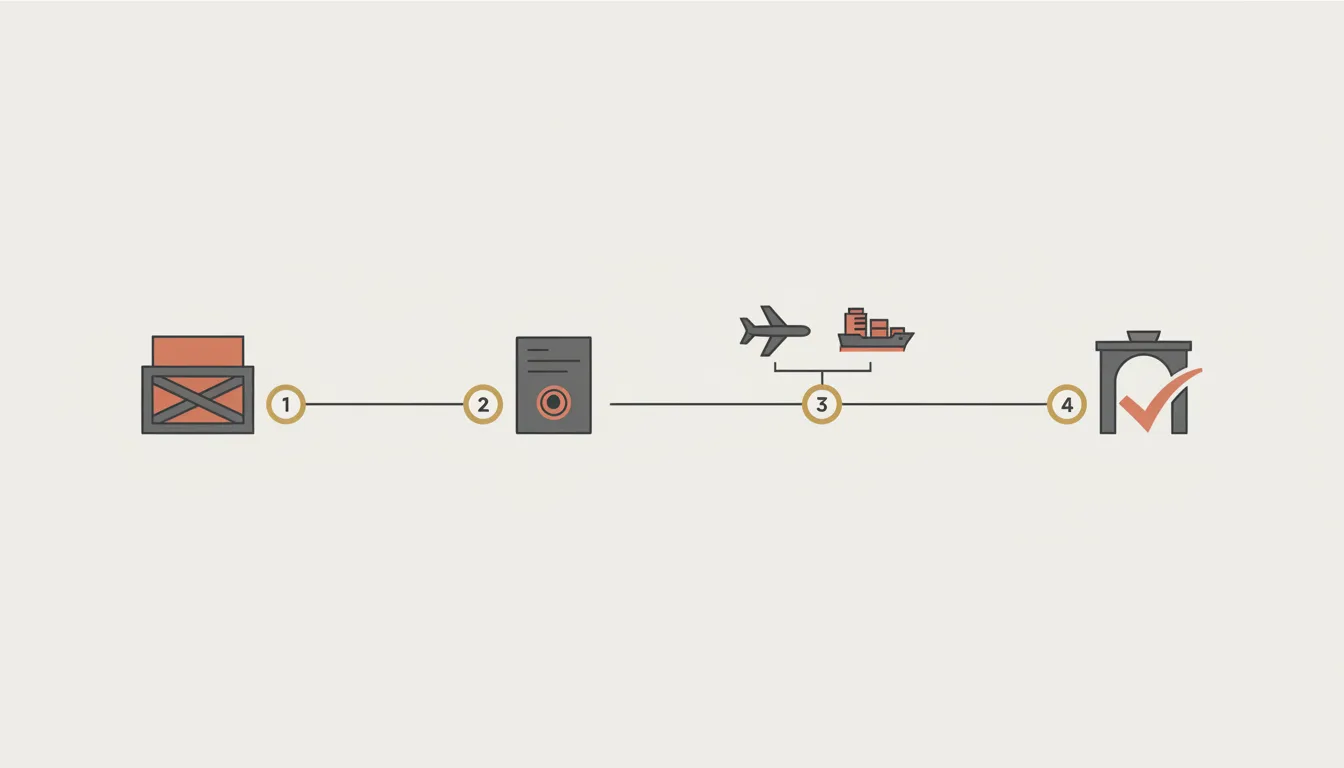
The four stages that make up the total time
"How long does shipping take" usually gets answered with a single transit number — but transit is only one of four stages that add up to the real door-to-door window, and it is rarely the longest one. A shipment moves through: packing and preparation at the studio, export clearance out of Brazil, transit to the destination country, and customs clearance on arrival before the piece is released to the buyer. Each stage has its own variable length, and delay in any one of them pushes the whole timeline back.
For a comparison of the transit leg specifically — air versus sea freight, with day ranges and sources — see the studio's guide on air freight vs. sea freight for a large painting. This page covers the stages before and after that leg, which is where most of the total time actually sits.
Packing and preparation: days, not weeks, if planned
A large-format, heavily textured mixed-media canvas cannot be boxed like a print. Packing decisions — crate versus rigid tube, foam placement around raised passages, whether the piece travels stretched or rolled — are made case by case once the specific piece and destination are known, and this preparation typically takes a few business days once a purchase is confirmed. It is not something a studio does in advance of a sale, since the packing method depends on where the piece is going.
Export declaration: the paperwork step inside Brazil
Before any artwork leaves Brazil commercially, the exporter registers a DU-E — Declaração Única de Exportação, the electronic export declaration administered through Siscomex by Receita Federal. The DU-E defines how the export is classified (fine art has its own enquadramento code) and is what enables the customs dispatch that clears the piece to leave the country. This is a documentation step, not a physical bottleneck — it runs in parallel with packing rather than after it — but an incomplete or incorrectly classified declaration is a common source of delay before a shipment can move at all.
Transit and customs clearance at destination: where the real variance is
Once the piece is in transit — by air or by sea, covered in the studio's dedicated comparison linked above — the next variable is customs clearance in the destination country, and this is where a US buyer and a European buyer see different mechanics, though similar timing.
United States. Original hand-executed paintings enter the US duty-free under HTS heading 9701 — the Harmonized Tariff Schedule lists the general duty rate for this heading as "Free." Duty-free does not mean paperwork-free: importers still need a detailed commercial invoice naming the artist, title, medium, year, and country of origin, plus a clear "original artwork" designation, and formal entry above $2,500 in value. With that documentation in order, clearance for a routine shipment typically runs 1-3 business days; incomplete paperwork, a flagged inspection, or restricted materials can push it out to 5-10 business days.
European Union. Original works of art are exempt from customs duty on import into the EU regardless of country of origin, but import VAT still applies — at a reduced rate in most member states (roughly 5% to 7% on qualifying artwork in France, Italy, or Germany, for example, versus the standard VAT rate on other goods), calculated on the declared value plus shipping cost. That VAT has to be paid by the recipient before the piece is released, which is the practical difference from the US: the clearance mechanic is a tax payment step rather than a duty assessment, but it still sits inside the same general clearance window.
In both cases, the single largest source of delay is the same: incomplete or inaccurate documentation, not the customs process itself.
Putting the stages together: a realistic total
Add the stages and a realistic door-to-door range emerges: a few business days of packing and export declaration (running in parallel), 1-5 days transit by air or 20-45 days by sea, and 1-10 business days of customs clearance on arrival. In practice that lands most air-freighted paintings in the destination country's hands within 2-3 weeks of a purchase being confirmed, and sea-freighted pieces closer to 5-8 weeks. Neither figure is a guarantee — it is the range that holds when paperwork is complete and nothing gets flagged for inspection.
From the studio
The ateliê's view: why the studio never quotes a fixed number upfront
Every piece that leaves this studio for another country is a different packing problem before it is a shipping problem. A 90 x 140 cm canvas with metallic fragments travels differently than a piece with texture paste and gold leaf, and the destination changes the calculus again — a rolled canvas re-stretched on arrival works for some pieces and not others, depending on how the surface was built. That is why the studio quotes packing method, cost, and a realistic delivery estimate only after a specific piece and country are confirmed, rather than publishing one number that would be wrong for most of the works in the catalog. It is not evasiveness — it is that the honest answer genuinely depends on what is being shipped and where.
Frequently asked
How long does international shipping of a painting actually take?
Door-to-door, plan for 2 to 6 weeks: a few business days for packing and Brazilian export declaration (these run in parallel), then 1-5 days in transit by air or 20-45 days by sea, plus 1-10 business days for customs clearance at the destination. Air-freighted pieces typically land within 2-3 weeks of a confirmed purchase; sea-freighted pieces closer to 5-8 weeks.
What should a foreign buyer know before acting on this?
The total time depends more on paperwork accuracy than on distance. A detailed commercial invoice with artist name, title, medium, year, and country of origin — plus a clear original-artwork designation — is what keeps customs clearance on the fast end of the range. Confirm the packing method, cost, and destination-specific estimate with the studio once a piece is chosen; there is no fixed number published in advance because it depends on the piece and the country.
Does this differ for a US buyer vs a European buyer?
The mechanics differ slightly, but the timing lands in a similar range. Original paintings enter the US duty-free under HTS heading 9701, with clearance typically 1-3 business days when documentation is complete. The EU also exempts original art from customs duty, but import VAT (a reduced rate in most member states) still applies and must be paid by the recipient before release — a tax step rather than a duty assessment, but occupying a comparable clearance window.
Who handles this in practice — the artist, a shipper, or the buyer?
Packing and the Brazilian export declaration are handled on the studio side once a sale is confirmed. Transit is carried out by the courier or freight forwarder engaged for that shipment. Customs clearance and any import VAT or duty at destination are the buyer's responsibility, since they are assessed by the buyer's own country — this is standard for direct international art purchases, not specific to this studio.
What could go wrong if this step is skipped?
Skipping or rushing the paperwork stage is the most common cause of delay. An invoice missing the artist's name, medium, or a clear original-artwork designation can get a shipment flagged for inspection, adding days on top of routine clearance. On the export side, an incomplete or misclassified declaration can stop a piece from leaving Brazil at all until corrected — which is why packing and paperwork are planned together, not as an afterthought once the piece is already at the courier.
Ask about shipping to your country
Send Alyne the piece you're considering and your destination — she replies personally, in English or Portuguese, with a packing plan and a realistic delivery estimate.
Sources
- FreightAmigo — 2026-09-27
- Receita Federal (gov.br) — 2026-09-27
- Flexport — 2026-09-27
- BorderBuddy — 2026-09-27
- Convelio — 2026-09-27
- Unicargo — 2026-09-27
Published on