What does a customs broker do when art crosses a border?
A customs broker is a CBP-licensed professional authorized to file entry paperwork, classify the artwork, and calculate duty on the importer's behalf — acting under a power of attorney the buyer signs directly with them, never through a freight forwarder. For a straightforward original painting, a broker becomes necessary mainly once a shipment requires a formal entry rather than a simplified one, or when the buyer would rather not handle the filing themselves.
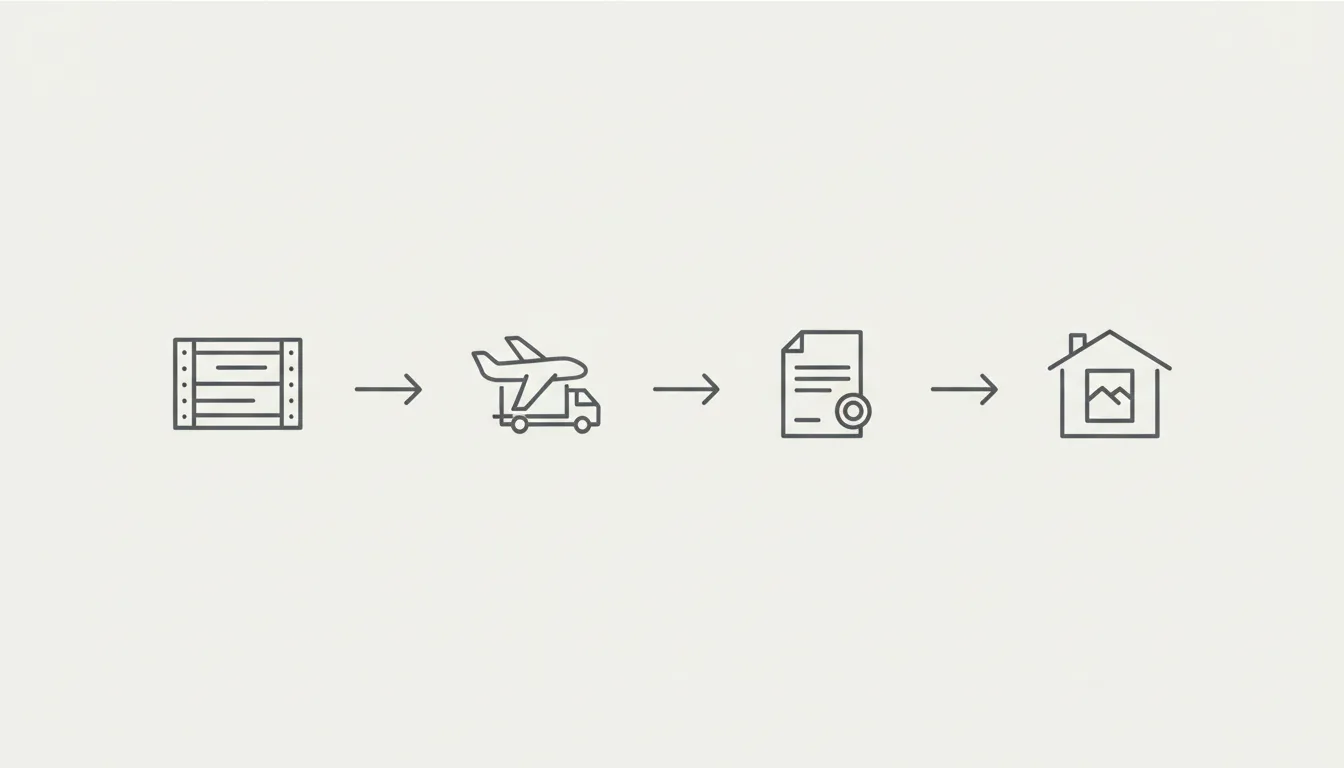
What a customs broker actually does
A customs broker is not a shipping company and not a bank — it is a professional CBP licenses specifically to handle the paperwork side of an import. U.S. Customs and Border Protection describes the role plainly: "All brokers are regulated and empowered by U.S. Customs and Border Protection (CBP) to assist importers and exporters in meeting Federal requirements governing imports and exports," and in practice that means the broker "submit[s] necessary information and appropriate payments to CBP on behalf of their clients and charge[s] them a fee for this service." The license itself comes from the Tariff Act of 1930 and is administered under 19 CFR Part 111, which is why brokers must pass CBP's own exam and maintain the license on an ongoing basis, not just obtain it once.
Concretely, for an artwork shipment that means the broker classifies the piece under the correct customs code, calculates whatever duty applies, files the entry with CBP, and answers any query customs raises about the invoice or the declared value — the same paperwork a buyer or their courier would otherwise have to handle directly.
The power of attorney — why the broker can't just "handle it"
A broker cannot file anything on a buyer's behalf without a signed power of attorney (POA) from that specific buyer. Under CBP's modernized broker regulations, "a broker must execute a power of attorney (POA) directly with an importer of record (IOR) or drawback claimant" — not through a freight forwarder, a shipping agent, or any other intermediary standing in between. The importer "must execute and sign the POA by directly communicating with the broker, and cannot have an agent or third party sign or negotiate the POA in their stead." This direct-execution rule, tied to 19 C.F.R. §141.46, is the reason a buyer receiving art from abroad usually deals with the broker's paperwork request personally, even when a courier or freight forwarder is coordinating the physical shipment.
When a broker is actually needed — and when it isn't
Not every shipment needs one. A courier handling a low-value parcel under a simplified, informal-entry process can often clear it without a broker filing on the importer's behalf. Where a broker becomes the practical path is once the shipment crosses into what CBP calls formal entry — generally more documentation and, in practice, a licensed broker doing the filing (confirm the current threshold with a broker or CBP directly) — or whenever the classification of the piece isn't a clean, obvious fit (an unusual medium, a mixed-media work with non-canvas elements, a large crate that a general parcel carrier hasn't handled before). A buyer can, in principle, act as their own filer for their own goods, but for anything beyond the simplest low-value entry, working with someone who already knows how CBP treats fine art — rather than a general carrier encountering an artwork shipment for the first time — is the detail that avoids a misclassification or a hold at the border.
What the studio provides versus what the broker provides
Perfeito Studio's role in an international sale is the same for every piece: a commercial invoice naming the artist, title, year, medium, and dimensions, a declared value that matches the actual sale price, and the signed Certificate of Authenticity with the piece's Archive ID. That paperwork is what a broker (or the buyer, filing directly) hands to customs. What the studio does not do is act as the broker itself — it does not hold a CBP license, does not file entry on a buyer's behalf, and does not quote duty figures for a country it isn't licensed to file in. Confirm with the studio directly whether a specific policy on packing, crating, or documentation language applies to your shipment; anything past the studio's own invoice and certificate is the broker's or the buyer's territory, not the studio's.
From the studio
The ateliê's view
Every piece in the current catalog is large format — canvas, heavy texture, layered mixed media — which means the invoice I write has to describe the object precisely enough that nobody downstream has to guess. I name the medium honestly, note that it is hand-executed and not printed, and give the real dimensions and the real sale price, because a vague description is exactly the kind of gap that turns a routine filing into a query. I am not a customs broker and don't try to be one; my job stops at handing over paperwork that is accurate and complete, so that whoever does the filing — the buyer or their broker — starts from a clean document instead of an incomplete one.
Frequently asked
What does a customs broker do when art crosses a border?
A customs broker is a CBP-licensed professional who files the import entry, classifies the artwork under the correct customs code, calculates any duty owed, and communicates with customs if a question comes up about the invoice or declared value — acting under a power of attorney signed directly by the importer.
What should a foreign buyer know before acting on this?
That the broker works for the importer, not the seller, and needs a power of attorney signed directly by the buyer before doing anything. Have the studio's invoice, packing list, and Certificate of Authenticity ready, since those are the documents a broker files against.
Does this differ for a US buyer vs a European buyer?
The broker's function is the same, but the licensing, duty rates, and entry thresholds are set by each country's own customs authority. A US buyer deals with CBP-licensed brokers under US rules; a European buyer deals with their own country's customs regime and its own broker licensing, so the specific numbers should be confirmed locally, not assumed to match.
Who handles this in practice — the artist, a shipper, or the buyer?
The studio provides the invoice and certificate. The buyer, as importer of record, is legally the one responsible for import clearance, though in practice they often delegate the filing to a customs broker by signing a power of attorney. The studio does not file entry and is not the broker.
What could go wrong if this step is skipped?
A shipment that needs a formal entry but is filed without proper classification or documentation risks delay, a request for more paperwork, or reassessment at a different duty rate. Misclassifying a hand-painted work as generic decor or printed art is one of the more common ways this happens with carriers unfamiliar with fine art.
Buying from abroad and want to know what documentation you'll need?
Tell Alyne your destination country and she'll confirm what the studio provides and what your broker or carrier will ask for.
Sources
- U.S. Customs and Border Protection — 2026-09-27
- U.S. Customs and Border Protection — 2026-09-27
- U.S. Customs and Border Protection — 2026-09-27
Published on