How to tell decorative abstract art from work worth collecting
Decorative abstract art is made to fill a wall and match a palette. Collectible abstract art is judged by intentional composition, materials that show visible evidence of decisions, and documentation — a signed certificate, a dated Archive ID, and a piece that exists as one, not as one of many. Color-matching is optional; intent is not.
What makes a painting merely decorative
Decorative abstract art is designed to solve a room, not to hold attention. It exists to fill a specific rectangle of wall in a palette that has already been chosen for the space — the brief runs from the sofa to the canvas, not the other way around. That's not a moral failing; plenty of interiors need exactly that, and there's an entire industry built to supply it well.
What identifies the category is the production logic behind it. Decorative pieces are typically produced as prints, giclée reproductions, or in open or very large editions, because the business model depends on volume: the same image sold many times, sized to standard frames, priced to move quickly. The brushwork, if there is any, is usually flat or simulated rather than physically present on the surface — texture that reads as texture in a photograph but disappears the moment you're standing in front of the object. None of this is deception when it's sold honestly as what it is. It becomes a problem only when a buyer pays collectible-work prices for it, or when a gallery lets the two categories blur.
Four markers of collectible-grade abstract work
Intentional composition. A collectible painting reads as a resolved decision, not a repeatable pattern. Try this test: does the arrangement of color, mass, and negative space still hold your eye after the first five seconds, or does it flatten out into wallpaper once you've registered the palette? Decorative work is built to be absorbed instantly and then recede into the background; a resolved composition keeps giving you something to look at.
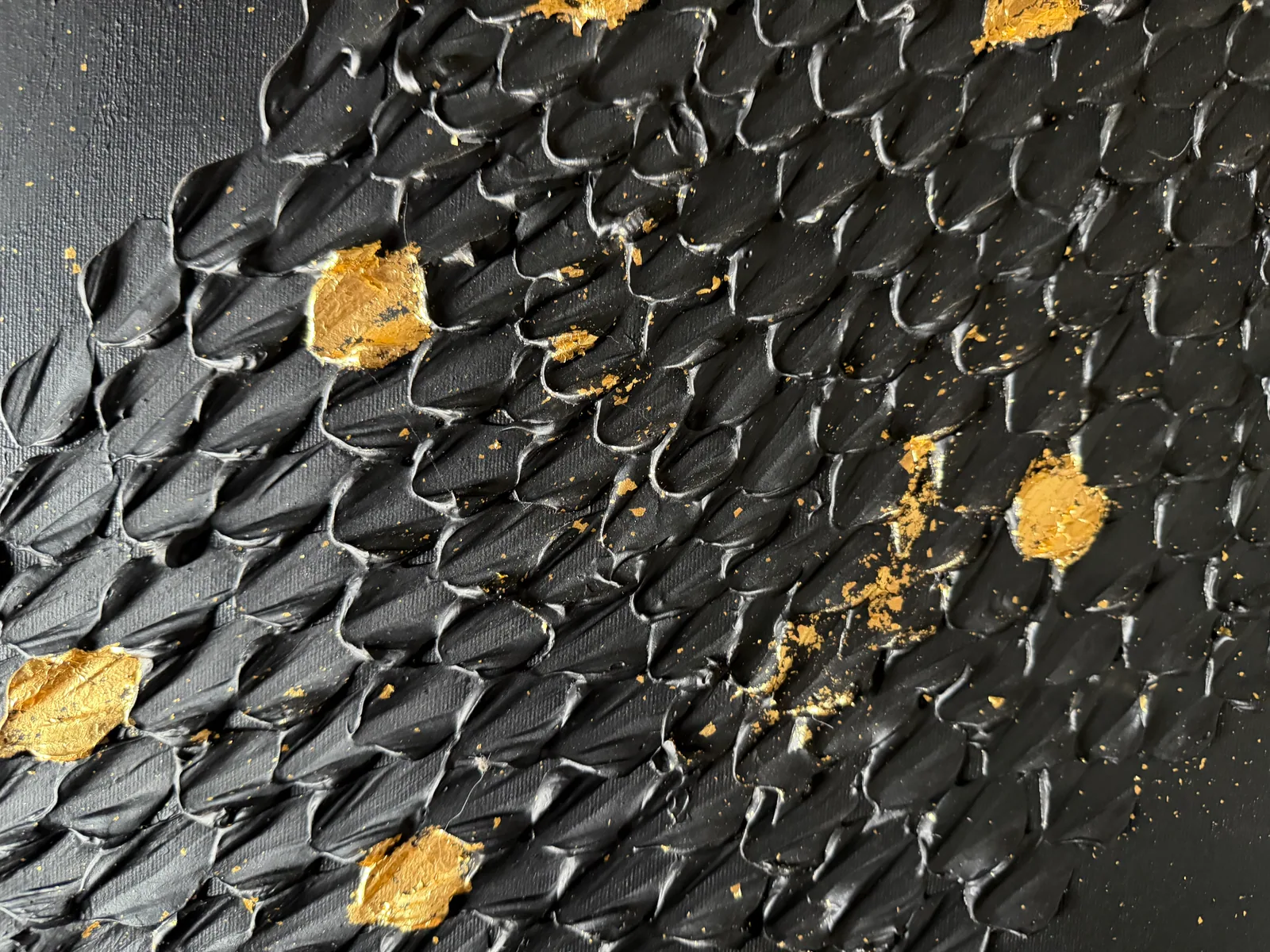
Materials that show evidence of process. Ask what the surface is actually made of, and expect a specific answer — not just "acrylic paint," but which layers, which tools, which order of decisions. Texture paste built up and carved back, metallic pigment set under a top coat, gold leaf applied by hand, sculpted relief that catches light differently depending on where you stand: these are physical records of a working process, and they're the reason a collectible piece looks different up close than it does from across the room.
Scale built for a specific space. A collectible painting is usually conceived at the size it needs to be, then built to that size once — it isn't a small study blown up to fit a wall, or a large image shrunk down to fit a frame. When a piece is resized after the fact to hit a standard dimension, some of the original intent in the composition is usually lost in the process.
Documentation and a one-of-one status. A collectible work exists as a single, dated, numbered object — not one print run among several. It comes with a way to verify that: a signed certificate of authenticity, a dated record (an Archive ID, an inventory number, a dossier), and an artist or studio that can speak specifically to that individual piece rather than reciting a general product description.
A four-question test for a piece you're standing in front of
This works in a showroom, an art fair booth, or in front of a set of online photographs, and it doesn't require any art-historical vocabulary.
- Read the description without the image. Could it describe a hundred other paintings — "vibrant abstract piece, perfect for any modern space" — or does it name the actual materials, dimensions, and decisions behind this specific object?
- Ask if it's one of one or one of many. A straight answer either way is fine. What matters is whether the seller can answer the question at all.
- Look for texture at an angle, not straight on. Tilt the piece, or move to the side if it's hanging. Real built-up surface catches light unevenly; a flat print or a simulated-texture reproduction looks the same from every angle.
- Ask what documentation comes with it. A certificate of authenticity, a numbered or dated record, and — ideally — a way to reach the person who made it. If none of that exists, the piece may still be worth buying for what it is, but it isn't collectible-grade in the sense this guide is using.
Price is not the signal
It's tempting to use price as a shortcut, but it isn't a reliable one. A large framed reproduction can cost more than a modest original from an artist early in her career, and a decorative print run can be priced well above what the materials and labor behind it would justify. The criteria above — composition, materials, scale, documentation — sort the two categories more accurately than the number on the tag does.
At Perfeito Studio, for instance, an original one-of-one piece by Alyne Perfeito — hand-built in texture paste, sculpted relief, or gold leaf, individually documented with a signed certificate and an Archive ID — runs in a range of roughly BRL 2,400 to BRL 8,800 (figures in other currencies are approximate conversions, not fixed prices), depending mostly on scale and technique rather than on how established the artist already is. The price tells you what the piece costs. It's the composition, the materials, and the paperwork that tell you what it is.
From the studio
From the studio
The question I get most often when someone is choosing between two pieces isn't about meaning — it's "will this still hold up in five years, or will I stop seeing it?" That's really the decorative-versus-collectible question in different words, and I answer it the same way every time: I walk them through what's physically on the canvas. In the Black & Gold series specifically, the gold leaf sits under a sealed top layer next to raised texture paste, and I show people how the two catch light differently depending on the time of day — that contrast is a decision, not a finish applied afterward to make the piece look expensive.
I trained as an architect before I painted full time, and the habit that stayed with me is thinking about a piece the way I'd think about a fixed element in a building — sized once, for a specific wall, meant to be lived with rather than swapped out with the next trend. That's also why every piece that leaves the studio gets its own Archive ID and a signed certificate: not as a formality, but because a one-of-one object should be traceable back to the decisions that made it, the same way a building drawing gets traced back to the architect who signed it.
Frequently asked
What's the fastest way to tell if an abstract piece is decorative or collectible?
Ask two questions: is it one of one or one of many, and can the seller describe the specific materials and decisions behind this individual piece rather than a general product description? A straight, specific answer to both usually signals collectible-grade work. A vague answer, or a piece sold as one of an open print run, usually signals decorative work — which isn't a flaw, just a different category.
Does a higher price mean a piece is more collectible?
No. Price reflects scale, materials, framing, and how a seller has chosen to position the piece, but it doesn't reliably track composition, process, or documentation. A large decorative reproduction can cost more than a smaller original by an artist early in her career. Use the criteria in this guide — composition, materials, scale, documentation — rather than the price tag alone.
Can a print of an abstract painting ever be considered collectible?
A print can be well made and worth owning, but it's a different category from a one-of-one original — it's judged by different standards, like edition size, paper or substrate quality, and whether the artist signed and numbered it personally. A photograph or reproduction of a painting is not the same object as the painting, and pricing it as though it were is where buyers get misled.
Do I have to buy from a gallery for a piece to count as collectible?
No. Gallery representation is one path to a career, not a requirement for a piece to be genuine, well made, or documented. Buying directly from an artist's studio is a legitimate way to acquire original work, provided the piece still comes with the fundamentals — a certificate of authenticity, a dated record, and a maker who can speak specifically to that individual object.
What documentation should come with a collectible abstract painting?
At minimum, a signed certificate of authenticity naming the work, the artist, and the date. Better documentation adds a unique identifier — an Archive ID or inventory number — and a curatorial note on the materials and series. Perfeito Studio also provides a conservation and installation guide with every piece, since a hand-built surface has different care needs than a printed one.
Can a first-time buyer really tell the difference without training?
Yes, using the physical tests rather than trained judgment: read the description without the image and see if it's specific, check whether the piece is one of one, look at the surface from an angle for real texture, and ask what documentation comes with it. These are observations anyone can make in a few minutes, not connoisseurship that takes years to develop.
Want to see the materials up close before deciding?
Alyne can send close-up photographs of the actual surface, a video in raking light, and the documentation — certificate, Archive ID, dossier — that comes with any piece you're considering.
Published on