Commissioning a painting vs. buying one that already exists
Buying a finished painting means the color, scale, and surface are already settled — what you see is what arrives. Commissioning means describing a piece that doesn't exist yet, with no guarantee the result matches what you imagined. An existing, finished work is the lower-risk choice for most buyers; commissioning only makes sense when nothing available fits.
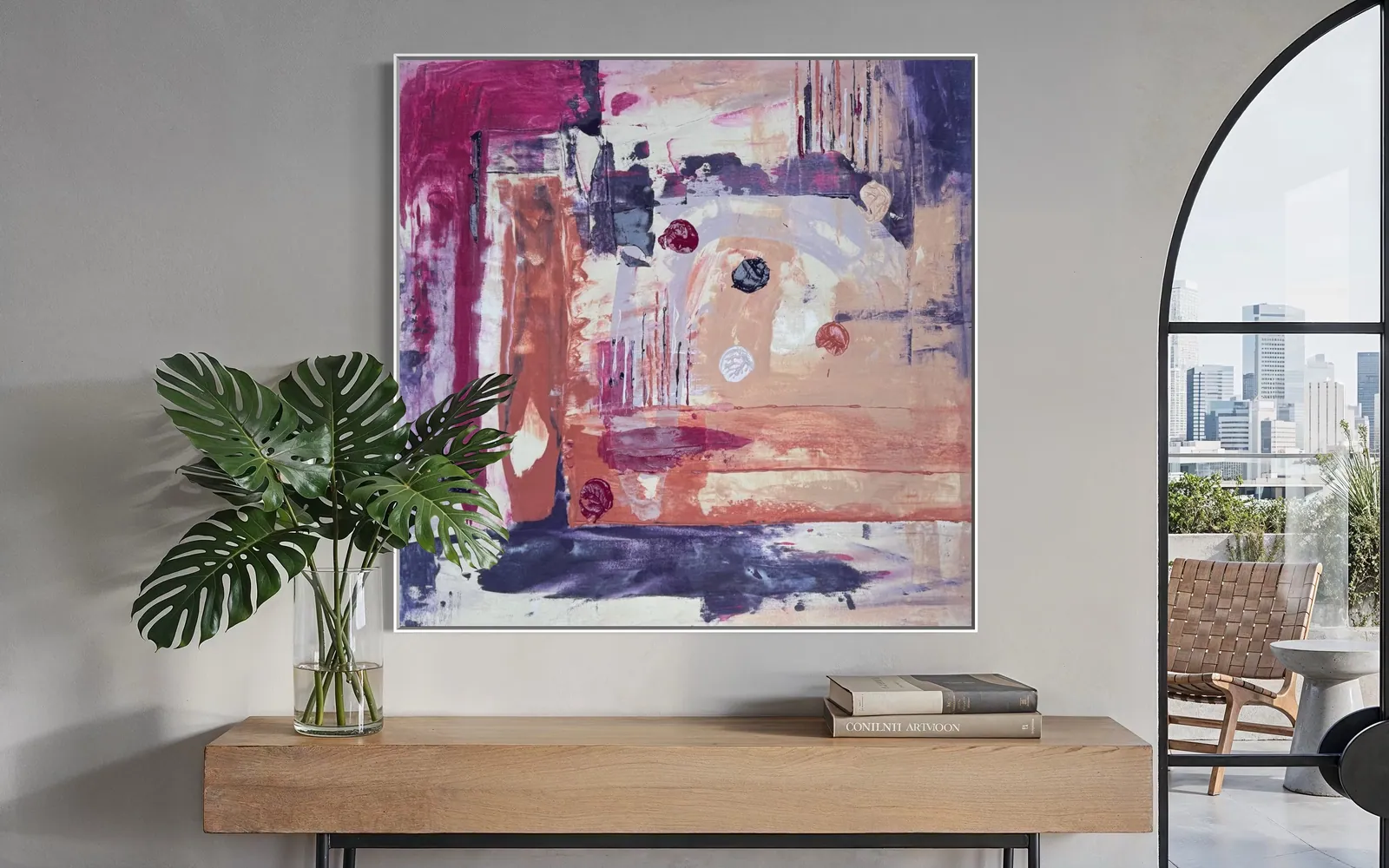
What actually changes when you commission instead of buy
Buying an existing painting is a transaction with the object already in front of you: the exact color, texture, scale, and finish are fixed, and the only thing left to decide is whether to acquire it. Commissioning starts from the opposite point — an idea, a reference image, a wall to fill — and the object itself doesn't exist until the artist makes it. Some artists will adjust an existing composition on request, shifting a color or a scale, but that is still closer to a custom order than to seeing a finished piece.
That single difference — object in hand versus object still to be made — is what drives almost every other trade-off between the two routes: how long it takes, what it costs, and how much risk the buyer is carrying.
The trade-offs of commissioning: timeline, cost, and the risk of not loving the result
Singulart, an online platform that works with artists on both commissions and existing inventory, lays out the trade-off plainly in its own guidance for collectors: a commission carries no guarantee that the finished piece will match what the client pictured, the process runs longer than picking something already made, and some artists price a custom piece higher than a comparable existing work, since materials and time are committed before a sale is certain. The same overview notes an upside that a finished piece can't offer — a say in the process itself, and a piece built specifically around the client's brief rather than selected from what already exists.
Not every artist accepts commissions in the first place, and among those who do, availability depends on their current workload — a real constraint that buying something already finished simply removes from the equation.
What buying an already-finished piece gives you that a commission can't
The clearest advantage of an existing painting is that it removes the guesswork: the surface, the weight of the paint or the gold leaf, the exact color under real light — all of it can be seen before any money changes hands, not approved from a sketch or a photo of a work in progress. At Perfeito Studio, part of the collection is on view in person in Brasília, at INTI (Lago Sul), a working clinic that hosts part of the collection — the viewing is arranged directly with the artist by WhatsApp rather than as an open showroom, since the space belongs to a third party and isn't a walk-in gallery. Buyers outside Brasília can request additional detail photographs and video of a specific painting through the same channel.
Every acquisition — of a finished piece, direct from the artist — also arrives with documentation that a commission agreement would otherwise have to spell out from scratch: a signed Certificate of Authenticity carrying the technical record and an internal Archive ID, an invoice or official receipt, an Artwork Acquisition Agreement covering ownership and image use, an artist dossier, and conservation guidance, all included in professional packaging. The studio ships within Brazil and internationally; domestic delivery runs up to 15 business days depending on destination, international shipping is quoted per destination on request, and the buyer covers freight and any import duties in the destination country.
If nothing existing fits — what a conversation about a custom piece looks like
When collectors do commission a painting, the shape of the process is fairly consistent across galleries and artists: sharing the idea and any reference images, working out scale and placement for the specific wall, agreeing on price and a rough timeline before work starts, and a review step — a sketch, a color study, progress photographs — before the piece is finished. UGallery, one online platform that runs commissions this way, states its own turnaround usually runs six to eight weeks and requires a 50% non-refundable deposit up front, with the balance due on completion — a useful reference point, though timelines and terms vary by artist, medium, and how much detail the piece involves.
Perfeito Studio doesn't run a standing commission program the way a portrait studio does. A request for a piece that doesn't exist in the current catalogue is welcome as a conversation, over WhatsApp, about the idea, the space, and whether it's something the studio has room to take on — not as a guaranteed service with a fixed price list or turnaround.
From the studio
From the atelier
I trained as an architect before I trained as a painter, and that order matters here: an architect doesn't hand a client a floor plan and ask them to imagine how the light will fall across it at four in the afternoon — you build the model, or you walk the actual site. I think about a painting the same way. Texture and metallic fragment and gold leaf only tell the truth about themselves in front of a person, under real light, at the real scale of the wall they're going on. A brief, however detailed, can't carry that.
That's the practical reason my own collection is what I lead with, not an open commission list. A custom piece isn't something I take on as standard practice right now — the priority is the series I'm already building. Someone can still write in about an idea outside the current catalogue, and I'll answer honestly, but more often than not the answer is that it doesn't fit what I have room for at the moment. I'd rather someone stand in front of Amethyst Ground, or see the detail photographs of it, and know exactly what they're getting, than commit both of us to a painting neither of us has seen yet.
Frequently asked
Is it more expensive to commission a painting than to buy one that already exists?
Often, yes, though it depends on the artist. General guidance for collectors from platforms like Singulart notes that some artists price a commission higher than a comparable existing piece, since materials, time, and risk are committed to a single client before the sale is certain. It isn't a fixed rule — some artists price commissions the same as their available work — but buyers should expect a custom piece to cost at least as much as an equivalent finished one, not less.
How long does commissioning a painting typically take?
It varies by artist, medium, and how much detail the piece involves. As one reference point, UGallery, an online platform that runs artist commissions, states its own process usually takes six to eight weeks from agreement to delivery. Artists working through galleries or with heavier demand can run longer. A finished, existing painting has no equivalent wait — it's ready to ship or view as soon as it's acquired.
What's the biggest risk of commissioning instead of buying an existing piece?
That the finished painting doesn't match what the buyer pictured. Because the piece doesn't exist yet when the agreement is made, there's no way to see the exact color, scale, or texture in advance — only a brief, references, and possibly progress photos along the way. Buying an existing piece removes that risk entirely: what's shown is what arrives.
Can I see a Perfeito Studio painting in person before buying?
Yes, in Brasília, by appointment. Part of the collection is on view at INTI, in Lago Sul, and a viewing is arranged directly with the artist over WhatsApp — it's a working clinic that hosts part of the collection, not an open studio or gallery, so visits are scheduled rather than walk-in. Buyers outside Brasília can request detail photographs and video of a specific work through the same channel.
Does Perfeito Studio accept custom commissions?
Custom commissions aren't a standard part of Perfeito Studio's practice right now — the current focus is the existing collection, each piece already finished, photographed, and documented. A request outside the catalogue can still be raised directly with the atelier over WhatsApp, but the honest answer is often no: declining a commission is a legitimate choice for an artist, not a brush-off, and it's usually the right one while the priority is the collection already on the wall.
What documentation comes with a painting bought directly from the artist?
Every acquisition from Perfeito Studio includes a signed Certificate of Authenticity with the full technical record and an internal Archive ID, an invoice or official receipt, an Artwork Acquisition Agreement covering ownership and image use, an artist dossier, conservation guidance, and professional packaging. The certificate carries a QR code linking to the work's official page, so provenance stays verifiable later.
Considering a piece for a specific wall?
Send a photo of the space and we'll help you work out whether something in the current collection already fits, or whether it's worth talking through a custom piece.
Published on