Original art in a desert-climate home
A desert or arid climate doesn't threaten a painting the way a humid one does — there's no mould risk — but sustained low humidity has its own mechanism. Canvas and paint film contract and stiffen at low relative humidity, and conservation guidance puts the safe range at 40–60% RH; below that, brittle paint is more prone to cracking, especially if the canvas is ever re-tensioned.
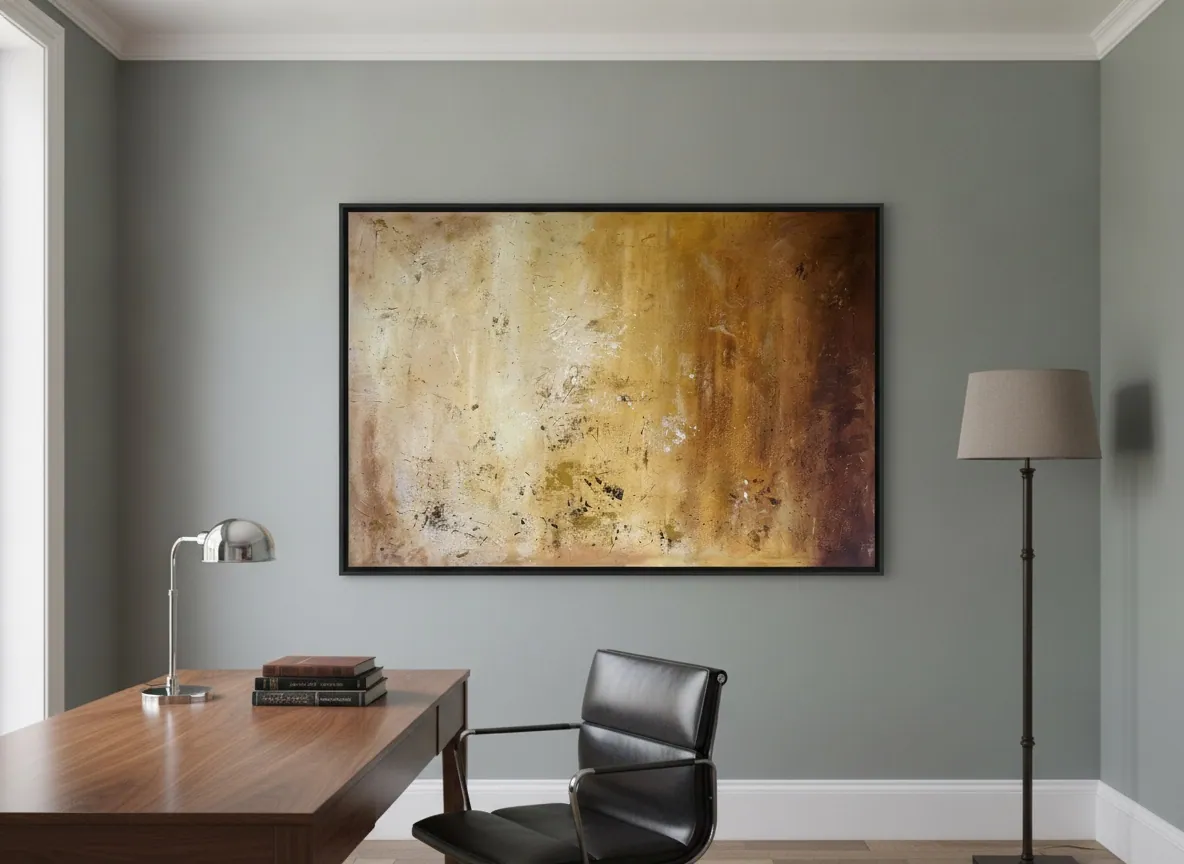
Dry heat is the opposite conservation problem from tropical humidity
A villa in a humid tropical climate holds elevated moisture in the air for weeks at a time, and the risk that creates is biological: mould. A home in a desert climate — the American Southwest, the Middle East, inland Australia, the Brazilian sertão in dry season — has the opposite baseline. Indoor air conditioned against outdoor heat, or simply arid outdoor air moving through an open plan, tends to sit low on the humidity scale rather than high. There is effectively no mould risk in that environment. The mechanism that replaces it is physical, not biological: materials that respond to moisture by contracting when it's removed from the air, not by growing when it's added.
The Canadian Conservation Institute's guidance on relative humidity as an agent of deterioration is built around a single stable band rather than a “the drier the safer” assumption: “The safest RH for paintings on canvas or wood is a stable level between 40 and 60%.” A desert interior that runs well under 40% for long stretches — common in centrally heated or heavily air-conditioned dry climates — is outside that band on the low side, the same way a tropical room stuck above 75% is outside it on the high side. The number on the hygrometer matters less than which side of the safe range a home sits on for months, not days.
What sustained dryness actually does to canvas and paint film
Canvas is a woven fabric, and like any hygroscopic material it holds a small amount of moisture that keeps its fibres flexible. Take that moisture away for a sustained period and the fibres contract and stiffen. The same happens, at a different rate, to the ground layer and the paint film sitting on top of the canvas — and because canvas, ground and paint don't contract at identical rates, the surface develops internal strain even before anything visibly cracks.
Conservation guidance summarizing this mechanism for canvas paintings is specific about where the real risk shows up: brittle, strained paint and ground layers become vulnerable to cracking during handling, and particularly if the canvas is ever re-tensioned on its stretcher — a process conservators call keying out. A slack, humidity-relaxed canvas that gets pulled tight again during a very dry spell is placing more tension on a paint film that has less flexibility left to absorb it. That combination — brittle paint plus new mechanical stress — is where cracking and, eventually, paint loss originate. None of this requires an extreme reading on a hygrometer; it accumulates from a home that simply never comes back up into the 40–60% band.
Heat and direct desert sun are a separate risk from dryness itself
Low humidity and high heat usually arrive together in a desert climate, but they damage a painting through different routes and both deserve attention on their own. Conservation guidance on display conditions is direct about the first move: keep artwork out of direct sunlight, both for the heat it generates at the canvas surface and for the ultraviolet component of daylight, which is unrelated to humidity and damaging on its own. A canvas hanging in a beam of desert sun for part of the day can reach a surface temperature well above the room's ambient reading, and that localized heat pushes moisture out of the paint film faster than the rest of the room's air exchange would on its own — compounding, rather than replacing, the dryness problem described above.
Heat on its own, independent of sunlight, also speeds up the chemical reactions behind fading and general ageing in pigments and binders, and can add its own expansion-and-contraction stress to canvas and wooden stretcher bars in a room that swings hot during the day and cools at night. The practical takeaway for a desert home is the same one that applies to any climate, just more consequential given the baseline dryness already at work: a wall away from direct sun and away from a vent, radiator, or fireplace does more for a painting's long-term condition than any single humidity reading.
Should you run a humidifier near original art in a dry home?
If a hygrometer placed near the painting — not the thermostat's built-in reading, which measures a different part of the house — shows the room sitting persistently under roughly 35–40% for weeks at a time, a small room humidifier that brings the space back toward the 40–60% band is a reasonable, low-intervention response, and it's the direct counterpart to the dehumidifier discussion that applies to a humid villa. The goal is the stable middle of that range, not the highest number achievable: over-humidifying a dry desert home quickly can introduce the opposite problem, condensation on cool surfaces like window glass or exterior walls, without meaningfully protecting the painting any better than a moderate, steady level would.
A humidifier is a slower, gentler correction than most owners expect, and that's the point — conservation guidance on relative humidity consistently frames the danger as compounding dryness (or compounding dampness) sustained over weeks, not a single dry afternoon. A hygrometer left in the room for a few weeks, checked periodically, gives a far more useful picture than a one-time reading.
From the studio
From the studio: why the warm-palette series read well in dry-climate rooms
Several works in the Terra & Ether and Black & Gold series build up ochre, amber, and gold-leaf tones in layers — a palette developed to hold its depth against warm, sun-washed interiors rather than cool, north-facing ones. In practice, that's exactly the kind of wall a desert-climate home tends to offer: plaster, timber, and stone finishes in warm tones, strong daylight for part of the day. The placement guidance is the same one we give any collector regardless of climate — keep the piece off the wall that gets direct sun for part of the day, and away from a heating vent or fireplace — but it matters more here, because a dry climate's baseline humidity gives a canvas less room to absorb an additional heat spike without stress. A studio piece shipped to a dry climate leaves with the same Archive ID, dossier, and certificate as any other; the only added note we give collectors in these climates is to keep a hygrometer in the room for the first few weeks and see where it settles before deciding whether a humidifier is worth adding.
Frequently asked
Does a dry desert climate damage a painting?
It can, but through a different mechanism than a humid climate. There's essentially no mould risk in dry air, but sustained low relative humidity makes canvas and paint film contract and stiffen. Conservation guidance places the safe zone at 40 to 60 percent relative humidity; a home that sits well below that for months is outside the safe range on the dry side, the same way a tropical room stuck above 75 percent is outside it on the humid side.
Can low humidity crack canvas or paint?
Yes, indirectly. Canvas, ground, and paint film all lose flexibility as they dry out, and because they contract at different rates, the surface builds internal strain. That strain becomes visible cracking mainly when the painting is also handled, moved, or if the canvas is re-tensioned on its stretcher (keying out) while the paint film is already brittle from sustained dryness. The dryness itself is the setup; a mechanical event is usually what turns it into visible damage.
Should you use a humidifier near original art in a dry home?
If a hygrometer placed near the painting shows the room persistently under roughly 35 to 40 percent for weeks, a small room humidifier bringing the space back toward 40 to 60 percent is a reasonable response. Aim for the stable middle of that range rather than the highest humidity you can reach — over-humidifying a dry home can cause condensation on windows or cool walls without adding meaningful protection for the painting.
What about extreme heat and direct desert sun?
Treat them as a separate risk from dryness, not the same one. Direct sunlight heats a canvas surface well above the room's ambient temperature and carries ultraviolet light that fades pigments regardless of humidity. Heat on its own also speeds the chemical reactions behind ageing in paint and binders. The standard fix is placement: keep the piece off any wall that receives direct sun for part of the day, and away from a heating vent, radiator, or fireplace.
Does a dry climate need different framing or stretcher bars?
No special framing is required for the works in this collection, since they're unglazed mixed-media and acrylic pieces on canvas rather than works on paper behind glass. The one practical caution is on re-tensioning: if a canvas develops slack during a dry season, wait for a stable stretch of weeks before deciding whether to re-tension it, since keying out a canvas while the paint film is still brittle from sustained dryness is when cracking is most likely to start.
Placing a piece in a dry-climate home?
Tell us about the room — light, wall, climate — and we'll help you choose a work and placement that hold up over time.
Sources
- Canadian Conservation Institute (Government of Canada) — 2026-09-27
- Canadian Conservation Institute (Government of Canada) — 2026-09-27
- Conservation & Design International — 2026-09-27
Published on