Art for an ophthalmology clinic
The art that works best in an eye clinic has moderate, well-separated contrast on a matte, non-reflective surface — not a glossy piece that throws glare, and not a low-contrast field that demands close focus. Because a meaningful share of patients pass through the waiting room with dilated pupils, before or after their exam, the piece should read clearly without close focusing and without catching direct light.
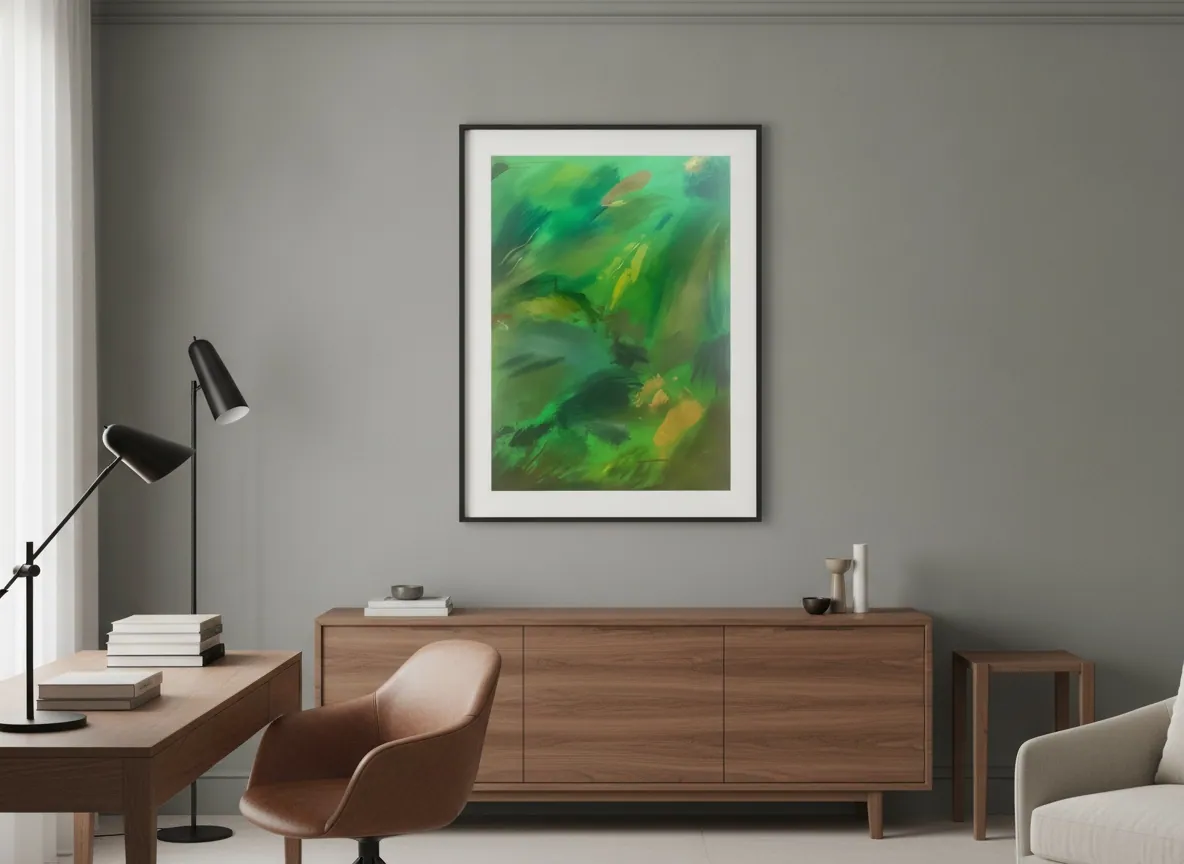
Why dilation changes what art needs to do
A meaningful share of ophthalmology patients go through pupil dilation as part of a routine exam, either before or after seeing the doctor. According to the American Academy of Ophthalmology, "the effects of dilating eye drops last a few to several hours", and during that window "you will have trouble focusing on close objects" and "you also will be extra sensitive to bright light."
That reshapes the brief for reception art. A piece that depends on fine detail or close inspection loses most of its effect on a patient who cannot focus on close objects. A piece with a glossy, reflective finish under direct light adds exactly the kind of brightness a light-sensitive patient is trying to avoid. Neither problem rules out art in the room — it rules out those two specific traits.
Contrast: moderate, not flat and not harsh
The instinct to go safe and pick a low-contrast, nearly monochrome piece is understandable, but it isn't necessarily the most comfortable choice for blurred near vision. A composition built from broad, well-separated tonal fields — large color masses rather than fine linework — tends to register clearly even when close focus is out of reach, because the eye is reading shape and mass, not detail.
What matters more than the contrast level itself is the finish. A matte, non-reflective surface in acrylic or mixed media avoids the glare that a high-gloss or metallic-leaf surface can throw back under overhead clinic lighting, which is the more direct source of discomfort for a patient with light-sensitive, dilated eyes.
Hanging height and viewing distance in a seated waiting room
Ophthalmology waiting rooms are usually low-chair, seated environments, often for a longer stretch than a typical medical office, and frequently with patients holding their eyes half-closed against the light. That favors hanging a piece so its center sits at seated eye level rather than the standard standing-eye-level axis used in most commercial spaces, and at a distance from the seating that lets the whole composition register without leaning in.
A mid-scale piece — roughly 60 x 80 cm up to 100 x 150 cm, depending on the wall — generally reads more comfortably in this setting than a small piece, which asks for exactly the kind of close approach and fine focus a dilated patient is least able to give.
Sizing a small reception area
A small ophthalmology reception rarely needs a monumental canvas. A single piece in the 50 x 70 cm to 80 x 120 cm range, hung on the wall with the longest unobstructed sightline from the seating, usually reads better than two smaller pieces competing for attention on the same wall — one clear focal point is easier to take in with reduced near-vision acuity than a cluttered arrangement.
Original work versus a print, for a specialty clinic
A specialty clinic's reception is a small, repeated-exposure space — the same patients often return for follow-ups, checks, or ongoing treatment, and see the same wall each time. An original mixed-media or acrylic piece has a physical surface texture that a flat print does not, which tends to hold up better to that repeated, close-range viewing over months or years, without becoming visual wallpaper. It also comes with a signed certificate of authenticity and an Archive ID, which some clinics value as part of the professionalism of the space itself.
From the studio
The studio's view
Because Alyne trained as an architect before she trained as a painter, she reads a wall the way she'd read a floor plan: who sits where, for how long, and from what distance. A medical reception is one of the more specific briefs we get — the viewer isn't relaxed, isn't standing, and in a clinic like this one, often isn't seeing at full clarity. That's exactly the kind of constraint her practice works well with: large, unified color fields in acrylic or mixed media that hold together as a single shape from across a room, rather than compositions that only resolve up close. Series like Terra & Ether or Luminous Rebirth, built from broad, layered fields rather than fine detail, tend to be the ones clinics gravitate toward for this reason.
Frequently asked
What art works in an eye clinic?
Art with moderate, well-separated contrast on a matte, non-reflective surface tends to work best. Broad color fields read clearly even with blurred near vision, and a matte finish avoids the glare a glossy or metallic surface can throw under clinic lighting, which matters for patients with light-sensitive, dilated eyes.
Should the art avoid strong contrast patterns for patients with vision issues?
It depends on the type of contrast. Sharp, fine-detail patterns that need close focus to resolve are the harder case, since a patient with blurred near vision from dilation loses most of that detail anyway. Broader tonal contrast between large color masses, without a reflective surface, is generally easier to read than a low-contrast, nearly flat composition, which can be harder to distinguish at a glance.
What about post-procedure patients with light sensitivity?
According to the American Academy of Ophthalmology, dilating drops leave patients 'extra sensitive to bright light' for a few to several hours. The main lever for that is the surface finish, not the color: a matte acrylic or mixed-media surface avoids the direct glare a glossy or high-metallic finish can throw back under overhead lighting, which is more likely to cause discomfort than the color palette itself.
What size for a small waiting room?
For a small ophthalmology reception, one piece in the 50 x 70 cm to 80 x 120 cm range on the wall with the clearest sightline from the seating usually works better than two smaller pieces splitting attention. A single, clear focal point is easier to take in with reduced near-vision acuity than a busier wall arrangement.
Original art or print for a specialty clinic?
An original piece has physical surface texture that holds up to repeated, close-range viewing from returning patients better than a flat print, which can start to read as wallpaper over months of follow-up visits. An original also comes with a signed certificate of authenticity and an Archive ID, which some clinics factor into the professionalism of the space.
Where does the art come from, and does it ship internationally?
Each piece is an original, one-of-a-kind mixed-media or acrylic work by Alyne Perfeito, acquired directly from the studio in Brasília, Brazil, with no gallery intermediary. Every acquisition includes a signed certificate of authenticity, a curatorial dossier, a conservation and installation guide, and an Archive ID. International shipping is arranged case by case; reach out via WhatsApp with the destination country for a quote.
Choosing the right piece for your ophthalmology clinic
Tell us the wall size and the light in the room, and we'll help you find a piece from the collection that fits a clinical reception.
Sources
- American Academy of Ophthalmology — 2026-09-27
Published on