Art for a veterinary clinic
A veterinary clinic reception does not need a painted dog or cat on the wall — that reads as pet-shop signage, not clinical care. An abstract composition in a restrained palette, sized to the actual free wall in the waiting area, on a surface without glass, communicates professionalism without competing with the anxious pet already sitting in the room.
Why skip the literal animal image
The default instinct when decorating a veterinary practice is to look for a painting of a dog, a cat, or a paw print — the same visual logic as a pet-shop window. A serious clinic does not need to repeat it. Figurative animal imagery tends to compete with the actual reason a client is there: an owner is sitting with a real, often stressed or sick, animal a few feet away, and a wall full of illustrated pets pushes the room toward retail rather than clinical care.
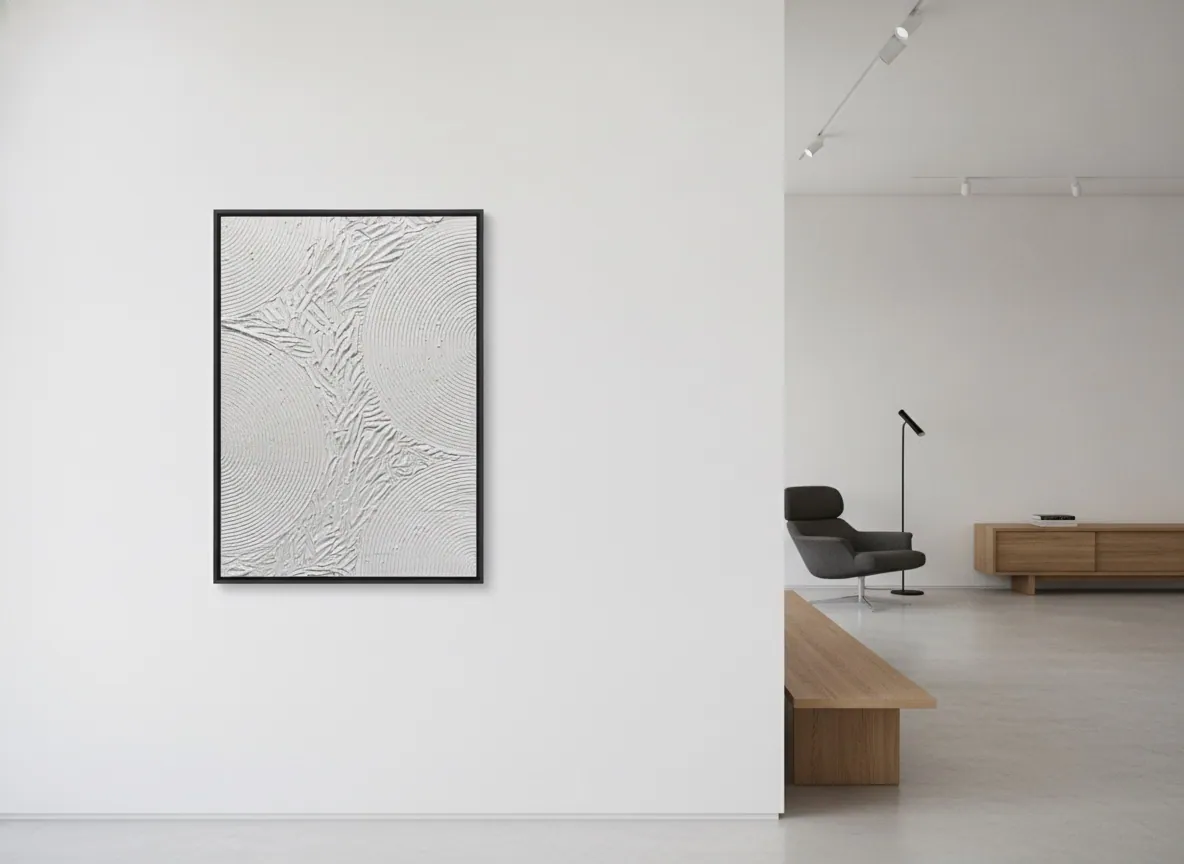
Abstract composition solves this from a different angle. It does not need a figurative subject to communicate quality and attention to the space. A piece built from sculpted texture or layered mineral pigment holds the wall with presence, without narrating a subject that competes with the patient already in the room.
Scale for a veterinary reception: usually smaller than a human clinic
A veterinary reception typically has less free wall than a hospital or a physician's office — the space is already shared with a check-in counter, retail shelving for food and supplies, carriers on the floor, and foot traffic. Measuring the actual available wall before choosing a format avoids ordering a piece too large for the space.
An entry-scale piece such as Echo of Silence (50 x 70 cm / 19.7 x 27.6 in, Matter & Silence series, R$ 2,400) fits a narrow wall behind the counter or beside the entrance without competing with reception furniture. A larger practice — one with an attached hospital wing or a shared, wider waiting room — can carry a piece such as Silent Interval (120 x 160 cm / 47.2 x 63 in, same series, R$ 7,900), a format that holds a longer head wall on its own, without needing a grouped composition.
Material and mounting height: pets roam, sniff, and bump into things
Unlike a physician's waiting room, a veterinary reception has a different physical reality: pets move through the room on a short leash or briefly off-lead, sniff objects near floor height, and can bump into furniture during a sudden movement. That does not rule out wall art — it changes two practical choices: keep the piece above the jump height of a medium or large dog, and avoid glass or a fragile frame that would shatter on accidental contact.
An unglazed canvas with a resilient surface finish — the sculpted relief or acrylic layering used across the Matter & Silence and Terra & Ether series — tolerates that environment better than a piece framed under glass. It is also worth keeping distance from the weighing scale, the exam table, and any path a gurney or cart moves through.
Ordering original art from Brazil without a gallery intermediary
For a clinic outside Brazil, or a designer specifying on a client's behalf, the piece is acquired directly from the artist's studio rather than through a gallery markup. Alyne Perfeito is also an architect, and the studio can work from photos of the actual wall and its dimensions rather than requiring an in-person visit. Every piece ships with its Archive ID and studio documentation — the same paper trail a gallery purchase would provide, without the gallery layer.
Pricing is set in Brazilian reais (BRL); a foreign buyer should treat any USD or EUR figure as an approximate conversion at the exchange rate on the day of payment, not a fixed number the studio commits to in advance.
From the studio
What I ask when the brief is for a veterinary clinic
Before I am an artist, I am an architect — and when the brief is for a veterinary clinic, the questions I ask differ from the ones I ask for a physician's office. I ask whether pets typically move through the reception off-lead or stay inside a carrier, because that changes the minimum safe mounting height. I also ask whether there is a bathing or grooming area in the same space, since humidity and loose hair call for extra care with the piece's surface.
For this kind of space, I tend to point toward pieces from Matter & Silence or Terra & Ether — restrained palette, tactile unglazed surface, composition that does not depend on a figurative subject to hold its own. A piece like Echo of Silence works well in a small reception; for a larger clinic with a shared waiting room, a bigger-scale piece such as Silent Interval carries a longer wall on its own.
Frequently asked
Is a painting of an animal the only option for a veterinary clinic?
No — it is usually the least effective option for a clinic that wants to read as clinical rather than as a pet-shop display. A literal image of a dog or cat reinforces a retail tone and visually competes with the actual patient present in the room. An abstract composition in a restrained palette communicates care and quality without depending on animal illustration.
Does abstract art make a veterinary reception feel cold or impersonal?
That depends on the palette and composition chosen, not on abstraction itself. A piece with saturated color and an expansive gesture can compete with a room already full of signage and vaccination notices; a piece with a light or earthy palette and a resolved composition tends to add presence without feeling cold or generic. The right choice depends on the room's light, the available wall, and the tone the rest of the reception already carries.
What size works for a small veterinary waiting room?
Veterinary receptions usually have modest free wall, shared with a check-in counter, retail shelving, and foot traffic with carriers. An entry-scale piece, such as Echo of Silence (50 x 70 cm, R$ 2,400), fits a narrow wall without competing with reception furniture. Larger practices, with an attached hospital wing or a shared waiting room, can carry a bigger format, such as a 120 x 160 cm piece.
Can a foreign clinic buy original art directly from the studio?
Yes. The studio works from photos of the actual wall and its dimensions and ships internationally, with the Archive ID and studio documentation accompanying the piece. Pricing is set in Brazilian reais; treat any foreign-currency figure as an approximate conversion, confirmed at the exchange rate on the day of payment.
Does art on the wall reduce anxiety in pets or their owners during the wait?
Perfeito Studio does not make that claim as a proven clinical effect — it is not therapeutic guidance, and the effect of an image on an animal's anxiety is not something the studio has grounds to guarantee. What environment curation offers is different: a wall that does not visually compete with the owner's moment, with a restrained palette and a composition that asks nothing of the viewer. It is a design decision, not a promise of a therapeutic outcome.
Choosing art for your veterinary clinic reception?
Send the wall dimensions, whether pets typically move off-lead or stay in carriers, and a photo of the space — the studio will point to the pieces in the collection that hold up at that scale and in that flow.
Sources
- Perfeito Studio catalogue (src/data/obras.json, acervo data) — 2026-09-27
Published on