Art for a private banking VIP room
A private banking VIP room is a small, seated space where a relationship manager and a client spend twenty or thirty minutes discussing wealth, credit, or succession — not a lobby people pass through. The art there should reward a close, unhurried look: contained scale, a restrained palette in black-and-gold or mineral tones, and a surface that won't throw glare back at a presentation screen. That brief is different from the bank's public floor, and the two rooms should not share the same piece.
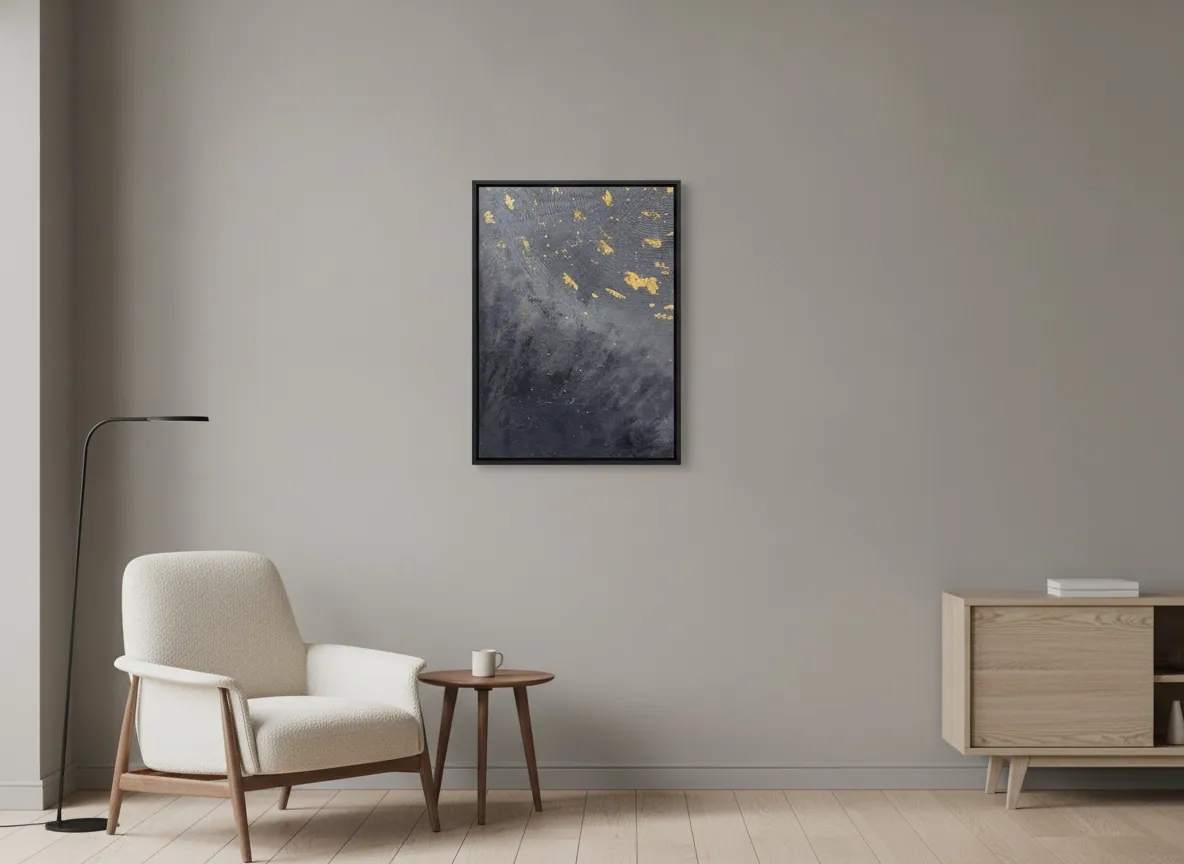
A VIP room is a seated conversation, not a lobby
The private banking VIP room exists for one kind of interaction: a relationship manager and a client, seated across a small table, working through a decision that involves real money — a credit line, a succession plan, an allocation review. Nobody in that room is passing through. The client faces the same wall for the length of the meeting, often while a screen or tablet is open on the table between them.
That changes what the art needs to do. On a public banking floor, a piece has to register in a glance from several meters away, past a queue rope. In the VIP room, the opposite is true: the piece is seen up close, for a long time, by someone with nothing else in their immediate field of view but the wall and the table. A composition with fine texture or layered tone that would disappear from across a lobby is exactly what rewards that kind of sustained, close attention.
Scale for a small room
A private VIP room is rarely large — often a single table, two or three chairs, and one or two walls available for art. That calls for a contained format rather than a gallery-scale statement piece: a work in the 50 × 70 cm to 80 × 120 cm range typically holds a wall of this size without crowding the seating area or forcing the piece into a viewer's peripheral vision at close range.
Celestial Plan, from the Black & Gold series at 50 × 70 cm, sits comfortably on the kind of single feature wall a small VIP room usually offers — present without demanding more space than the room has to give.
Discretion over display: palette and surface
Discretion, in this context, is a visual instruction, not a mood. It means a palette that reads as considered rather than decorative — black and gold, or mineral tones such as ochre, terracotta, and slate — instead of a bright, high-saturation color that asks to be noticed first. A VIP room's job is to support a serious conversation, not to compete for attention with the person doing the talking.
Surface matters just as much as color. A glass-framed or heavily varnished piece can throw reflected light straight back at a client sitting a few feet away, and directly toward whatever screen is open on the table — a document, a portfolio chart, a signature pad. A piece with sculpted texture or matte gold leaf, like Celestial Plan, distributes light rather than bouncing it, which keeps both the art and the screen legible at the same time.
Corporate collection documentation
When a bank buys art for a client-facing room, the piece usually becomes a line in the institution's asset register, not a personal purchase — which means it needs the same paperwork any other tracked corporate asset carries. For a Perfeito Studio piece, that includes a signed certificate of authenticity, the work's Archive ID (a permanent reference number tied to the studio's own catalog), and a dated invoice naming the purchasing entity. That documentation set is what a bank's own compliance, insurance, or facilities team will typically ask for when the piece is entered into a corporate inventory, and it travels with the work if the branch or the room is ever reconfigured.
The studio issues this documentation directly at the time of purchase; there is no separate request or delay built into the process.
From the studio
The view from the studio
Alyne trained as an architect before she trained as a painter, and a small room changes her approach more than a large one does. In a room the size of a typical private banking VIP space, she thinks about the table first — where the client sits, how far the nearest wall is, whether the piece will be read from four feet away or eight — before she thinks about which series fits. For that kind of seated, close-range brief she tends to point toward Black & Gold or Terra & Ether: work built with enough surface texture and metallic depth to keep giving something back after the tenth time a client has sat in that chair, rather than a flat composition that's fully read in the first glance and ignored after that.
Frequently asked
What art works in a private banking VIP room?
A contained-format piece with restrained color — black and gold, or mineral tones — and a textured or matte surface that won't reflect glare toward a nearby screen. Because the room is seen at close range for extended periods, a composition with fine texture or layered tone works better here than it would on a public floor seen only in passing.
Should it differ from art on the public banking floor?
Yes. The public floor is read from several meters away by people passing through, which calls for a bold, simple pattern that carries at a distance. The VIP room is the opposite: a seated audience at close range for a long conversation, which rewards a piece with detail and texture that only resolves up close. The two rooms should not share the same piece or brief.
What signals discretion and wealth without being ostentatious?
A restrained palette and quality of material, not scale or flash. Black-and-gold or mineral tones, a matte or sculpted surface instead of high-gloss varnish, and a size proportioned to the room — rather than a large, attention-seeking piece — read as considered and confident. Ostentatious, in this setting, usually means a piece competing for attention with the conversation happening in front of it.
What size for a small VIP room?
For a single feature wall in a small private room, a piece in the 50 x 70 cm to 80 x 120 cm range typically fits without crowding the seating area. The exact size depends on the wall available and the distance from the table to that wall; a piece meant to be read at four to six feet doesn't need the scale of one built for a lobby seen from across the room.
Does the art need documentation for a corporate collection?
Yes, when a bank purchases the piece as an institutional asset rather than a personal one. A signed certificate of authenticity, the work's Archive ID, and a dated invoice naming the purchasing entity are the standard paperwork a corporate collection or facilities team will expect, and the studio provides this documentation directly at the time of sale.
Sizing a piece for a private banking VIP room
Share the room's dimensions and the wall in question, and the studio can propose a piece sized to fit, with documentation ready for a corporate collection.
Published on