Art for a penthouse with floor-to-ceiling glass
A penthouse with floor-to-ceiling glass usually has less usable wall than the floor plan suggests, and the glass itself is the harder problem: strong, shifting daylight with almost no shade. The safest approach is one large-scale piece on the single solid wall, angled out of any direct light path, with UV-filtering glazing protecting both the painting and the view.
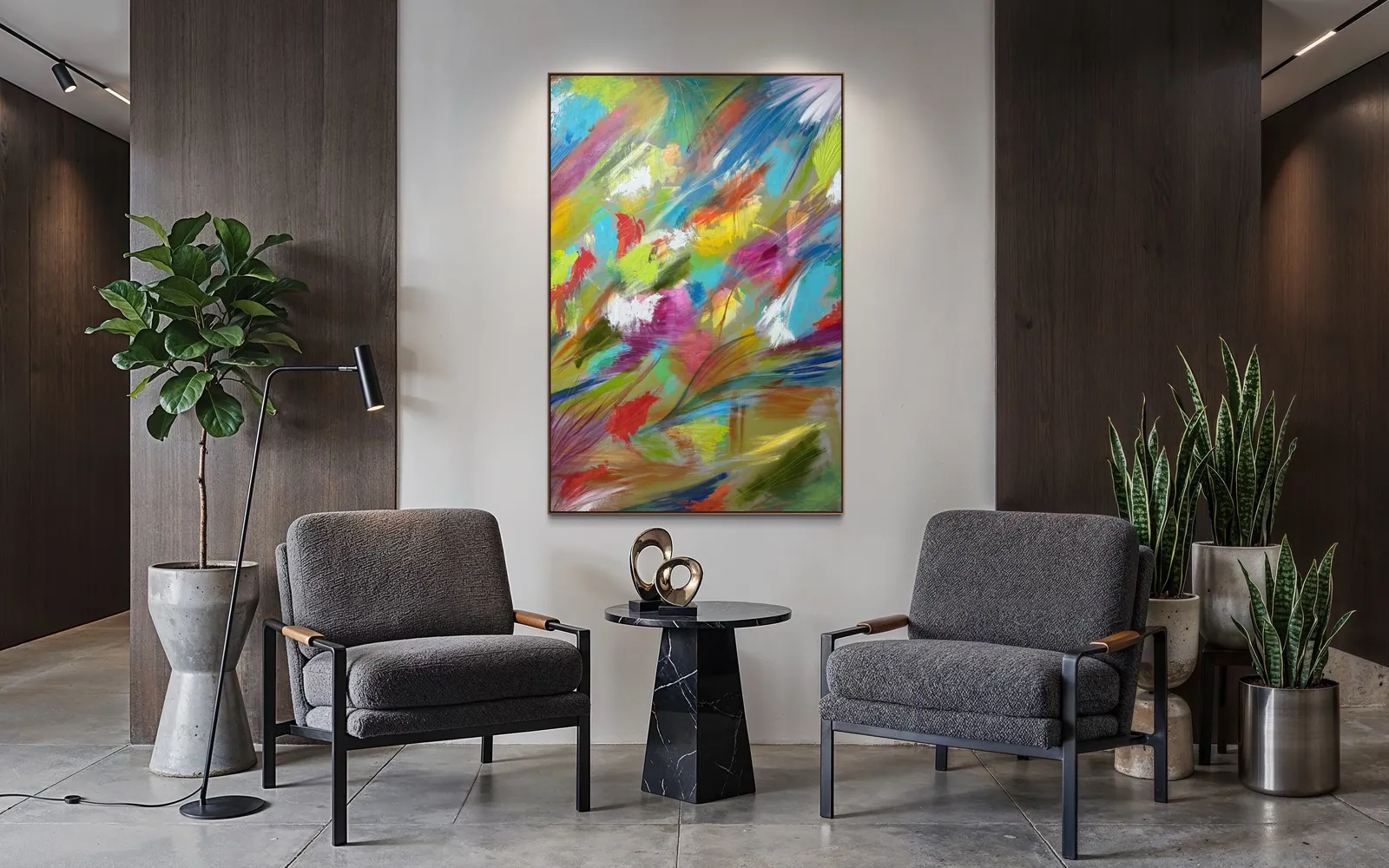
The glass is the real design problem, not the missing wall
A floor plan with a full glass wall reads like more space than it delivers on hanging area — floor-to-ceiling glazing removes an entire wall from the room, and the wall or walls that remain are often shorter or lower than expected once windows wrap two or three sides of a corner unit. But the harder constraint isn't square footage of wall, it's what the glass lets in: strong, directional daylight that shifts across the day and, depending on orientation, can hit a nearby wall at a low, intense angle during a few hours of sunrise or sunset.
That matters for an original painting more than most people expect. Conservation guidance for paintings recommends keeping light exposure low — around 50 lux for general display, rising to roughly 150 lux only where a darker passage needs to be legible — because the effect of light on pigment is cumulative and irreversible: the same total damage results from bright light over a short period as from weaker light over a much longer one. A wall that catches several hours of direct, high-intensity sun daily accumulates exposure far faster than an equivalent wall lit only during a few visiting hours, which is the situation most conservation benchmarks were written for.
What actually protects the painting — and the view
UV-filtering window film blocks more than 99% of UVA and UVB light when properly applied to glass, and it's worth checking whether a penthouse's glazing already specifies it — many high-rise curtain-wall buildings install UV-filtered or low-e glass for heat control and skin protection, which happens to do useful double duty for anything hung nearby. It's not a complete answer on its own, though: UV is the fastest-acting cause of fading, but ordinary visible light still causes gradual, cumulative fading over years, film or no film.
The more reliable protection is positioning — keeping the piece out of the direct beam path rather than relying on the glazing alone, especially on a west-facing wall that takes low, intense sun in late afternoon. A matte or sculpted-texture surface, more common in the studio's Matter & Silence and Terra & Ether work, also handles the glare bouncing off a full glass wall better than a high-gloss finish, which can pick up a second, distracting reflection of the sky or the room itself.
Finding the wall inside a glass box
Most penthouses with wraparound glazing still keep one substantial mass of solid wall — usually backing the elevator or stair core, a kitchen run, or a chimney breast — and that tends to be the only surface tall and wide enough to hold a large piece against the room's full glass-to-ceiling height. It's worth measuring that specific wall rather than judging by the apartment's total size: the usable hanging area in a glass-walled unit is often smaller, and more oddly proportioned, than the floor plan suggests.
A tall, narrow section of solid wall — the kind these units tend to leave — favors a vertical-format piece over a wide horizontal one. Vibrant Awakening (100 × 150 cm, Luminous Rebirth, R$ 5,900) is built at that kind of architectural scale, meant to hold a wall on its own rather than share it with other pieces. Where the solid wall runs wider than it does tall — a kitchen island wall, say — a large-format piece from Terra & Ether, which tends to work more horizontally, is usually the better fit.
Color and scale against a skyline
A floor-to-ceiling glass wall doesn't only bring in light — it brings in a second, constantly changing image. A skyline, a treeline, or open sky competes with a painting for visual weight in a way a normal window never does, and that changes how palette and intensity should be chosen. One approach is to match the room's energy: a saturated, large-scale piece holds its own next to a dramatic view instead of getting visually erased by it. The other approach is restraint — a monochrome or sculpted-relief piece lets the view stay the main event and gives the eye a quiet place to land instead of competing with it.
Silent Interval (120 × 160 cm, Matter & Silence, R$ 7,900) is an example of the second approach: a single dark gesture and a block of blue against a warm, bone-white field, built for a room that already has enough visual activity from elsewhere. Neither approach is more correct than the other — it comes down to how much work the glass wall is already doing in the room.
From the studio
From the studio
Floor-to-ceiling glass isn't a decorating condition to me, it's a structural one — before I think about which piece goes where, I think about which way that glass faces and what the sun is doing on that wall across a day, the same way I would if I were still reading a section drawing. A north-facing glass wall behaves completely differently from a west-facing one, and no two rooms with "floor-to-ceiling glass" in the listing are actually solving the same light problem.
In practice, the works that read best in these rooms tend to want the wall furthest from the glare, not the one with the most dramatic sightline — a painting's own saturation and texture get washed out fast next to that much daylight and that much view. I'd rather place a piece where its surface still reads clearly at four in the afternoon than on the wall that photographs best at ten in the morning.
Frequently asked
Will direct sunlight damage an original painting hung against floor-to-ceiling glass?
Yes, over time. Visible light and UV both contribute to fading, and the effect is cumulative rather than a one-time risk from a single bright afternoon. Conservation guidance for paintings recommends keeping light exposure low, generally around 50 lux, because the same total damage results from intense light over a short period or weaker light over a long one. In a glass-walled apartment, the practical fix is positioning the work off the direct beam and specifying UV-filtering glazing or film, not avoiding a bright room altogether.
Does UV-filtering window film actually protect artwork, or is it mainly for skin and heat?
Both. UV window film is usually installed for skin protection and heat control, but it blocks more than 99% of UVA and UVB light, which is the same radiation that accelerates fading in paint and paper. It does not eliminate risk from visible light, though, so a painting still benefits from being kept out of the direct sun path rather than relying on the film as a complete solution.
Where is the actual wall in an apartment with glass on two or three sides?
Most glass-walled penthouses keep at least one substantial solid mass — commonly the wall backing the elevator or stair core, a kitchen or media wall, or a chimney breast — and that is usually the only surface tall and wide enough to anchor a large piece against the room's full height. Measure that wall specifically rather than the apartment's total square footage, since the usable hanging area is often smaller than the floor plan suggests.
Should a painting for this kind of room be bold or quiet?
Either can work, and it depends on what the view is already doing. A saturated, large-scale piece can hold its own against a dramatic skyline without disappearing, while a monochrome or sculpted-texture piece lets the view stay the visual event and gives the eye somewhere calm to land. There is no single right answer — it comes down to whether the room already has enough visual activity from the glass itself.
Does a glass wall change how a painting's finish should be chosen?
Yes. A high-gloss surface facing a wall of glass can pick up reflections from the sky, the room's lighting, or the view itself, which competes with the image. A matte or sculpted-texture surface, common in the studio's Matter & Silence and Terra & Ether series, tends to hold up better in a room with this much ambient reflection.
Can the studio help figure out which wall and which piece will actually work?
Yes. Send a floor plan or a few photos of the space, including which direction the glass faces, and the studio can suggest scale, palette, and positioning before any purchase decision, the same way it would work through a brief with an architect or interior designer.
Not sure which wall to use, or how much light it gets?
Send a floor plan or a few photos of the space — including which way the glass faces — and the studio will help with scale, palette, and positioning before any purchase decision.
Sources
- Canadian Conservation Institute (CCI Notes 10/4) — 2026-09-10
- The Skin Cancer Foundation — 2026-09-10
Published on