Art for a newly built home: why fresh walls are the wrong place for a painting
Wait for the wall to fully cure, not just dry — a typical interior wall paint can take up to 30 days to reach full hardness, and new concrete needs the same 30-day minimum before it is painted at all. Hang too early and the anchor point, not the artwork, pays the price.
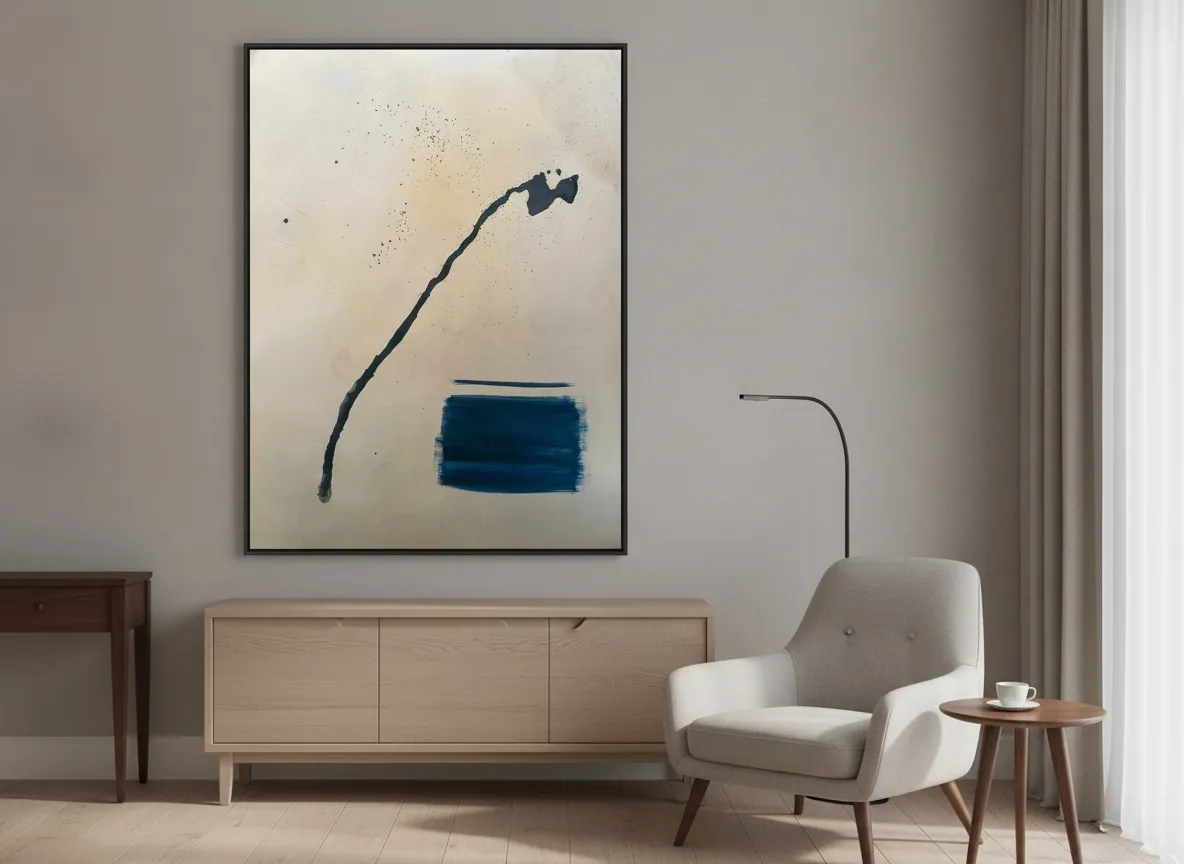
Dry to the touch is not the same as cured
A wall can look and feel finished within hours of the last coat, which is exactly what makes it deceptive. Benjamin Moore's own technical data for a standard interior wall enamel shows the film is dry to the touch in 4 to 6 hours and ready for a second coat in 16 hours, both measured at 77°F and 50% relative humidity — but the same data sheet is explicit that full hardness and adhesion develop over weeks, not hours: "depending on weather and drying conditions, it could take up to 30 days to reach optimum hardness and final sheen," and the surface should not be exposed to heavy abrasion for at least 3 to 5 days.
Driving a picture hook, a French cleat, or a drywall anchor through paint is a small, concentrated act of abrasion and puncture at exactly the point where the film is still softest. Do it in week one and the paint around the hole is more likely to crack, dent, or peel away from the substrate than if the same hardware goes in a month later.
What's still drying behind the paint
If the wall is new construction rather than a repaint, the paint film is only the last layer of a longer drying chain. According to the Drywall Finishing Council — a technical body whose members include the major North American gypsum and paint manufacturers — a single coat of joint compound at a standard 1/16 inch thickness can dry in as little as 2 hours under hot, dry conditions, or take 3 to 5 days under cold, humid ones. Humidity is the dominant variable: at 55°F with little ventilation, raising the room's relative humidity from 50% to 90% alone can quadruple the drying time of that same coat.
Poured or troweled concrete is even slower. Sherwin-Williams' own surface-preparation guidance states plainly that new concrete should cure for at least 30 days before it is painted at all — which means, on a fast-tracked build, the concrete, the joint compound, and the paint can all still be finishing their cure at roughly the same time.
The air in a freshly painted room is still working, too
Cure time is not only a wall-surface question. The U.S. Environmental Protection Agency notes that during and for several hours immediately after certain higher-VOC activities such as paint stripping, indoor concentrations of volatile organic compounds can run up to 1,000 times higher than outdoor background levels — and that ordinary painting, while typically milder, still elevates VOC levels that "can persist in the air long after the activity is completed." The EPA's own recommendation is to maximize ventilation during and after painting, not just while the brush is wet.
For most collectors this is a comfort question, not a conservation one. But it is a reason to treat a freshly painted room as still settling — temperature and humidity swings while windows are opened and closed, HVAC is adjusted, and finishing trades move through the space are exactly the conditions a mixed-media surface with texture paste, metallic pigment, or gold leaf is better off avoiding.
A practical timeline for a newly built or freshly painted wall
Put together, the safest default is to treat the manufacturer's own full-cure window as the real deadline: roughly 30 days after the last coat of paint, and the same 30 days after concrete is poured, before anything goes into the wall. If the room simply cannot wait that long, 3 to 5 days is the hard floor a major paint manufacturer sets before any abrasion — which is the closest thing to an official minimum for hanging hardware, not a comfortable one.
On a genuinely new build, add the substrate's own timeline on top: a wall skimmed with joint compound recently, or poured concrete, should be treated as still curing even if the paint on top looks and feels done. When the schedule is tight, the more conservative move is choosing a stud or the heaviest-rated anchor available, rather than testing a softer, faster-finished patch of wall.
From the studio
How the studio times an installation in a new space
As an architect before I am a painter, the age of a wall is one of the first things I ask about when a piece is going into a home that was just finished. A newly plastered or newly poured wall reads differently to me than one that has settled for a year — the surface hasn't found its final texture yet, and the room around it usually hasn't either, with humidity still swinging as trades finish and HVAC gets balanced.
In practice, this means I would rather push an installation date back by a few weeks than watch a fresh coat of paint chip around a new anchor point, or see a canvas with sculpted relief or gold leaf hang in a room where the air is still unsettled. It's not a rule I impose from a distance — it's the same patience I apply to my own walls before I judge a room finished enough to hold a piece of real weight.
Frequently asked
How long should I wait to hang a painting after a wall is freshly painted?
Treat 30 days as the target, not the minimum. Manufacturer technical data for a standard interior wall paint shows it can take up to 30 days to reach full hardness, even though the surface is dry to the touch within hours. If the timeline is tight, most manufacturers set 3 to 5 days as the point before which the surface shouldn't be exposed to abrasion, including a nail or anchor going through it.
Does it matter whether the wall is newly built or just freshly repainted?
Yes. A repaint over an already-settled wall only carries the paint's own cure time. A newly built wall carries that plus the substrate underneath it: new concrete needs at least 30 days to cure before it's even painted, according to paint-manufacturer guidance, and drywall joint compound can take anywhere from about 2 hours to several days to dry per coat depending on temperature and humidity.
What actually goes wrong if I hang art on a wall too soon?
The most common issue is cosmetic: the paint film around the hardware chips, dents, or pulls away from the wall instead of holding cleanly, because it hasn't reached full hardness yet. It's rarely a structural failure of the hardware itself — it's the paint immediately around the puncture point that pays for the early install.
The paint smell has faded — does that mean the room is ready?
Not necessarily. The EPA notes that elevated indoor VOC levels from painting can persist well after the strongest smell is gone, even though the sharpest spike happens during and right after the work. A faded smell is a reasonable sign the room is improving, not confirmation that temperature and humidity have fully stabilized.
Is there a safe minimum if I genuinely cannot wait 30 days?
A major interior paint manufacturer's own technical data sets 3 to 5 days as the point before which its finish shouldn't face heavy abrasion — that's the closest thing to an official floor. Below that, and on any wall that was skimmed with joint compound or poured as concrete more recently than 30 days ago, it's worth choosing the strongest available anchor point rather than the most convenient one.
Does this apply differently to a mixed-media piece with texture paste or gold leaf?
The wall-cure guidance is the same regardless of the piece. Where it compounds is the room's air: a newly finished space with swinging humidity is also not the ideal environment for a work with sculpted texture or metallic leaf to settle into. The studio's general care guidance is to hang any original in a dry, stable environment away from direct sun and humidity swings, which a freshly built or freshly painted room usually is not, yet.
Planning where a piece will hang in a new space?
Tell the studio about the room and its timeline — installation guidance, including when to hang, comes with every acquisition.
Sources
- Benjamin Moore & Co. (Technical Data Sheet, Advance Waterborne Interior Alkyd Semi-Gloss 793) — 2026-09-17
- Sherwin-Williams (Interior: Surface Preparation Frequently Asked Questions) — 2026-09-17
- Drywall Finishing Council, Incorporated ("Joint Compound Drying Time: The Impact of Environmental Conditions") — 2026-09-17
- U.S. Environmental Protection Agency (Volatile Organic Compounds' Impact on Indoor Air Quality) — 2026-09-17
Published on