Art for a mountain or ski chalet: dry heat, timber walls and a fire burning
For a mountain or ski chalet, choose acrylic on canvas over oil, and keep the piece off the wall directly above a working mantel. Heating-season indoor air can fall to single-digit relative humidity, and acrylic tolerates that swing far better than oil paint does — placement relative to the hearth and flue matters more than the palette you pick.
Why heating-season air is harder on a canvas than summer air
A chalet's central heating and its wood-burning stove or fireplace do the same thing to relative humidity: they push it down. Winter air already carries little moisture, and warming it to a comfortable indoor temperature increases its capacity to hold water faster than the actual water in it increases — so the reading on a hygrometer falls. The Canadian Conservation Institute (CCI) sets the safest relative humidity for a painting on canvas or wood at a stable band between 40% and 60%, with 50% as the practical target for most collections.
Left uncontrolled, that fall can go well past the safe band. CCI's own guidance on relative humidity as an agent of deterioration notes that heating cold air to around 21°C indoors, without adding moisture back, can push relative humidity down to as low as 5% — an extreme case, but a realistic one over a full heating season in a house that leans on a wood stove or a fireplace for warmth. At that level the ground and paint layers on a canvas contract unevenly and lose flexibility, and a canvas already under stretcher tension picks up added strain with every heating cycle.
Why an acrylic surface like Patina Field is the safer bet
Medium matters here more than most buyers expect. In CCI's own classification of paintings by sensitivity to relative-humidity swings, acrylic paintings on canvas are rated low sensitivity, while oil paintings on canvas are rated medium sensitivity — acrylic's more flexible paint film tolerates the contraction and expansion of a fluctuating chalet interior noticeably better than a rigid oil paint layer does.
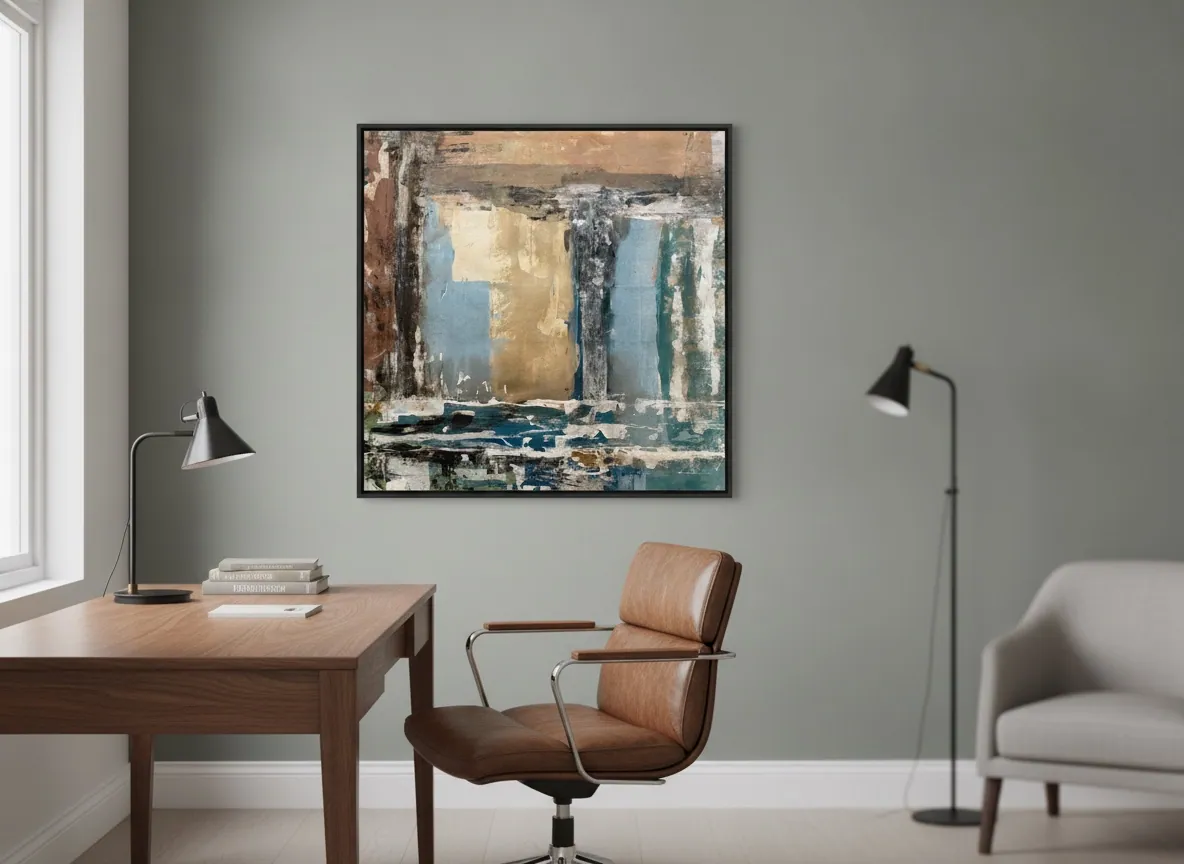
Patina Field is acrylic on canvas, 100 x 100 cm, from the Terra & Ether series — Archive ID AP-TAE-2026-006, priced at R$ 5.200 (BRL; a USD reference is available on inquiry). Its palette of iron brown, slate blue and a single passage of ochre was built in layers that were applied, scraped back and applied again, which gives the surface a worked, weathered read that sits closer to a wall's own patina than to a glossy statement piece.
Keeping the canvas clear of soot, smoke and the mantel's heat
A fireplace or a wood stove doesn't only change the humidity in a room — it puts fine particulate matter into the air. CCI's own overview of pollutants as an agent of deterioration lists the burning of combustibles, including candles and lamps, among the sources of indoor particulates, and is direct about the effect: "fine particles are particularly damaging, because they discolour or soil surfaces." A wood fire is a larger, more sustained combustion source than a candle, so the same soiling logic applies with more force directly above and around an open hearth.
In practice, that argues for hanging the piece to the side of the fireplace wall rather than centered above the mantel, with enough clearance from the flue surround that the canvas isn't sitting in the plume of warm air the fire sends up the wall. If the room only has the one wall, ask the installer for an anchor point high enough to clear the worst of the heat, and plan on dusting the surface a little more often than you would in a room without an open flame.
Where Patina Field sits well against timber or stone
Terra & Ether is the series built around mineral color and geological time, and Patina Field is its most architectural entry — vertical panels of tone that read like a weathered façade rather than a landscape. Against a plain drywall accent wall it can look slightly cool; against real timber, exposed brick, or a stacked-stone chimney breast, the browns and ochre in the piece pick up the warmth already in the room instead of competing with it.
At 100 x 100 cm it works as a single anchor on a modest wall — a stairwell landing, the wall beside (not above) a fireplace, or a reading nook away from direct afternoon sun and from any heating vent that would blow straight onto the surface. In a larger great room it can also be paired with a second square-format Terra & Ether piece rather than scaled up, keeping each work close to its intended viewing distance. If the wall in question is drywall over furring rather than solid timber or masonry, the anchor points need the same care as any heavy canvas.
From the studio
From the studio
With Patina Field I built the surface and then took part of it away — pigment applied, scraped back with a blade, applied again, until the wall stopped looking painted and started looking like something that had simply aged in place. It's the same logic a timber wall follows over years of dry winters and wood smoke: color settling into the grain rather than sitting on top of it. I didn't make the piece for a specific chalet, but I did make it to hold up against a room that already has some weather in it, and that's exactly the kind of wall it tends to get hung on.
Frequently asked
Can acrylic paintings hang safely in a room with a wood-burning fireplace?
Yes, more safely than an oil painting on canvas would. The Canadian Conservation Institute classifies acrylic on canvas as low sensitivity to relative-humidity fluctuation, against medium sensitivity for oil on canvas, so the swings a wood-heated room produces are less risky for an acrylic surface. Placement relative to the hearth still matters more than the medium.
What relative humidity should a mountain house aim for around original art?
A stable 40% to 60% relative humidity, with 50% as the practical target, is the range the Canadian Conservation Institute considers safe for paintings on canvas or wood. A hygrometer near the piece is the only way to know where a specific room actually sits through the winter.
Should the painting hang directly above the fireplace mantel?
It is better avoided. That spot concentrates the fire's radiant heat and any fine particulates the flue doesn't fully carry away, and CCI's own guidance notes that fine particles discolour and soil surfaces over time. A wall beside the fireplace, clear of the flue's heat plume, is the safer placement.
Does dry mountain air actually damage a canvas, or is that overstated?
It is a real, documented mechanism. The Canadian Conservation Institute's guidance on relative humidity shows that heating cold winter air to around 21°C indoors, without added humidification, can push relative humidity down to as low as 5% — well below the 40-60% range considered safe for a painting on canvas.
Does Perfeito Studio ship an original artwork to a chalet outside Brazil?
Yes. International shipping is quoted per destination once a piece is confirmed with the studio directly, and the studio can advise on letting the canvas acclimatize gradually after it arrives in a heated, drier interior.
Is Patina Field a good fit for a timber-walled room specifically?
Yes. Its palette of iron brown, slate blue and ochre was built in scraped-back layers that read like a weathered surface, which sits naturally against real timber, stone or brick. At 100 x 100 cm (R$ 5.200) it works as a single anchor piece rather than needing a large wall.
Ask about hanging Patina Field in your chalet
Send Alyne a photo of the wall — timber, stone, or drywall — and she'll help you place the piece clear of the hearth and confirm shipping to your address.
Sources
- Canadian Conservation Institute (CCI Notes 10/4) — 2026-09-06
- Canadian Conservation Institute — Agent of deterioration: incorrect relative humidity — 2026-09-06
- Canadian Conservation Institute — Agent of deterioration: incorrect relative humidity — 2026-09-06
- Canadian Conservation Institute — Agent of deterioration: pollutants — 2026-09-06
Published on