Art for a home office: what actually works
Home office art has one added job beyond decorating the room: it's often what sits behind you on video calls. The safest choice is a mid-size abstract piece with enough visual quiet to read well on camera — not too busy, not too blank — hung slightly off-center from where your face lands in frame.
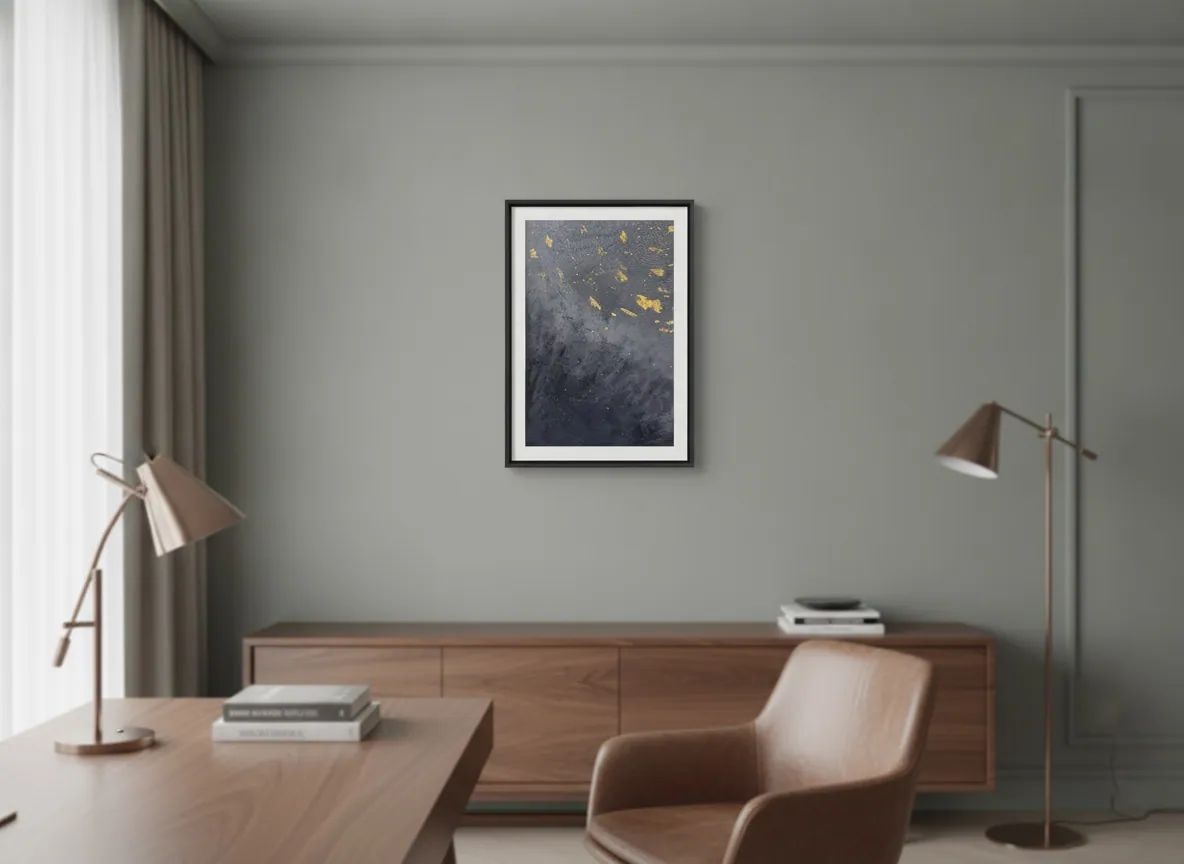
What reads well behind you on a video call
A home office wall gets looked at differently than a living room wall — not from across a room at a relaxed distance, but head-on, compressed by a webcam, often for hours a week. That changes what works. Busy, high-contrast compositions with a lot of small detail tend to shrink and flatten on camera, sometimes reading as visual noise behind a talking head. A piece with a clearer structure — broad fields of color or texture, fewer competing focal points — holds up better at webcam resolution.
Finish matters more here than in most rooms. A high-gloss surface can pick up a window or a ring light and throw a small bright reflection straight into frame, which is distracting on a call in a way it wouldn't be to someone walking past the piece in person. A matte or sculpted-texture surface is generally the safer pick for a wall you'll be filmed in front of regularly.
Contrast with the wall color also matters: a piece close in tone to the wall behind you can disappear on a compressed video feed, while one with a bit of separation reads clearly even at low bitrate.
Calming or energizing — matching the art to the work you do
There's no single right temperature for a home office; it depends on what the room is for. Deep-focus work — writing, analysis, long stretches of concentration — tends to pair well with something quieter: a monochrome, sculpted-relief piece like the works in the Matter & Silence series, where the surface rewards close attention without competing for it. Echo of Silence (50 × 70 cm, R$ 2,400) is a modest example — restrained, textural, built to sit quietly in the periphery of a workday.
A room used for calls, pitches, or creative work can carry more charge. The Black & Gold series — like Celestial Plan, shown above — pairs a dark, contained field with small flecks of gold leaf that catch light without overwhelming the composition; it reads as considered rather than loud. Something from Heart of Chaos, built around the moment light breaks through darkness, sits further toward the energizing end and works better in a room used for creative sessions than for sustained deep focus.
Neither register is objectively better for a home office — it's a match to how you actually use the room, not a universal rule.
Sizing a piece for a home office wall
Home offices are usually the smallest rooms in a home to get dedicated wall art, and the wall available is often interrupted by a window, a shelf, or the desk itself. That makes the entry and medium tiers of a collection — roughly 50 × 70 cm up to 80 × 120 cm — the range that fits most home offices without a size correction later. Celestial Plan and Echo of Silence, both 50 × 70 cm, sit at the compact end of that range; Origin of Light (60 × 80 cm, Heart of Chaos, R$ 3,300) sits a step up if the wall has more room to spare.
As a rough guide, leave clear wall margin on both sides of the frame — a painting that runs edge to edge on a narrow office wall reads as cramped rather than deliberate. If the office doubles as a larger room (a library, a converted bedroom with a proper desk wall), a large-format piece becomes an option, but it needs a wall wide enough to give it breathing room on both sides, not just enough width to technically fit.
Where to hang it relative to your desk and the camera
Two positions do most of the work in a home office: directly behind the desk chair, in the camera's field of view, or on a side wall, visible in passing but out of frame during calls. The two calls for different things. A piece meant to be seen on video should sit high enough that it's not partially cropped by your head and shoulders, and shifted slightly off the centerline of your face rather than dead-center behind it — centered-behind-the-head tends to look like the painting is growing out of you on screen.
A piece on a side wall, out of camera range, can be hung at standard eye level for a seated adult — roughly 145–155 cm (57–61 in) to its center — since it's judged by how the room feels to work in, not by how it reads through a lens.
Either way, avoid hanging directly behind a bright window if the piece will be on camera: strong backlight during calls washes out both your face and the painting, and no amount of positioning fixes that after the fact.
From the studio
From the studio
Most of my conversations with collectors about scale and placement now happen over video call, not in person — someone sends a photo of a wall, and we talk through size and hanging height with me looking at their room through a screen the same way they'll later look at the painting through one. It's given me a practical education in how a piece actually reads on camera versus in the room, which are not the same thing.
The gold leaf pieces are the clearest example. In the studio, under shifting daylight, the metallic fragments catch light unpredictably through the day — that's part of the point. On a webcam, under a fixed ring light or window, the same flecks can either read as a quiet accent or throw a small hot spot into frame, depending on exactly where the light source sits relative to the canvas. When someone tells me the piece is going behind a desk they'll be filmed at, I ask about their light source before I recommend anything with gloss or metallic finish — it changes the answer.
Trained as an architect, I still think about a wall's actual constraints before I think about the painting — a home office wall usually has less to give than a living room wall, interrupted by a window or a shelf, and I'd rather steer someone toward a piece that fits what's really there than one that only works in a photo of an empty wall.
Frequently asked
What kind of art works best behind you on video calls?
A piece with a clear, uncluttered structure and a matte or textured finish tends to work best — high-gloss surfaces can catch a window or ring light and throw a distracting reflection into frame, and busy, detailed compositions can read as visual noise once compressed by a webcam.
Should home office art be calming or energizing?
It depends on how the room is used. A quieter, monochrome or sculpted-texture piece suits deep-focus work, while a piece with more chromatic or textural energy suits a room used mainly for calls, pitches, or creative sessions. Neither is objectively correct — match the piece to the work you actually do in the room.
What size painting fits a home office wall without overwhelming it?
Most home offices suit the entry to medium size range of a collection, roughly 50 x 70 cm up to 80 x 120 cm, since the available wall is often interrupted by a window, shelf, or the desk itself. Leave clear margin on both sides of the frame rather than sizing it edge to edge on a narrow wall.
Does abstract art work in a home office, or is it too informal?
Abstract work is not inherently informal — a restrained, well-composed piece in a considered palette reads as professional on a call, the same way a considered bookshelf or a plain painted wall does. What reads as informal is usually clutter or a mismatch in tone with the rest of the room, not the fact that the art is abstract.
Where should the art go relative to the desk and camera line?
If it will appear on camera, hang it high enough that it is not cropped by your head and shoulders, and shift it slightly off the centerline of your face rather than placing it dead center behind you. If it is on a side wall out of camera range, standard seated eye level, around 145 to 155 cm to its center, works well. Avoid positioning it directly in front of a bright window that will be behind you on calls.
Not sure what fits your home office wall?
Send a photo of the wall and your desk setup, and we will tell you what fits and how it will read on camera before any purchase decision.
Published on