Art for a dermatology clinic: what works in a skin-focused practice
A dermatology reception calls for a calm, non-figurative abstract composition in a restrained palette that reads clearly under bright, clinical lighting -- never an image of skin or a condition, which puts the exact subject a patient came to have examined back in front of them. Research on art in healthcare settings backs original work as a stress-reducing choice.
A dermatology waiting room carries a specific kind of anxiety
Dermatology carries a kind of clinical anxiety a general medical waiting room does not: patients arrive to have a visible part of their body examined, often for a cosmetic or oncologic concern, under unusually bright, unforgiving light. A 2024 study of dermatology outpatients found that 18.7% screened positive for clinically relevant anxiety, depression, or both at a level warranting psychiatric support -- and that this mental-health burden was linked to lower overall well-being and quality of life even among patients who were satisfied with their clinical care. A reception that reads as calm rather than sterile is working against a real, measured baseline of tension in that specific patient population, not just decorating a wall.
What the research on art and calmer patients actually shows
A 2025 scoping review of the effect of viewing visual artwork on patients in healthcare settings looked at 25 peer-reviewed patient studies: 72% reported improved well-being, 52% reported an improved healthcare experience, 52% reported a positive distraction effect, and 12% (three studies) reported reduced heart rate or improved sleep quality. The review is candid about its limits -- study designs varied so much in art type, exposure length, and outcome measure that the authors could not settle on which specific style of art works best, only that viewing art in a clinical space was associated with a better outcome in most of the studies reviewed.
That is the honest basis for recommending original art for a dermatology reception: not a guarantee tied to one style, but a body of evidence that leans toward calmer, better-rated visits when the walls carry considered work instead of nothing.
Skin imagery, nature scenes, or abstraction: the right call for this room
The same 2025 review found mixed results even for nature imagery, the category with the most research behind it in healthcare settings generally -- one pediatric study included in the review reported that a nature video actually increased measured anxiety, against several other nature-based interventions that showed a benefit. Nature imagery is not the automatically safe choice it is sometimes assumed to be. And no image of skin, a dermatologic condition, or a cosmetic result belongs on a dermatology reception wall: it puts the exact subject the patient is there to have examined back in front of them while they wait, which works against the room's purpose rather than for it.
A restrained, non-figurative abstract composition sidesteps both problems. It reads as considered and calm without literalizing skin, illness, or a procedure, and without leaning on a single nature-imagery result the research itself does not treat as settled.
Strong, color-accurate light and how a textured surface actually reads
In the studio's experience, dermatology practices generally run brighter, more neutral-white, more color-accurate lighting than a typical medical office, because skin tone and lesion color are part of the clinical read -- the light is tuned for that, not for atmosphere. In the studio's experience, that kind of light is unusually honest with a painted surface: it flattens a warm, low-contrast palette that looks rich under a home's warmer bulbs, while it makes a sculpted or textured relief -- raised paste, an impasto ridge, the edge of a gold-leaf passage -- read with more definition, because the shadow lines the light throws across the texture get sharper rather than softer. A flat, low-relief piece is the one that risks looking thin under that kind of light; a piece with real surface movement tends to hold up better.
Placement, surface care, and the right size for a reception wall
A dermatology reception is a working clinical space that typically gets wiped down and disinfected more visibly than a general practice waiting room. In the studio's practice, the rule here is the same as in any clinic: the concern is placement, not the canvas surface itself -- keep the piece away from a sanitizer dispenser, a check-in counter that gets sprayed down, or anywhere in the splash range of a cleaning routine, rather than treating a finished acrylic or mixed-media surface as something that needs to withstand disinfectant directly. For the reception wall itself, an entry to medium-scale piece in the 50 x 70 cm to 100 x 150 cm range usually reads well from where patients sit -- large enough to hold its own against a check-in desk and signage, without crowding a wall that also has to carry way-finding and the practice's own information.
From the studio
The studio's view
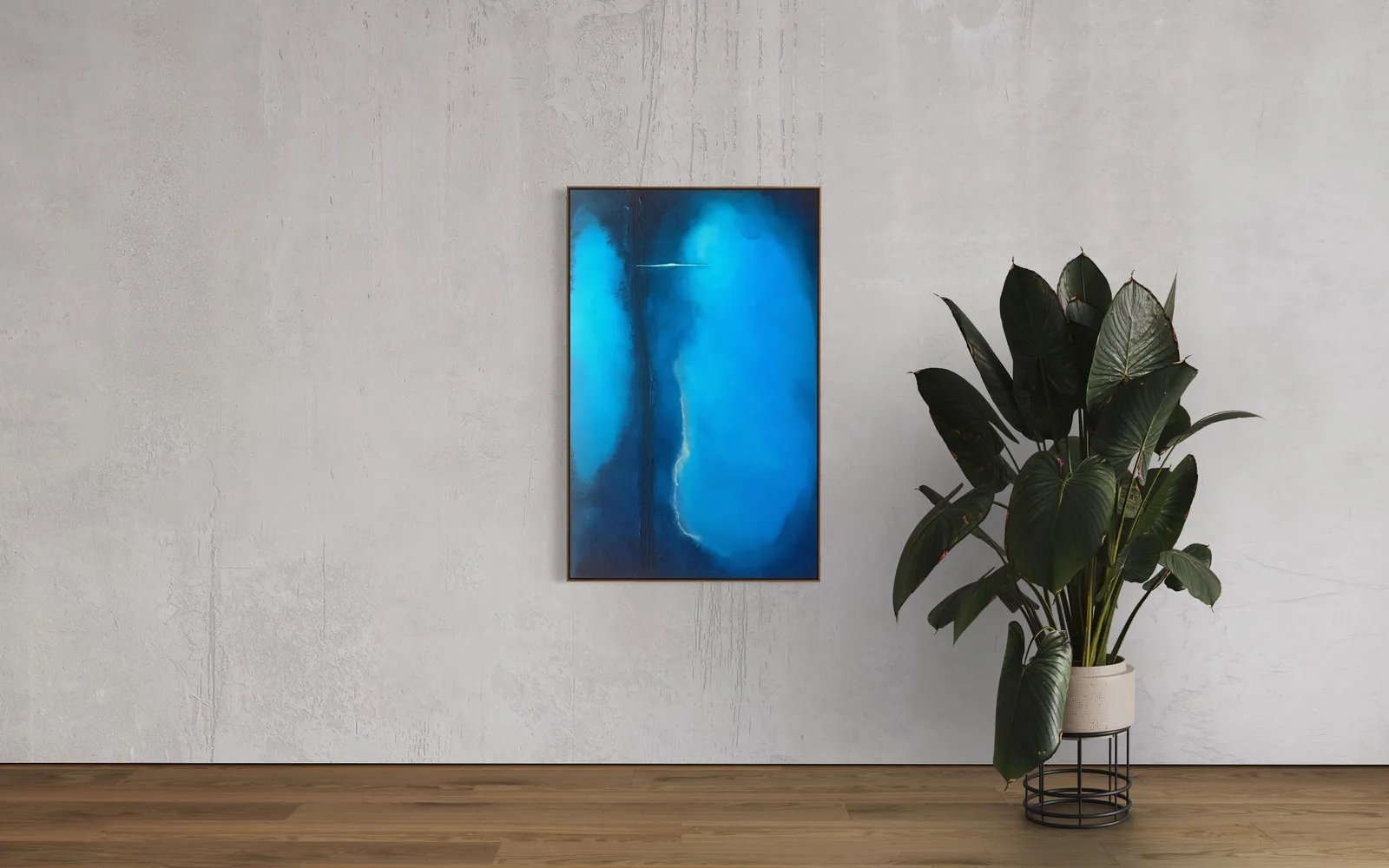
Trained as an architect, I think about a dermatology reception as a room built around one very particular kind of light -- neutral, shadow-flattening, tuned to read skin tone rather than to feel warm. When a piece like Veil of Light goes into that kind of room, the atmospheric blue holds its temperature instead of shifting warm the way it would under a home's yellower bulbs, and the sculpted ridge running down the canvas throws a cleaner, more legible shadow line than it does under softer ambient light. I have learned to ask a clinic for a photo of the actual reception wall under its real lighting before recommending a piece, because a palette that reads calm on a screen can turn cold, or a flatter piece that looked fine in a render can look thin, once it sits under that specific white light all day.
Frequently asked
What art fits a dermatology clinic?
A calm, non-figurative abstract composition in a restrained, mostly cool or neutral palette, sized to hold its own against a check-in desk and signage without crowding the reception wall. The piece should read clearly under bright, color-accurate clinical lighting rather than depend on warm ambient light for its effect. A 2025 scoping review of art in healthcare settings found that most peer-reviewed patient studies reported better well-being or a better care experience when original art was present on the walls, which supports the choice on evidence, not only on taste.
Should the art reference skin or nature imagery?
No, not skin or a dermatologic subject: it puts the exact thing the patient is there to have examined back in front of them while they wait. Nature imagery has the largest body of research behind it in healthcare settings generally, but a 2025 review found mixed results even there -- one included study recorded a nature video that increased measured anxiety. A restrained abstract composition avoids both problems without depending on a single nature-imagery result the research itself does not treat as settled.
What about strong overhead lighting?
Dermatology practices typically run brighter, more neutral-white, more color-accurate light than a general medical office, because skin tone and lesion color are part of the clinical read. That light is unusually honest with a painted surface: it can flatten a warm, low-contrast palette that looks rich under home lighting. The studio's practice is to ask for a photo of the reception wall under its real lighting before recommending a specific piece and palette.
Does texture read well under clinical light?
Often better than under softer ambient light. In the studio's experience, a bright, neutral, shadow-reducing light source throws sharper, more legible shadow lines across a sculpted or textured surface -- raised paste, an impasto ridge, the edge of a gold-leaf passage -- than warmer, softer lighting does. A flat, low-relief piece is the one that risks looking thin under that kind of light, not a piece with real surface movement.
What size for a reception wall?
An entry to medium-scale piece, roughly 50 x 70 cm to 100 x 150 cm, usually fits a dermatology reception wall well -- large enough to hold visual weight against a check-in counter and signage, without overwhelming a wall that also has to carry way-finding. A larger, more architectural piece can work in a bigger lobby or a hospitality-scale clinic, but the studio recommends confirming wall dimensions and sightlines before committing to the largest end of that range.
An original work for your dermatology practice
Send the dimensions of your reception wall and a photo under its real lighting, and Alyne will recommend a piece and palette suited to a bright, color-accurate clinical space. International shipping, documentation, and installation guidance are quoted on request -- direct from the artist's studio in Brasília, Brazil, no gallery in between.
Sources
- Industrial Psychiatry Journal (Mohapatra, Sahu, Mohapatra & Kar, 2024) — 2026-09-28
- PLoS One (Foster, Sanhueza, Bahr et al., 2025) — 2026-09-28
- PLoS One (Foster, Sanhueza, Bahr et al., 2025) — 2026-09-28
Published on