Art for a country estate: stone walls, unheated rooms and rising damp
Yes — an old country house with stone or solid masonry walls can hang original paintings safely, but the wall dictates the plan. Keep humidity near 40–60%, hang above the 0.5–1.5m band where rising damp typically concentrates, and leave a small air gap behind the frame so the surface can breathe.
Why an old stone house is a harder hang than a modern one
A country house built in stone or solid brick behaves nothing like a modern stud-and-drywall room. The walls are thick, often unheated for parts of the year, and porous enough to draw moisture up from the ground and in from the weather — conditions no canvas, however well made, was designed to sit against without a plan.
The three problems compound each other: cold, damp masonry chills the air nearest the wall; that cooler air holds less moisture capacity, so relative humidity spikes right where a painting would touch the surface; and an unheated room swings harder between seasons than a heated one ever will. None of this makes hanging original work in an old house a bad idea — it just means the wall, not the piece, sets the plan.
The humidity band that keeps a canvas safe
Canvas responds to moisture in the air, not just moisture it touches directly. The Canadian Conservation Institute's guidelines for paintings put the safest range at a stable 40–60% relative humidity, and are explicit that levels above 70–75% "will encourage mould growth."
The National Trust, which manages more historic houses with exactly this problem than almost any institution in the world, works to a similar band — its conservation team targets roughly 40–60%, extending to 65% for mixed collections where a single figure can't suit every material — and notes that once humidity climbs, it "makes a perfect home for mould." A hygrometer left in the room for a season, not a guess, is the only way to know which side of that line a given wall sits on.
How high rising damp actually reaches
Rising damp is capillary action, not a puddle: groundwater is drawn up through porous stone or brick the way a paper towel draws up a spill, and it has a ceiling. Heritage guidance on the phenomenon puts that ceiling at 0.5 to 1.5 metres above ground level in a typical wall, with the exact height depending on the wall's porosity and how much moisture it is exposed to.
That figure is the practical reason a low-hung painting is the riskiest position in an old house, not just an aesthetic one. Anything hanging within that band sits closest to the wall's wettest, coldest section; moving the piece higher, or confirming the wall has a functioning damp course before committing to a low hang, removes the single largest variable.
Giving the piece an air gap, not full wall contact
However dry a wall looks, letting a frame sit flush against it is the detail that causes the most avoidable damage. Air trapped between canvas and cold masonry cannot circulate, so any moisture that does reach the surface has nowhere to go — the same mechanism behind mildew forming on the back of a frame hung flush in a corner, where airflow is already at its worst.
The fix is simple hardware, not a renovation. Picture hanging bumpers or spacers that lift the frame roughly 6–7mm off the wall move noticeably more air than the 2–3mm standard bumpers most frames ship with. It is a five-minute adjustment that matters more in an old stone room than almost anywhere else the piece might hang.
Living with an unheated room's seasonal swings
A heated, climate-controlled gallery keeps humidity within a narrow band year-round. An unheated country room does not — it tracks outdoor weather closely, running damp through winter and drying out in summer, a much wider swing than any canvas experiences in a modern apartment.
None of that rules the room out. It changes the maintenance: check the piece each season rather than once a year, keep it off exterior walls and away from unused fireplaces where cold air pools, and treat a hygrometer as standard equipment for the room, not an extra. A painting built to travel and to be re-hung — unframed canvas, gallery edges finished, nothing fragile tying it to a single wall — tolerates that kind of house far better than one already boxed under glass.
From the studio
How we read a room before recommending a piece
Because the studio is run by an architect, the first question about any piece headed for an older house is not which wall looks best — it is what that wall is doing physically. Stone and solid masonry hold their own microclimate: cooler and often damper than the room's air, and slower to respond when a fire or a radiator is switched on. Reading that before a piece leaves the studio is part of the conversation, not an afterthought.
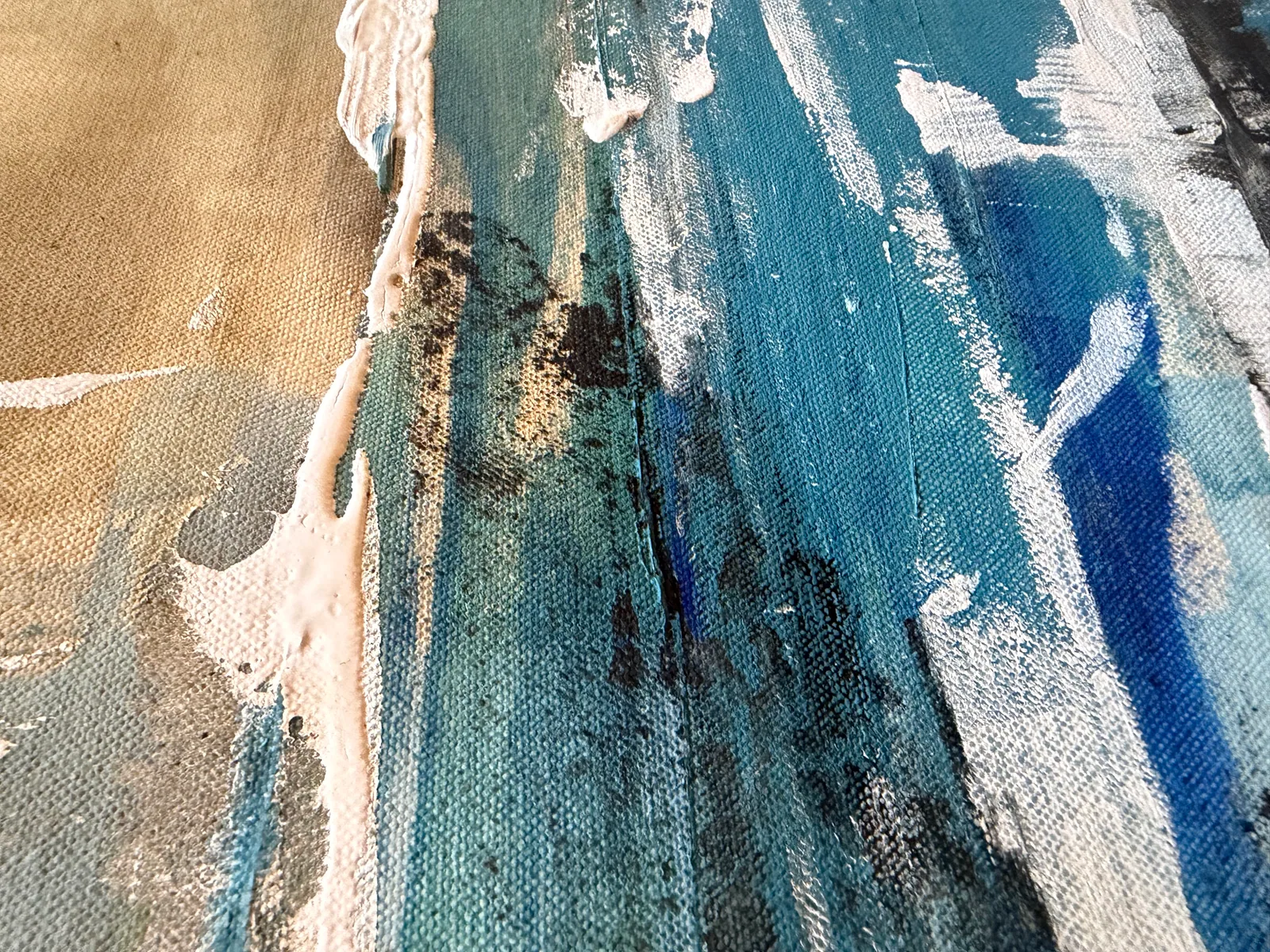
Patina Field, from the Terra & Ether series, is built the way an old wall actually is: pigment applied, scraped back, and reapplied until the surface reports wear rather than a single gesture — the same accumulation of layers you see in a stone façade that has weathered decades rather than seasons. It is one of the pieces we point to most often for a country house, not because it hides the room's age, but because it sits comfortably next to it.
Frequently asked
Is it safe to hang an original painting on a stone or masonry wall in an old house?
Yes, with two precautions: keep the piece off any wall known to have rising damp, and never let the frame sit flush against the masonry. A small air gap, picture hanging bumpers around 6 to 7mm are enough, lets air move behind the canvas, which prevents mildew far more reliably than the type of wall itself. Confirming the wall's damp course and monitoring humidity with a basic hygrometer for a season covers the rest.
What humidity level is too high for a canvas painting?
Conservation guidelines put the safe range at a stable 40 to 60 percent relative humidity, with the Canadian Conservation Institute noting that levels above 70 to 75 percent actively encourage mould growth. The National Trust, which manages this exact problem across historic properties, works to a similar 40 to 60 percent target, extending to 65 percent for mixed collections. A hygrometer left in the room over a season is the only reliable way to know where a given wall falls.
How high up a wall does rising damp typically reach?
Heritage guidance on the phenomenon puts the usual ceiling at 0.5 to 1.5 metres above ground level, since rising damp is driven by capillary action through porous masonry and loses force with height. That is why a painting hung low on an exterior wall in an old house carries more risk than the same piece hung higher on the same wall — the height alone moves it out of the zone where dampness is most concentrated.
Can I hang a painting on an exterior wall at all?
Generally yes, provided the wall is not actively damp and the frame does not sit flush against it. Exterior walls run colder than interior partition walls, which is exactly the condition that produces condensation and, eventually, mildew behind a frame. A small air gap and a slightly higher hanging position address most of that risk without ruling the wall out entirely.
Does an unheated room make a painting more likely to be damaged?
It makes the room's humidity swing more than a heated space, since it tracks outdoor weather more closely rather than staying in a controlled band. That is a maintenance question, not a reason to avoid the room: check the piece each season, keep it away from exterior corners and unused fireplaces where cold air collects, and use a hygrometer to catch a problem before it shows on the canvas.
Is a work with heavy texture, like sculpted or built-up paint, more or less risky in a damp room than a flat canvas?
The risk comes from moisture and airflow at the wall, not from the paint surface itself, so texture does not add danger on its own. What matters is the same for any piece: an air gap behind the frame, a wall that is not actively damp, and humidity kept close to the 40 to 60 percent range conservation guidelines recommend for canvas generally.
Considering a piece for an older house?
Tell us about the wall — stone, brick, exterior, interior — and the studio can talk through hanging position and hardware before the piece ships.
Sources
Published on