Art for a boutique resort: what can hang in open-air areas and what has to stay indoors
A covered, shaded lobby with fans or air conditioning can hold an original painting; a fully open-air veranda exposed to sun and swinging humidity cannot. Conservation guidance treats direct sun and uncontrolled humidity as active damage, not cosmetic fading — the rule: originals stay under roof and off the sun path, open-air walls get weatherproof reproductions instead.
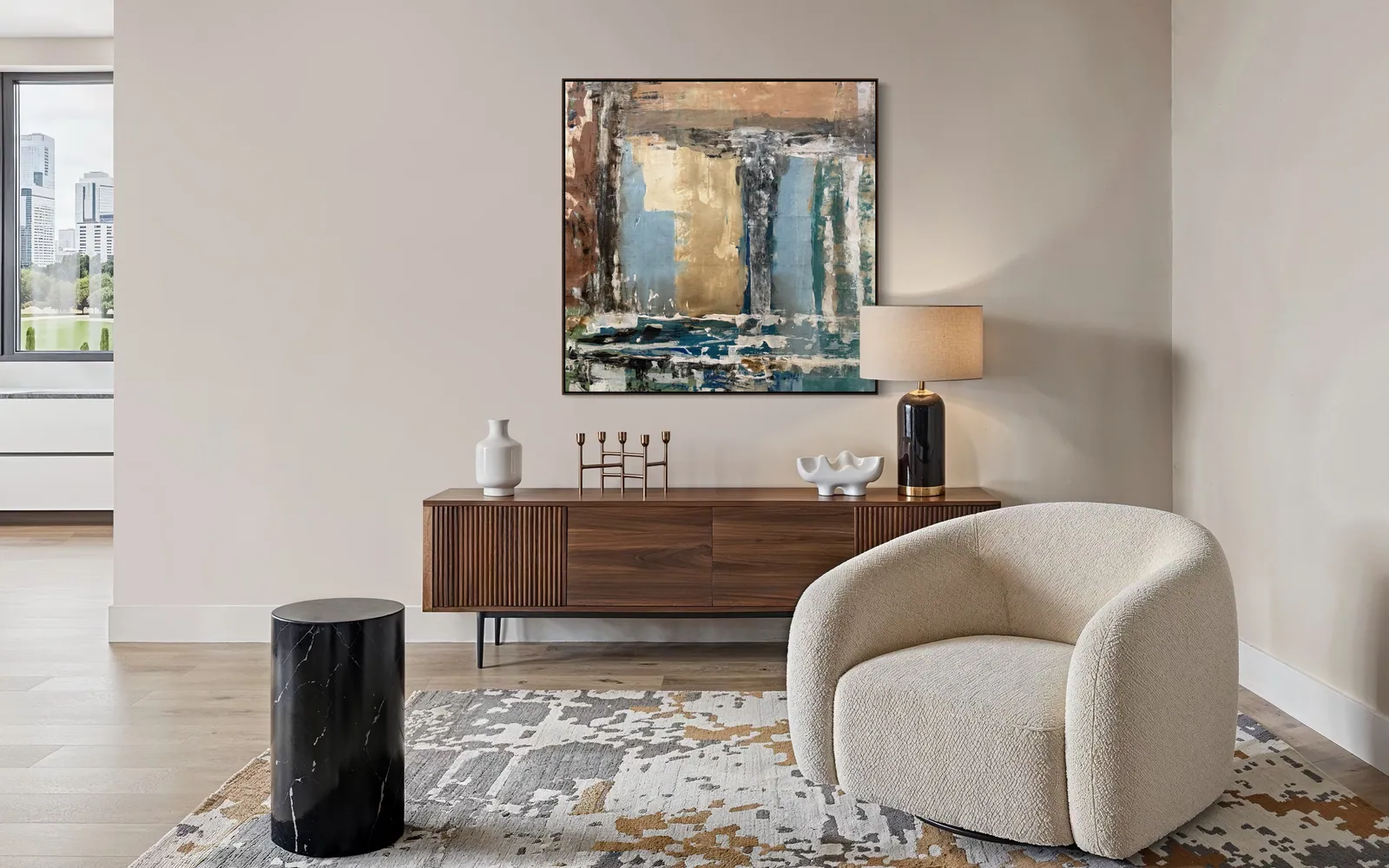
Covered vs. fully open-air: the distinction that decides everything
Hospitality design uses the word "open-air" loosely, and that looseness is exactly where an expensive mistake happens. A covered lobby — deep eaves, a solid roof, walls on at least two sides, air moved by fans or partial air conditioning — behaves, for a painting, much closer to an indoor room than to the outdoors. A fully open-air space — a poolside veranda, a breezeway lounge, a lanai with no glazing on any side — is exposed to whatever the sky and the weather are doing at that hour: direct sun crossing the wall at some point in the day, wind-driven rain reaching the back wall in a storm, and relative humidity that simply follows the outside air.
The test worth applying with an architect or designer is not "is it covered by a roof" but "does this wall, at any point in the day or season, receive direct sunlight, blown rain, or outdoor humidity swings with no buffering." If the answer is yes even for twenty minutes at sunset, the wall is functionally open-air for conservation purposes — regardless of how the space reads to a guest walking through it.
UV and heat: why direct sun disqualifies a wall on its own
Conservation guidance from the Canadian Conservation Institute (CCI) is direct on this point: paintings should not be placed in direct sunlight, and spotlights or picture lamps should not be focused on them either, because both raise the temperature around the painting and add stress the paint layer has to absorb. In an open-air lobby, direct sun rarely stays put — the angle that misses a wall at 10am can hit it directly by 4pm, especially in a double-height space with skylights or the low sun angles common near the equator.
The scale of the risk is documented in CCI's own light-damage guidance: professional display standards try to keep ultraviolet exposure under roughly 75 microwatts per lumen, the historic benchmark set for incandescent lighting, while unfiltered daylight typically runs in the 600–1,000 microwatt-per-lumen range. Under CCI's own daylight-spectrum exposure comparison, materials it classifies as highly light-sensitive show visible change within about a month, and materials classified as very high sensitivity within about three days. Glazing over a painting reduces the UV reaching the surface, but no glazing on the market turns an open, sun-struck wall into a controlled display case.
Humidity swings: why lobby paintings crack more than they fade
Sun gets the attention, but CCI's guidance for paintings puts equal weight on a quieter risk: relative humidity that does not stay stable. Its recommendation is to stabilize RH and avoid extremes and fluctuations, because a canvas and its paint layer expand and contract with moisture, and it is the repeated swings — not a single humid afternoon — that produce cracking and delamination over months.
This is the detail hospitality teams miss most often: a covered lobby with no glass doors, cooled only by fans and the breeze off a garden or the sea, still breathes the outside air. Its relative humidity rises and falls with the weather almost as much as a fully open veranda does. A roof solves the direct-sun and rain problem; on its own, it does not solve the humidity-stability problem an original painting needs.
Mould and insects: the tropical hospitality-specific risk
For a property in a warm, humid climate, the conservation literature adds a second consequence to unstable humidity: biological damage. The Conservation Center for Art & Historic Artifacts (CCAHA) states it plainly — relative humidity "also contributes to biological deterioration," and "higher RH means more insect activity and increased risk of mold." That describes exactly the environment many boutique resorts are designed to feel like: warm, breeze-ventilated, close to a garden or the sea, with humidity that rarely drops for long.
CCI's own pest-control guidance is built around holding relative humidity below 75% during warm, humid seasons — and preferably below 65% year-round — specifically because that range limits the moisture mould and other microorganisms need to establish themselves. A naturally ventilated, non-air-conditioned open-air lobby in a tropical or coastal climate can sit above those numbers for weeks at a time, which is why a canvas left there for a season can develop problems a climate-controlled room of the same design never sees.
What can actually go where in a boutique property
In practice, this sorts hospitality walls into three categories rather than two. A climate-controlled interior — reception desk, indoor lounge, corridor to the suites — takes an original without qualification. A covered, buffered lobby — roofed, out of the direct-sun path across the whole day, cooled by fans or partial air conditioning — can still take an original if it is framed with UV-filtering glazing and checked seasonally for humidity-related change; it is a workable compromise, not a risk-free one. A fully open-air veranda, pool deck or breezeway exposed to sun, rain or outdoor humidity with no buffering at all should not carry an original painting — that wall is better served by a printed reproduction on a weatherproof substrate, a metal or dibond panel, or a sculptural piece made for outdoor conditions.
None of this rules art out of open-air spaces — it just moves the decision from "which painting" to "which medium," and that second question has good answers.
From the studio
What I look for, as an architect, before I recommend a wall
Before I was ever a painter, I trained as an architect, and the habit that stays with me on a hospitality project is asking for the roof plan before I ask about the wall the client actually wants to use. A wall that looks perfectly protected on a floor plan can still catch three hours of low western sun in the dry season that nobody accounted for, because nobody walked the space at 4pm.
My large-format pieces — the ones built for hospitality scale, like the horizontal works in the Terra & Ether series — are made with acrylic and texture on canvas, and some carry gold leaf; they read beautifully under the soft, indirect light of a covered veranda. That is a very different statement from saying they belong on a veranda with no roof over it. What I actually recommend to a resort or boutique hotel is almost always the same sequence: put the original where the light is controlled and the air is stable, and treat the fully open-air wall as its own design problem — one where a print or a different material does the job the space needs, without asking a one-of-a-kind canvas to survive conditions it was never built for.
Frequently asked
Can an original painting hang in an open-air hotel lobby?
It depends entirely on whether that lobby is covered and buffered from weather, or fully open-air. A roofed lobby out of direct sun and away from wind-driven rain can work, ideally with UV-filtering glazing; a veranda or breezeway with no roof, direct sun at some point in the day, or humidity that tracks the outside air is not a safe spot for an original.
What's the practical difference between "covered" and "open-air" for hanging art?
Covered means a roof plus enough walling that the space is shielded from direct sun across the whole day and from rain reaching the wall. Open-air means the wall is exposed to at least one of those — sun, rain or outdoor humidity swings — with nothing buffering it.
Does framing or glazing make it safe to hang a painting outdoors?
Glazing reduces the ultraviolet light reaching the surface, which helps, but it does not stop heat building up on a sun-struck wall or humidity swinging with the weather. Framing improves a covered, buffered space; it does not turn a fully open-air wall into a controlled environment.
What should a resort use instead of an original painting in a truly open-air space?
A printed reproduction on a weatherproof substrate — a UV-cured print or a metal or dibond panel — or a sculptural piece made for outdoor exposure. These are designed to tolerate sun and moisture in a way an original canvas is not.
Why is tropical or coastal humidity specifically a problem for hospitality art?
Conservation guidance links higher relative humidity directly to more insect activity and greater mould risk, and recommends holding humidity below roughly 75% in warm, humid periods to limit that. Many open, naturally ventilated resort lobbies in humid climates sit above that threshold for long stretches, which original paintings are not built to tolerate.
Can a Perfeito Studio piece be adapted for a covered but breezy resort lobby?
Yes, with the right framing and placement — out of the direct-sun path, glazed against UV, and checked seasonally. We work through the room with the architect or designer before recommending a specific piece; reach out through the studio's architecture program for a walkthrough.
Planning art for a boutique resort or hotel lobby?
Tell us which walls are covered and which are fully open-air — we'll help you place originals where they belong and choose the right medium for the rest.
Sources
- Canadian Conservation Institute — Caring for Paintings — 2026-09-26
- Canadian Conservation Institute — Caring for Paintings — 2026-09-26
- Canadian Conservation Institute — Agent of Deterioration: Light, Ultraviolet and Infrared — 2026-09-26
- Conservation Center for Art & Historic Artifacts (CCAHA) — Temperature, Relative Humidity, and Dew Point for Collections — 2026-09-26
- Canadian Conservation Institute — Agent of Deterioration: Pests, Basic Control of Typical High Risks — 2026-09-26
Published on