Art for a beach house: salt air, sun, and months with the house closed
A beach house poses three real risks to an original painting: salt-laden air that corrodes metal hanging hardware, wide humidity swings when the house sits closed for weeks or months, and direct sun through south- or west-facing glass. Acrylic on canvas tolerates the humidity swings better than oil, and a closed house should be monitored rather than left completely unattended.
Humidity swings, not humidity itself, are what damage a painting on canvas
The Canadian Conservation Institute treats incorrect relative humidity as one of the ten recognized agents of deterioration for paintings on canvas, and its guidance is specific: it is the swing, not any single humidity reading, that stresses a paint film. A fluctuation larger than 10% relative humidity within a short period can create internal stress across the canvas, ground and paint layers, and that stress is what eventually shows up as cracking. The Institute also notes that these fluctuations happen seasonally as much as day to day — which is exactly the pattern a beach house produces when it is used for a few weeks a year and left closed the rest of the time.
The medium of the painting changes how much that swing matters. CCI's notes on painting materials record that oil paint becomes more likely to crack once relative humidity drops below 35%, because the paint film loses flexibility and turns brittle. Acrylic paint, by contrast, forms a more flexible film that appears less prone to cracking under the same swings — though the Institute is careful to add that acrylic has not been around long enough to know exactly how it behaves after many decades. For a house that sits at high coastal humidity for weeks, then gets flushed with dry, air-conditioned air on arrival, that flexibility is a real, if not absolute, advantage. The other risk of a closed, humid house is mold on the canvas surface itself, not just stress on the paint film — CCI's technical guidance on mould prevention notes that at 75% relative humidity, noticeable mould growth can appear within two weeks to three months, and recommends keeping collections below that level as a hard ceiling. That is a separate concern from the cracking discussed above, and it matters most in a house left shut for weeks at a stretch, where humidity is not being actively managed.
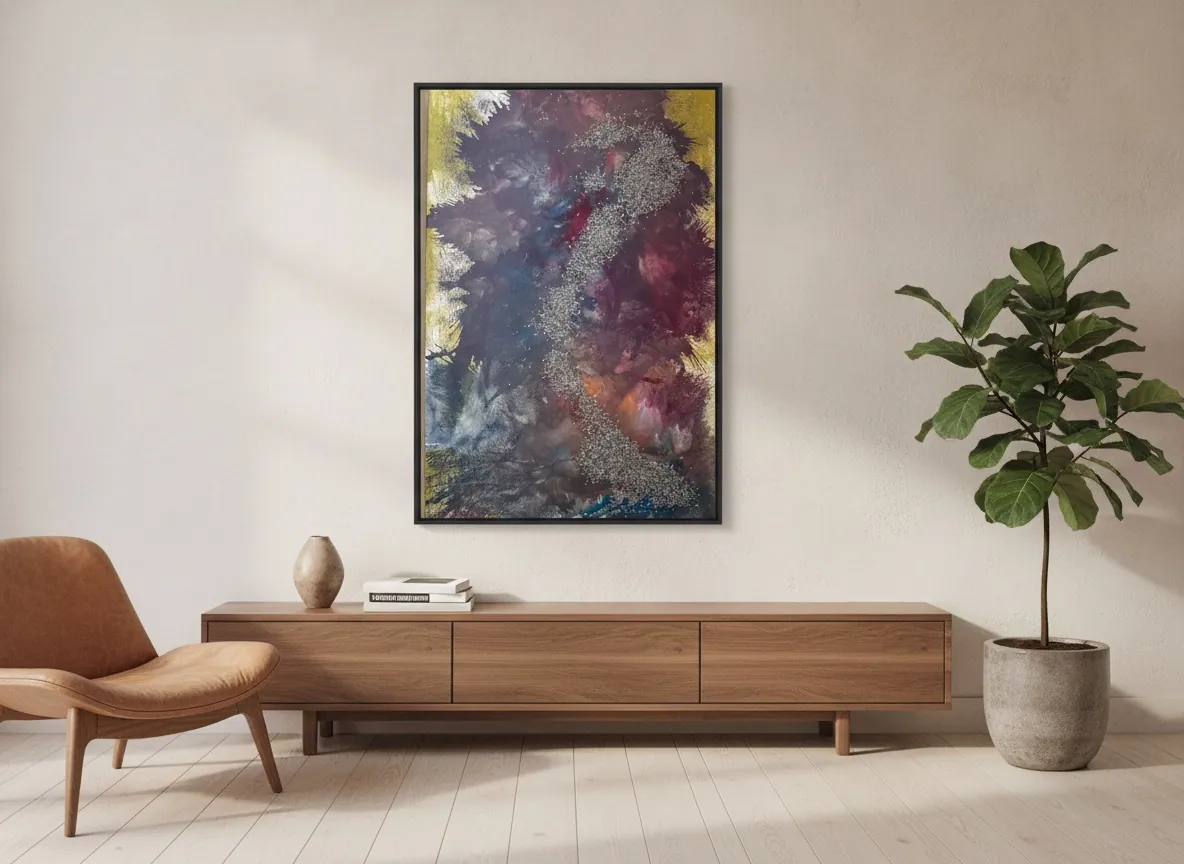
The safest target, once the house is occupied and the air conditioning is running normally, is a stable level between 40% and 60% relative humidity — the range CCI recommends for paintings on canvas or wood. Elemental Veins, from the Terra & Ether series, is built from an acrylic base with metallic fragments and mineral pigment layered over canvas — closer to the material profile that tends to tolerate a beach house's wider humidity range than an oil painting would.
Salt air corrodes the hardware long before it reaches the canvas
Salt does not attack a paint film the way it attacks metal. CCI ran a direct comparison to show how much difference contamination makes: a clean iron key held at 85% relative humidity developed only minor corrosion after 18 days, while an identical key deliberately contaminated with salt and dust — standing in for a polluted, coastal atmosphere — showed visible corrosion spots within a single day. The Institute's conclusion is straightforward: high humidity alone corrodes metal slowly, high humidity combined with salt corrodes it far faster, and the lower the relative humidity around the metal, the slower that process runs.
In a beach house, the metal at risk is not the canvas — it is everything that holds the painting to the wall: D-rings, hanging wire, staples inside the frame, and any exposed hardware on a metal frame profile. Sliding glass doors left open for the ocean breeze, and salt residue carried in on window screens and balcony rails, both put that hardware in the path of the same contamination CCI tested. Stainless-steel or powder-coated hangers, a sealed dust cover on the back of the frame, and avoiding raw, untreated metal frame edges are the practical response — inexpensive choices that matter more fifty meters from the water than they do inland.
Direct sun through beach-house glass does real, cumulative damage
A beach house is usually built for the view, which means more glass, fewer interior walls, and often no shutters or heavy drapery to interrupt the light. Conservation lighting guidelines from the Conservation Center for Art & Historic Artifacts (CCAHA) place oil paintings in a "less sensitive" category with a recommended ceiling of about 150 lux, roughly three times the limit set for works on paper. CCAHA does not publish a separate figure for acrylic or mixed-media works on canvas, but treating them under the same 150-lux ceiling is the conservative default most conservators use in the absence of a medium-specific guideline. The same guidelines cap ultraviolet exposure at 75 microwatts per lumen, with 0 to 10 microwatts per lumen considered ideal.
Nobody measures lux with a meter in a living room, but the general point holds without one: a wall of unfiltered glass facing the beach accumulates far more total light over a year than an interior wall does, especially through the brightest afternoon hours. A UV-filtering film applied to the window itself — rather than to the painting's frame — cuts the ultraviolet component for the whole room, and closing blinds or shades during the hours of direct sun reduces total exposure without asking anyone to give up the ocean view outside those hours.
The practical placement follows from this: an interior wall, perpendicular to the glass rather than facing it directly, keeps the piece out of the direct light path while usually still being visible from the rooms that face the water.
What actually protects the work when the house sits closed for months
Guidance for historic buildings that close for an extended season, published by CCAHA, is built around one idea: sudden, dramatic swings do more damage than a level that sits outside the ideal range but stays put. Its recommendation is to make any temperature or humidity adjustment gradually — over two to three days rather than in one step — and to keep environmental monitoring or HVAC systems running through the closure, so a problem shows up on a reading rather than as damage discovered on return. The same guidance calls for closing shutters or ultraviolet-filtering blinds over the windows for the duration of the closure, which addresses the sun exposure problem from the previous section at the same time.
Translated to a beach house closed for weeks or months at a stretch: leave the air conditioning or a dehumidifier running at a low, steady setting instead of switching it off and running it hard on return, keep the blinds or shutters closed over the wall that gets direct sun, and — if the property allows it — a smart humidity and temperature sensor gives an early warning that a caretaker or property manager can act on before the next visit, rather than after.
Acquiring a piece for a beach house from outside Brazil
A piece for a beach house is often bought without an in-person viewing, and increasingly that includes contemporary Brazilian art acquired directly from the artist's studio rather than through a gallery — international collectors buying on the strength of documentation and studio photography, then having the work shipped to a second home. A painting destined for that kind of home benefits from more documentation, not less: whoever checks on the house between visits, or eventually inherits or resells the piece, should be able to identify exactly what they are caring for.
Every work acquired through Perfeito Studio is sold directly by the artist's studio, with no gallery intermediary, and comes with a signed Certificate of Authenticity, an artist dossier, and an internal Archive ID — Elemental Veins, for example, is registered as AP-TAE-2025-001 — along with written care and preservation guidance. Pricing across the current collection runs from R$2,400 to R$8,800 for a unique, signed original; Elemental Veins is priced at R$6,400. For an international buyer, that figure is quoted in reais, with a USD or EUR reference given on request at the time of inquiry rather than fixed in advance, since the exchange rate moves. International shipping is quoted per destination, with professional packaging included and transit insurance available; the studio ships from Brasília, and collecting the piece in person is also possible for a buyer visiting Brazil.
From the studio
From the studio
Before a piece leaves for a house by the sea, I ask about the room's exposure before I ask about the wall color — which way the glass faces, how many weeks a year the house actually sits closed, whether there is a caretaker who checks on it in between. Training as an architect before I trained as a painter left me unable to think of a canvas as separate from the volume of air and light around it; a house that closes for the season is never a neutral container.
Elemental Veins and the rest of the Terra & Ether series build up an acrylic base with metallic fragments and mineral pigment rather than oil, and I think of that as a practical decision as much as an aesthetic one — the layered surface holds up through the kind of humidity swing a coastal house goes through between visits. When a piece is going somewhere that will sit closed for stretches of the year, that is usually the first thing we talk about, before framing or delivery.
Frequently asked
Will the humidity at the beach itself damage an original painting?
Not by itself. What causes structural damage — cracking, lifting paint — is a swing larger than about 10% relative humidity in a short period, not a humid reading held steady. A beach house produces exactly this kind of swing because it sits at high coastal humidity while closed, then gets rapidly dried out by air conditioning when someone returns. The fix is keeping the house's climate steadier, not fighting the coastal humidity itself.
Is acrylic really a better choice than oil for a beach house?
For this specific problem, yes, with a caveat. Conservation notes describe acrylic paint as more flexible and less prone to cracking under humidity swings than oil, which becomes brittle and can crack below about 35% relative humidity. The caveat is that acrylic is a newer material, so its very long-term aging is less proven than oil's. Most current Perfeito Studio works, including the Terra & Ether pieces, are acrylic-based mixed media for exactly this reason.
Does salt air affect the paint itself, or just the frame and hardware?
Mainly the hardware. Salt does not attack a dried paint film the way it attacks metal — the real target is the D-rings, hanging wire, and any exposed screws or metal frame edges. A conservation test found a salt-contaminated iron key corroding visibly within a day, against eighteen days for a clean key at the same humidity. Stainless-steel hardware, a sealed backing on the frame, and avoiding raw metal profiles address the actual risk.
What should happen to the air conditioning when we close the house for months?
Leave it, or a dehumidifier, running at a low, steady setting rather than switching everything off. Guidance for buildings that close for an extended season recommends making any temperature or humidity change gradually, over two to three days, and keeping monitoring or climate systems running through the closure, so a developing problem shows up on a reading rather than as damage found on the next visit.
Do I need UV-filtering glass to protect a painting near all that natural light?
It helps, particularly on a wall that faces unfiltered glass. Conservation guidelines cap paintings at roughly 150 lux of visible light and 75 microwatts per lumen of ultraviolet radiation, well below what a beach house's glazing lets through on a bright day. A UV-filtering film on the window itself, plus keeping blinds closed through the brightest hours, protects the room generally rather than requiring a special frame for the artwork.
Can a piece be shipped to a beach house outside Brazil?
Yes. International shipping is quoted per destination once a work is chosen, professional packaging is included, and transit insurance is available. Every acquisition also ships with a signed Certificate of Authenticity, an artist dossier, and care instructions, so that whoever maintains the house between visits — not just the buyer — has a record of exactly what the piece is and how to look after it.
Ask about a piece for a house by the sea
Tell Alyne which room, how the light falls, and how many months the house sits closed — she'll suggest a piece and material suited to that pattern, and answer questions about shipping and care.
Sources
- Canadian Conservation Institute (Government of Canada) — 2026-09-10
- Canadian Conservation Institute (Government of Canada) — 2026-09-10
- Canadian Conservation Institute — CCI Notes 10/4 (Government of Canada) — 2026-09-10
- Canadian Conservation Institute (Government of Canada) — 2026-09-10
- Conservation Center for Art & Historic Artifacts (CCAHA) — 2026-09-10
- Conservation Center for Art & Historic Artifacts (CCAHA) — 2026-09-10
- Canadian Conservation Institute (CCI) — Technical Bulletin 26 — 2026-09-10
Published on