Who was Tarsila do Amaral?
Tarsila do Amaral (1886-1973) was a Brazilian painter, trained in São Paulo and Paris, who became the central figure of Brazilian Modernism in the 1920s. Her 1928 painting Abaporu inspired the Manifesto Antropófago, the text that redefined how Brazilian art absorbs outside influence and turns it into something distinctly its own.
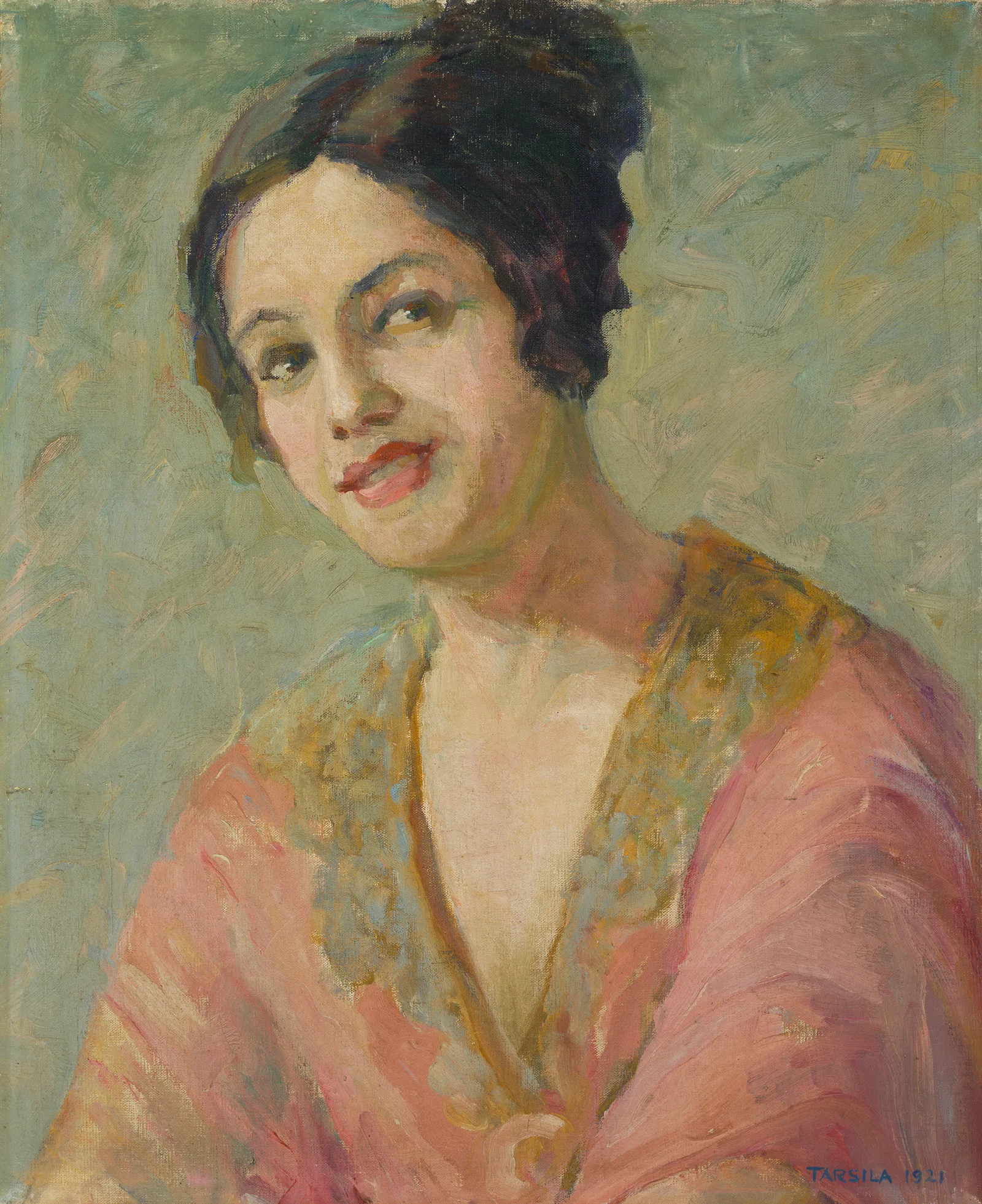
Early life and training, from São Paulo to Paris
Tarsila do Amaral was born on September 1, 1886, in Capivari (in what is now the town of Rafard), in the state of São Paulo, into a family of coffee farmers. She began formal painting studies in São Paulo in 1916, after early private training under the painter Pedro Alexandrino Borges in her hometown.
In 1920 she moved to Paris and enrolled at the Académie Julian, where she studied until 1923. During a brief return to Paris in 1929 she studied under the Cubist painters André Lhote, Fernand Léger, and Albert Gleizes — a period that sharpened her work's formal discipline: the simplified, sculptural way she organizes a canvas, whatever the subject.
Return to Brazil and the Grupo dos Cinco
Tarsila did not attend the Semana de Arte Moderna, the exhibition held in São Paulo in February 1922 that is usually cited as the founding event of Brazilian Modernism — she was still in Paris. She returned to São Paulo later that year and met Anita Malfatti, Oswald de Andrade, Mário de Andrade, and Menotti Del Picchia, forming the circle that became known as the Grupo dos Cinco.
Between 1923 and 1926, in the phase now called Pau-Brasil (named after Oswald de Andrade's 1924 poetry collection), her painting turned toward Brazilian landscape and everyday life rather than European academic subjects — works such as A Negra (1923), São Paulo (1924), and Morro da Favela (1924). She held her first solo exhibition at the Galerie Percier in Paris in 1926.
Abaporu and the Antropofagia movement
In January 1928, Tarsila painted Abaporu — oil on canvas, 85 x 73 cm — as a birthday gift for Oswald de Andrade, her husband at the time. The title, chosen by Oswald de Andrade together with the poet Raul Bopp from Tupi-language roots, means roughly "man who eats." The image is stark: a solitary, distorted figure with an oversized foot, seated beside a cactus under a hard sun.
The painting itself, not a text Tarsila wrote, is what launched the movement she is best known for: it directly inspired Oswald de Andrade's Manifesto Antropófago, published later in 1928, and gave the Antropofagia movement (1928-1929) both its name and its central idea — that Brazilian culture should absorb outside influence and transform it, rather than imitate it. Abaporu now belongs to MALBA, the Museo de Arte Latinoamericano de Buenos Aires, which acquired it in 1995 when Argentine collector Eduardo Costantini bought it at a Christie's auction in New York for US$1.4 million, a record at the time for a work by a Brazilian artist.
Where to see Tarsila do Amaral's work today
Abaporu, Tarsila's most famous painting, is part of the permanent collection of MALBA in Buenos Aires. In Brazil, MASP — the Museu de Arte de São Paulo Assis Chateaubriand — holds an earlier work, her 1921 self-portrait Autorretrato com vestido laranja, on loan from the country's Central Bank.
The two paintings sit almost a decade apart and show how far her language traveled: the 1921 self-portrait is careful, academic, still finding its footing; Abaporu, seven years later, is the stripped-down, unmistakably Brazilian image that gave a movement its name.
From the studio
From the atelier
I keep coming back to Tarsila's Pau-Brasil years for one specific reason: she treated Brazilian material — red earth, a cactus, a solitary figure under a hard sun — as subject enough on its own, without needing a European reference to validate it. I don't paint figures, and my training is architecture, not the Cubist discipline she absorbed in Paris. But the instinct to trust the raw material of a place is the same one behind Quartz Seam, where the composition is built from where the pigment cracks and where the gold settles into the fracture, rather than from a drawing planned in advance.
What I take from her example isn't the palette — hers is tropical and high-contrast, mine sits in dustier, mineral tones. It's the permission to let the surface itself carry the argument. A painting doesn't need a borrowed vocabulary to be serious; it needs to be honest about the matter it is made of.
Frequently asked
When and where was Tarsila do Amaral born?
Tarsila do Amaral was born on September 1, 1886, in Capivari (in what is now the town of Rafard), in the state of São Paulo, Brazil. She died on January 17, 1973, in São Paulo.
What is Abaporu, and why is it her most famous work?
Abaporu is an oil painting on canvas, 85 x 73 cm, that Tarsila painted in January 1928 as a birthday gift for her husband at the time, the writer Oswald de Andrade. Its title comes from Tupi-language roots meaning roughly 'man who eats.' The painting is her most famous work because it directly inspired Oswald de Andrade's Manifesto Antropófago later that year, launching the Antropofagia movement that shaped how Brazilian Modernism absorbed and transformed outside influence. Abaporu now belongs to MALBA, in Buenos Aires, which acquired it in 1995 when collector Eduardo Costantini bought it at a Christie's auction in New York for US$1.4 million, a record at the time for a work by a Brazilian artist.
What was Tarsila's role in Brazilian Modernism?
Tarsila was one of the central figures of Brazilian Modernism, though she did not attend the movement's founding event, the Semana de Arte Moderna of February 1922 — she was still in Paris at the time. After returning to São Paulo later that year, she joined Oswald de Andrade, Mário de Andrade, Menotti Del Picchia, and Anita Malfatti to form the Grupo dos Cinco. Her Pau-Brasil paintings of the 1920s, and later Abaporu, helped define a modern visual language built from Brazilian material rather than imported European convention.
Did Tarsila study art in Europe?
Yes. After early private training under the painter Pedro Alexandrino Borges in Brazil, Tarsila moved to Paris in 1920 and studied at the Académie Julian until 1923. During a brief return to Paris in 1929 she also studied under the Cubist painters André Lhote, Fernand Léger, and Albert Gleizes, absorbing a formal discipline that shows up throughout her later, distinctly Brazilian work.
Where can you see Tarsila do Amaral's work today?
Her best-known painting, Abaporu (1928), belongs to the permanent collection of MALBA, the Museo de Arte Latinoamericano de Buenos Aires, which acquired it in 1995 at a Christie's auction in New York. In Brazil, MASP (Museu de Arte de São Paulo Assis Chateaubriand) holds an early self-portrait from 1921, on loan from the country's Central Bank.
Sources
- Wikipedia (Tarsila do Amaral entry) — 2026-08-24
- Wikipedia (Tarsila do Amaral entry) — 2026-08-24
- Wikipedia (Tarsila do Amaral entry) — 2026-08-24
- Wikipedia (Abaporu entry) — 2026-08-24
- Wikipedia (Abaporu entry) — 2026-08-24
- Wikipedia (Abaporu entry) — 2026-08-24
- MASP - Museu de Arte de São Paulo Assis Chateaubriand — 2026-08-24
- Perfeito Studio - obras catalog (non-draft) — 2026-08-24
See Quartz Seam, from the Terra & Ether series
One original, one signature. Write to the atelier for detail photos, dimensions on your wall, and acquisition details.
Talk to the studio on WhatsApp
Published on