Artists similar to Tarsila do Amaral
Tarsila do Amaral (1886-1973) remains the defining figure of Brazilian modernism, known above all for Abaporu (1928), the painting that inspired the Manifesto Antropófago. No painter occupies her historical place today, but her territory — Brazilian land, color as structure, a modern language built from local material — still draws contemporary artists, in Brazil and beyond.
Who was Tarsila do Amaral
Tarsila do Amaral was born on September 1, 1886, in Capivari (in what is now the town of Rafard), in the state of São Paulo, and died in São Paulo on January 17, 1973. She trained first in academic painting before moving to Paris in 1920, where she studied with the Cubists André Lhote, Fernand Léger, and Albert Gleizes — a period of formal discipline that shows up throughout her mature work, in the simplified, sculptural way she organizes a canvas.
She returned to São Paulo in the 1920s and became, alongside her partner Oswald de Andrade, one of the central figures shaping a modern visual language built from Brazilian material rather than imported from Europe.
Pau-Brasil and Antropofagia: the two movements that define her
Amaral's mature work runs through two named phases. The Pau-Brasil period, roughly 1923 to 1926, took its name from the manifesto Oswald de Andrade published in 1924, calling for a Brazilian art built from national landscape, color, and everyday life rather than European academic convention — railways, hillside towns, and rural scenes rendered in the simplified, toy-like forms she had learned in Paris.
The Antropofagia (Anthropophagy) phase followed, from 1928 to 1929, and takes its name from the Tupi word for a person who eats human flesh. It began with a single painting: Abaporu, which Amaral gave to Oswald de Andrade as a birthday present in January 1928 and which directly inspired his Manifesto Antropófago later that year — the proposal that Brazilian culture should absorb outside influence and transform it into something new, rather than imitate it.
Abaporu: the painting that changed Brazilian art
Abaporu is a small painting — oil on canvas, 85 x 73 cm — of a solitary, distorted figure with an oversized foot and a tiny head, seated on a green plain beside a single flowering cactus. Amaral painted it in January 1928.
It now belongs to the Museo de Arte Latinoamericano de Buenos Aires (MALBA), which acquired it in 1995 when Argentine collector Eduardo Costantini bought it at a Christie's auction in New York for US$1.4 million — at the time, a record price for a work by a Brazilian artist. The title comes from Tupi: aba (man) plus poru (who eats), the fusion that gave Oswald de Andrade's manifesto both its name and its central image.
Contemporary artists working in adjacent territory
There is no living painter who occupies Tarsila do Amaral's historical position — she named a movement, and movements aren't repeated. But some contemporary artists work in adjacent territory, treating Brazilian color and material as structure rather than decoration.
The São Paulo Museum of Art (MASP) names Amaral as one of the reference points for contemporary painter Beatriz Milhazes, alongside Sonia Delaunay, Bridget Riley, and Ione Saldanha — artists MASP links to Milhazes's own investigation of pattern, color, and Brazilian visual culture. Comparisons like that one are about procedure, not stature: what a painter does with color and local material, not how their historical importance measures up. It is the same lens worth applying to anyone working with land, pigment, and Brazilian identity today, including outside the gallery system — in ateliers producing new work in direct dialogue with that same territory.
From the studio
From the atelier
I don't work anywhere near Tarsila do Amaral's language — she painted figures, and I don't paint figures at all. But there is a point of contact worth naming honestly: her Pau-Brasil period turned Brazilian land into the actual subject of the painting, not a backdrop for something else.
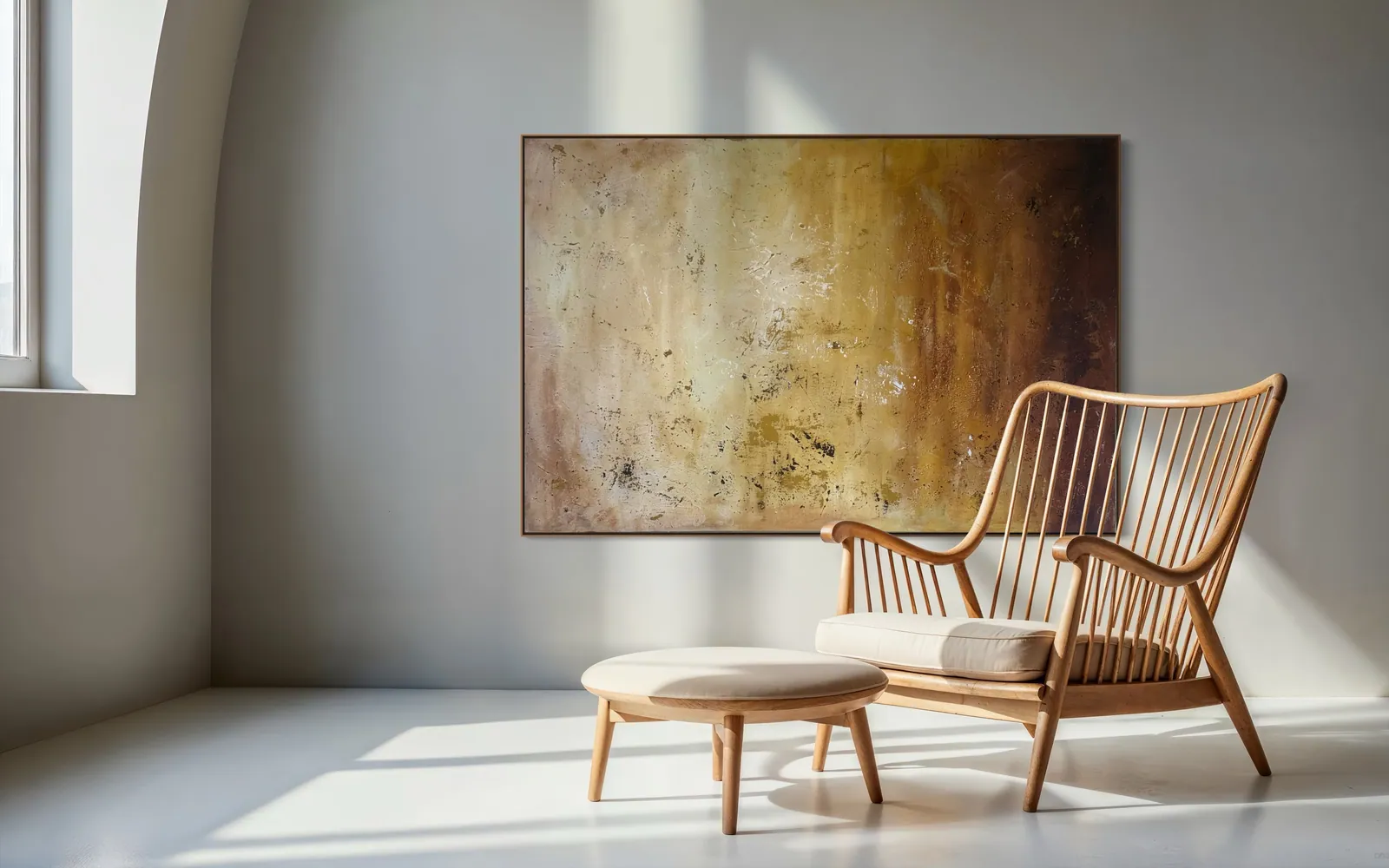
In Amber Strata, from the Terra & Ether series, I'm doing something structurally similar with different tools — no figure, no narrative, just horizontal passages of ochre, bone, and oxidized umber built up until the canvas reads less like a picture of a landscape and more like a cross-section of one. That's the architect in me: treating the surface as something built in layers, the way a stratum is built, rather than illustrated. It isn't Tarsila's palette — hers is bright, tropical, contrastive; mine sits in a narrower, warmer register — but it's the same basic decision: let the land organize the composition instead of a subject sitting on top of it.
Frequently asked
What makes Tarsila do Amaral's style distinct in Brazilian modernism?
Her style comes from combining two things that don't usually travel together: rigorous Cubist training from her years studying in Paris with André Lhote, Fernand Léger, and Albert Gleizes, and a deliberate turn toward Brazilian subject matter — landscapes, rural towns, and figures rendered in simplified, almost toy-like forms. The Pau-Brasil manifesto that named her early phase called for exactly this: a modern art built from national material rather than imported from Europe. That combination, formal discipline plus local subject, is what separates her from both academic Brazilian painting and European Cubism itself.
Are there contemporary Brazilian painters working with similar color and land-inspired themes?
Yes, though no single painter occupies Tarsila do Amaral's historical position. The São Paulo Museum of Art (MASP) names her as one of the reference points for contemporary painter Beatriz Milhazes, alongside Sonia Delaunay, Bridget Riley, and Ione Saldanha — artists linked by an interest in pattern, color, and Brazilian visual culture rather than by shared style. Beyond named institutional comparisons like that one, land and material as subject remain an active line of investigation for painters working in Brazil today, including outside the traditional gallery system.
Is Tarsila do Amaral's work abstract or figurative?
Figurative. Even at her most stylized — the elongated limbs and simplified forms of Abaporu are the clearest example — Tarsila do Amaral kept recognizable subjects: figures, landscapes, plants, everyday scenes. Her Cubist training shows up in how she simplifies and organizes those subjects, not in abandoning them for pure abstraction. That places her closer to figurative modernists like Fernand Léger, one of her Paris teachers, than to fully abstract painters of the same period.
What movement is Tarsila do Amaral associated with?
Two, in sequence. Her Pau-Brasil phase (roughly 1923-1926) took its name from Oswald de Andrade's 1924 manifesto and focused on Brazilian landscape and everyday life. Her Antropofagia (Anthropophagy) phase (1928-1929) followed, launched by a single painting — Abaporu, which she gave Oswald de Andrade as a gift in January 1928 — and which directly inspired his Manifesto Antropófago, the document that gave the broader Anthropophagic Movement its name and its central idea: absorbing outside influence and turning it into something distinctly Brazilian.
Where can you see Tarsila do Amaral's major works today?
The clearest answer concerns her single most famous painting: Abaporu (1928), part of the collection of the Museo de Arte Latinoamericano de Buenos Aires (MALBA). MALBA acquired the work in 1995, when Argentine collector Eduardo Costantini bought it at a Christie's auction in New York for US$1.4 million — a record at the time for a painting by a Brazilian artist. It remains one of the museum's signature holdings.
Sources
- Wikipedia (Tarsila do Amaral entry) — 2026-08-07
- Wikipedia (Abaporu entry) — 2026-08-07
- Google Arts & Culture, in partnership with MALBA — 2026-08-07
- MASP — Museu de Arte de São Paulo — 2026-08-07
See Amber Strata, from the Terra & Ether series
One original, one signature. Write to the atelier for detail photos, dimensions on your wall, and acquisition details.
Talk to the studio on WhatsApp
Published on