Who was Hilma af Klint
Hilma af Klint (1862–1944) was a Swedish painter who began working abstractly in her Stockholm studio in November 1906, roughly five years before Wassily Kandinsky's first abstract work. She kept almost all of her abstract paintings out of public view during her lifetime; she is now widely recognized as a pioneer of abstraction in Western art.
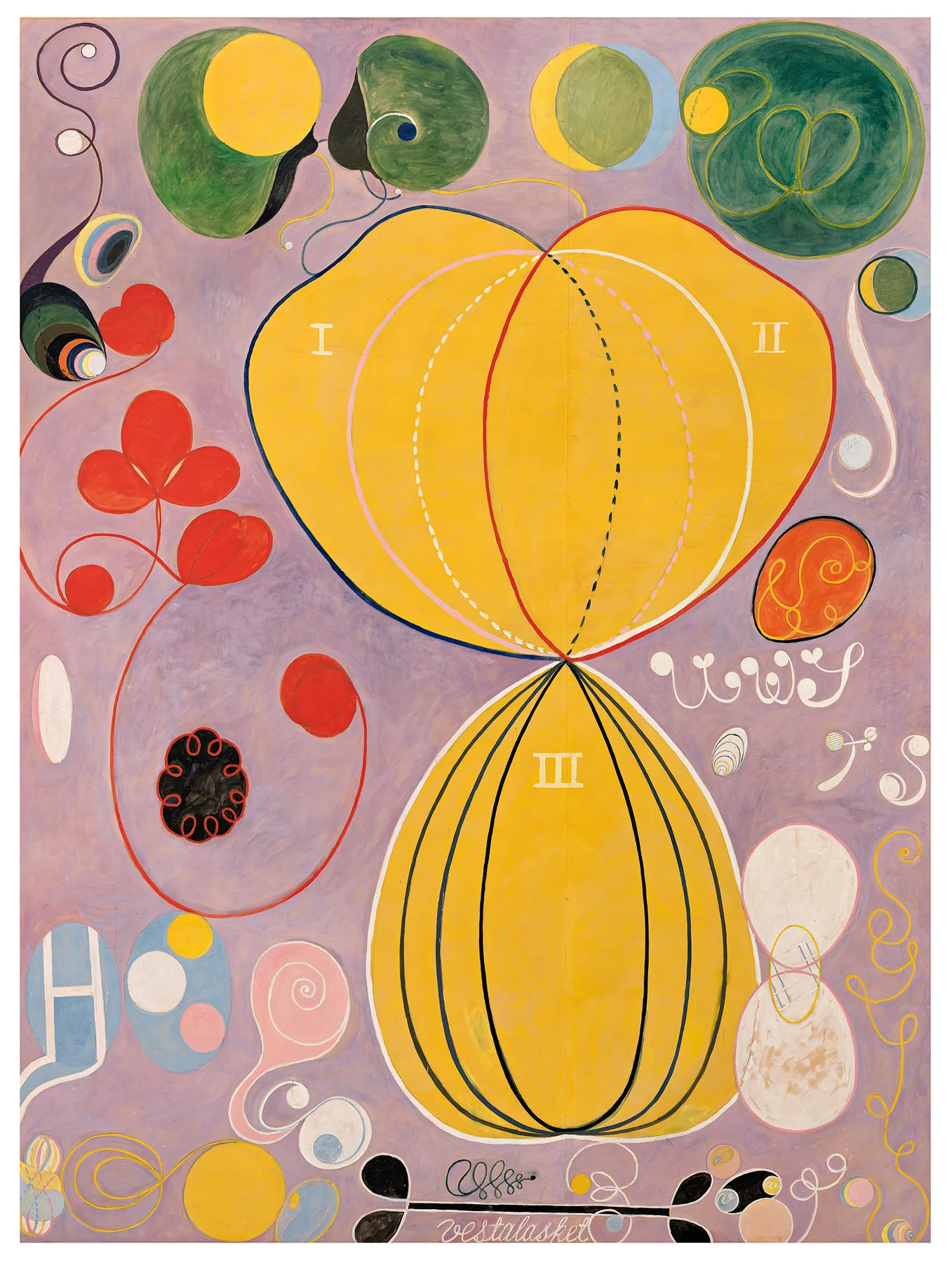
A Stockholm Studio, November 1906
Hilma af Klint graduated with honors from the Royal Academy of Fine Arts in Stockholm in 1887, after five years of study in portrait painting, botanical drawing and landscape. She kept a studio in the city's artists' quarter and made a conventional living from that training for two decades. In November 1906, at forty-four, she began a sequence of twenty-six small canvases she called Primordial Chaos — spirals, loops and unplanned lines, with no model, no preparatory sketch, and no precedent in anything she had painted before. She worked on the series until March 1907.
The shift was not gradual. Af Klint later described painting under guidance she attributed to spiritual “High Masters” contacted through the séance practice she had taken up as a teenager. Whatever the source, the paintings themselves mark one of the earliest known instances of a Western artist working without any figurative or landscape subject at all.
Paintings for the Temple: A System, Not a Single Canvas
Primordial Chaos opened a larger project af Klint called Paintings for the Temple — 196 individual paintings and works on paper, made across two phases (1906–1908, then 1912–1915) and organized into named groups rather than produced as standalone pieces. The best-known group, The Ten Largest (1907), comprises ten monumental compositions in oil, tempera and paper, each tracing a stage of human life from childhood through old age using a private vocabulary of circles, spirals and looping script.
Af Klint intended the Temple paintings as a connected argument, not decoration: read as a sequence, the groups chart a spiritual cosmology she believed underlay the visible world. The name comes from her stated intention to install the full cycle in a spiral-shaped temple that was never built.
Why the Paintings Stayed Hidden
Af Klint did not exhibit this body of work. By the time of her death in 1944, she had shown none of her abstract paintings in any exhibition. Her will instructed her nephew, Vice Admiral Erik af Klint, to keep the collection sealed for at least twenty years after her death — she believed the world was not yet prepared to understand what the paintings meant.
The crates were not properly opened, catalogued and studied until the late 1960s -- roughly a quarter century after her death in 1944, and a few years past the twenty-year seal she had set in her will. For most of the twentieth century, paintings that predate Kandinsky's breakthrough by roughly five years were simply absent from the story anyone was telling about the origins of abstract art.
From a Sealed Archive to the Guggenheim's Most-Visited Show
The Hilma af Klint Foundation, based in Stockholm, today holds and manages more than 1,200 paintings and 125 notebooks from her estate. Moderna Museet, Sweden's national museum of modern art, keeps a permanent Hilma af Klint room where works from the collection are on long-term view.
Wider recognition came late and fast. The Solomon R. Guggenheim Museum's 2018–2019 retrospective, Hilma af Klint: Paintings for the Future, drew more than 600,000 visitors between October 12, 2018 and April 23, 2019 — the highest attendance ever recorded for a single exhibition in the museum's history. It was the show that moved af Klint from a footnote to a name most audiences interested in abstraction now recognize on sight.
From the studio
The Atelier's Perspective
I come back to af Klint most when I'm partway through one of my own series rather than looking at a single finished canvas. I currently keep five running at once — Heart of Chaos, Matter & Silence, Luminous Rebirth, Black & Gold, Terra & Ether — and a piece from any of them only fully makes sense next to the others in its group, the way one of af Klint's Ten Largest only reads completely alongside the other nine. That's a working method before it's anything else: you commit to a system, not a single image, and you trust the individual canvas will be read in relation to what surrounds it.
Veil of Light, from my Luminous Rebirth series, is the piece closest to what stops me in her work — a single vertical column of blue I built to behave less like color and more like climate, the way af Klint used circles and spirals as something closer to notation than illustration. I don't share her belief that the paint was carrying instructions from elsewhere. But the working premise underneath it — that an abstract field can hold specific, felt content rather than function as decoration — is the same premise I'm testing every time I start a new canvas here in the studio in Brasília.
There's also a plainer thing I think about: af Klint painted The Ten Largest at forty-five, working from a private system she trusted enough to keep building for another eight years without showing it to anyone. That's the part of her example that stays useful in the studio day to day — not a promise about how any particular body of work turns out, but a reminder that the discipline of finishing the next canvas in a series doesn't need an audience's verdict to be worth doing.
Frequently asked
Why is Hilma af Klint now called a pioneer of abstract art?
Because she began painting non-representational compositions in November 1906, roughly five years before Wassily Kandinsky's first fully abstract work in 1911 -- the artist usually credited with originating abstraction in Western art history. Once her sealed archive became accessible and reached wide public attention through the Guggenheim's 2018-2019 retrospective, art historians revised the standard account: af Klint, not Kandinsky, appears to be the first artist in the West to paint without reference to a visible subject.
Why weren't Hilma af Klint's paintings shown publicly during her lifetime?
She kept them almost entirely out of public view. By the time of her death in 1944 she had not shown her abstract works in any exhibition. In her will, she instructed her nephew, Erik af Klint, to keep the collection sealed for at least twenty years after her death -- a condition tied to her belief, shaped by Theosophy and Spiritualism, that the world was not yet ready to understand what the paintings meant. The crates were not properly opened and studied until the late 1960s.
What is the 'Paintings for the Temple' series?
It is the body of work af Klint produced between 1906 and 1915, in two phases separated by a break from 1908 to 1912. It totals 196 paintings and works on paper, organized into groups such as Primordial Chaos and The Ten Largest. Rather than single artworks, af Klint conceived them as a connected visual system charting stages of spiritual and human development -- intended, by her own account, for an unbuilt spiral temple, which is why the series carries that name.
Did Hilma af Klint predate Kandinsky's abstract work?
Yes, by the dating now generally accepted. Her Primordial Chaos series was painted between November 1906 and March 1907 in her Stockholm studio -- about five years before Wassily Kandinsky produced his first fully abstract composition in 1911. Kandinsky remains the artist historically credited with founding abstraction, largely because his work was public from the start and af Klint's was not; but on the surviving dates, her non-representational paintings came first.
Where can you see Hilma af Klint's paintings today?
Her archive, more than 1,200 paintings and 125 notebooks, is held by the Hilma af Klint Foundation in Stockholm. Moderna Museet, the Swedish national museum of modern art, maintains a permanent Hilma af Klint room where works from the collection are on long-term display. Her paintings also travel internationally for major exhibitions, including the Guggenheim Museum's 2018-2019 retrospective 'Paintings for the Future,' which drew more than 600,000 visitors and became the most-visited show in the museum's history.
See Where Alyne Perfeito Takes Abstraction Next
Veil of Light, from the Luminous Rebirth series, shares af Klint's instinct for color as atmosphere rather than illustration. Original, signed, with a Certificate of Authenticity.
Sources
- Tate Etc. (Tate) — 2026-08-03
- Wikipedia — 2026-08-03
- Art & Object — 2026-08-03
- Wikimedia Commons — 2026-08-03
- Perfeito Studio -- internal catalog source — 2026-08-03
Published on