How artists get into galleries and museums
Galleries, prizes, and museums do not discover artists at random — each runs on a specific mechanism: a studio visit, a jury of nominators, a committee weighing a purchase fund against a donor's gift. None of these institutions certifies quality on their own; they are lagging signals that a body of work already had visibility.
The realistic routes into a gallery
A gallery deciding to represent an artist is a separate question from an artist selling well — and the paths galleries actually use to find people are narrower than most artists expect. Reporting on the gallery system consistently points to the same handful of channels: a referral from an artist or collector already inside the gallery's circle, a studio visit that the gallery itself initiates, and visibility earned at art fairs or institutional group shows. A gallery testing the relationship by including an artist in a group show before any exclusive arrangement is also a common intermediate step. For a fuller look at what representation itself means once it happens, see how an artist is represented by a gallery — this page is about the path there, not the arrangement itself.
Unsolicited portfolios and open calls exist, but the trade itself is candid about their limits: galleries that do accept open submissions typically reserve them for one-off group or digital shows, and gallerists interviewed on the subject have said plainly that cold submissions rarely convert into representation. That is not a reason to withhold work from view — it is a reason to expect visibility, not a portfolio email, to do the work.
Residencies, open calls, and prizes: what they actually change
Artist residencies typically run on a juried open call: an organization advertises a period in a studio or shared space, often ranging from a few weeks to several months, and a jury selects from applicants based on the work submitted. What a residency changes is concrete but limited — time, space, sometimes a stipend, and contact with visiting curators or critics who might not otherwise see the work. It does not by itself produce a sale or a gallery contract; it produces exposure to people positioned to act on it later.
Prizes and juried open calls work on a similar logic, and Brazil has a well-documented example in the PIPA Prize, run by Instituto PIPA since 2010. Artists cannot apply directly — a rotating nominating committee of roughly 20 to 30 contemporary art professionals each proposes up to three artists whose careers began within the previous 15 years, and a board then selects finalists and winners from that shortlist. Being named is not a purchase and does not require gallery representation; it is a professional peer-review process that produces a public record.
Art fairs add a third, adjacent route: dedicated sections for younger or newer practices, distinct from a fair's main program of established gallery booths. SP-Arte, one of Latin America's largest fairs, runs a Showcase sector built specifically around a small number of emerging artists each edition. None of these three mechanisms — residency, prize, or fair section — substitutes for gallery representation or museum acquisition; each simply adds a layer of documented, peer-reviewed visibility that later decision-makers can point to.
How museums acquire work — and why that matters to the market
Museum acquisition is rarely a single curator's decision. The typical path starts with a curator — through a studio visit, a gallery exhibition, a biennial, or a recommendation from a collector or fellow curator — who researches the artist and proposes the acquisition internally. From there it moves to an acquisition or collections committee, usually made up of museum leadership, trustees, and curatorial staff, who review provenance, condition, and cost before approving. Larger proposals can take months to finalize.
Funding for the purchase itself comes from one of a few sources: a dedicated acquisition fund or endowment, a specific donor underwriting the purchase, or an outright gift — a work donated directly by a collector or the artist, sometimes through a bequest. Some museums also run patron or acquisition circles, where a group of donors pools funds annually and has input on what the museum buys. What almost never happens is a museum acquiring a work with no prior context: curators consistently report that acquisitions follow existing visibility — a gallery show, a biennial, a residency, a body of critical or curatorial attention — rather than creating that visibility from nothing. A related curatorial channel worth knowing about, separate from institutions entirely, is how to find emerging artists before representation.
What this means for a collector reading an artist who has none of it yet
Put together, the picture is straightforward: gallery representation, residencies, prizes, and museum acquisition are downstream of a documented, visible body of work — not gatekeepers who decide from scratch whether that work has merit. An artist with none of these credentials is not disqualified from being worth collecting; they are, definitionally, earlier in a sequence that most artists who eventually reach those institutions also once had not yet reached.
For a collector, the honest reading of an artist without a gallery, prize, or museum history is that the market has not yet priced in outside validation — not that the validation was sought and denied. What is available to check instead is what the artist controls directly: a coherent, named body of work; consistent documentation per piece; and a price that reflects direct-from-studio sale rather than a gallery margin. None of that predicts future institutional recognition, and no honest account of the art market should promise appreciation as a result of buying early — but it is the real, verifiable information available before any of the mechanisms above have had time to act.
From the studio
From the studio
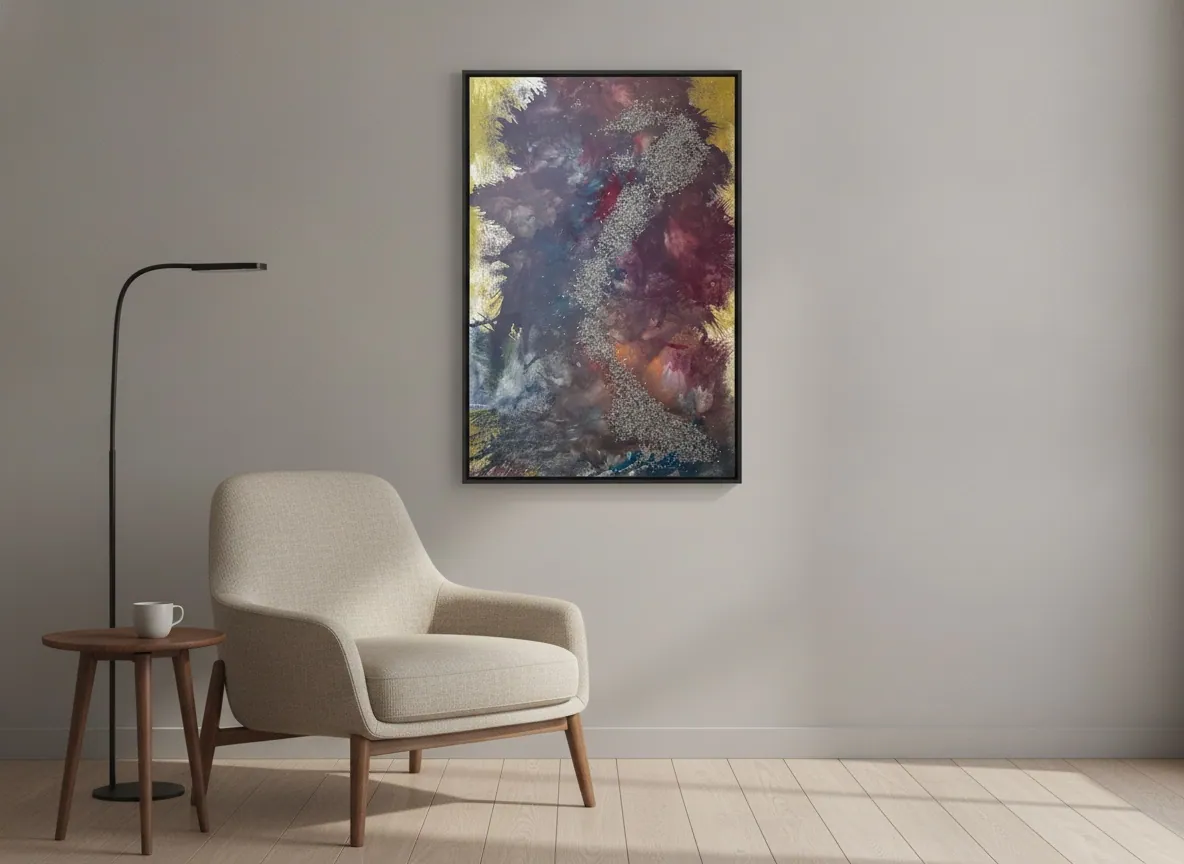
I have no residency, no prize, no exhibition history, no biennial, and no gallery — and no application in progress toward any of it. I am not going to write around that. What I am doing instead is building the kind of record that would make sense to a curator or a committee if that conversation ever happens: five series with a coherent line of investigation running through them — Heart of Chaos, Matter & Silence, Luminous Rebirth, Black & Gold, and Terra & Ether — each piece unique, numbered with its own Archive ID from the very first work forward, and documented individually with a certificate, a curatorial dossier, and a conservation guide.
The training I bring to this is architecture, not an art degree, and it shows in how I think about a piece before I finish it — scale against a wall, how a surface holds or interrupts light in a room, not just how it reads in a photograph. I publish prices for the same reason I publish the Archive ID system: because an early-career artist selling directly has nothing to hide behind, and I would rather a collector know exactly what they are getting and exactly what stage I am at than infer either from silence.
Frequently asked
Does an artist need a gallery to be worth collecting?
No. A gallery is a distribution and promotion arrangement, not a certification of quality — it changes how a work is sold, not whether it deserves to be. Plenty of significant collections include work bought directly from an artist's studio before any gallery was involved. What a gallery does add is vetting, in-person viewing, and program support; what it does not add is a guarantee the work itself did not already have.
Can an artist apply directly to a museum to have work acquired?
Generally no. Museum acquisitions almost always originate with a curator who already has some awareness of the work — through a gallery show, a residency, a fair, or a recommendation — and are then approved by a committee. A cold approach with no prior visibility rarely leads anywhere, which is why visibility through other channels tends to come first.
What does winning or being nominated for a prize like PIPA actually get an artist?
Public, peer-reviewed visibility and a documented professional record — a nominating committee of art professionals proposing the artist, inclusion in a catalog, and for finalists, exhibition and cash recognition. It does not itself produce a gallery contract or a museum acquisition, but it is the kind of credential curators and collectors do notice.
Are open calls and unsolicited portfolios a good way to get gallery representation?
They are one of the least effective routes, by the gallery world's own account. Galleries that accept open submissions usually reserve them for one-off group shows rather than ongoing representation. Referral, a gallery-initiated studio visit, and visibility from fairs or institutional shows are the channels that most often actually lead to representation.
Does Alyne Perfeito have a gallery, residency, or museum acquisition?
No, none of the three, and there is no application for any of them in progress. She sells directly from the studio, at an early-career stage, with full documentation per piece — a certificate, a curatorial dossier, a conservation guide, and an Archive ID — in place of an institutional track record.
Sources
- About PIPA Prize — PIPA Prize
- PIPA Prize | Wikipedia
- SP-Arte Tracks Rising Artists in Brazil | Newcity Brazil
- How Museum Acquisitions Work for Living Artists | Mallory Shotwell
- Two Brazilian curators selected to organise 2027 Bienal de São Paulo | The Art Newspaper
- São Paulo Bienal announces 2025 theme and curatorial team | Artsy
- How Do Galleries Choose Artists to Represent? | Artsy
Want to see where a piece from the archive fits before deciding?
No gallery in between — I answer questions about any piece directly, before you buy.
Talk to the studio on WhatsApp
Published on