Contemporary artists similar to Cy Twombly
“Similar to Twombly” is a question of procedure, not reputation: which artists build large marks that read as handwriting rather than drawing -- looping, scribbled lines laid over raw or pale ground. Verified names sharing that vocabulary include Julie Mehretu, Christopher Wool, and, in Brazil, Manabu Mabe.
What makes Twombly's mark-making distinctive
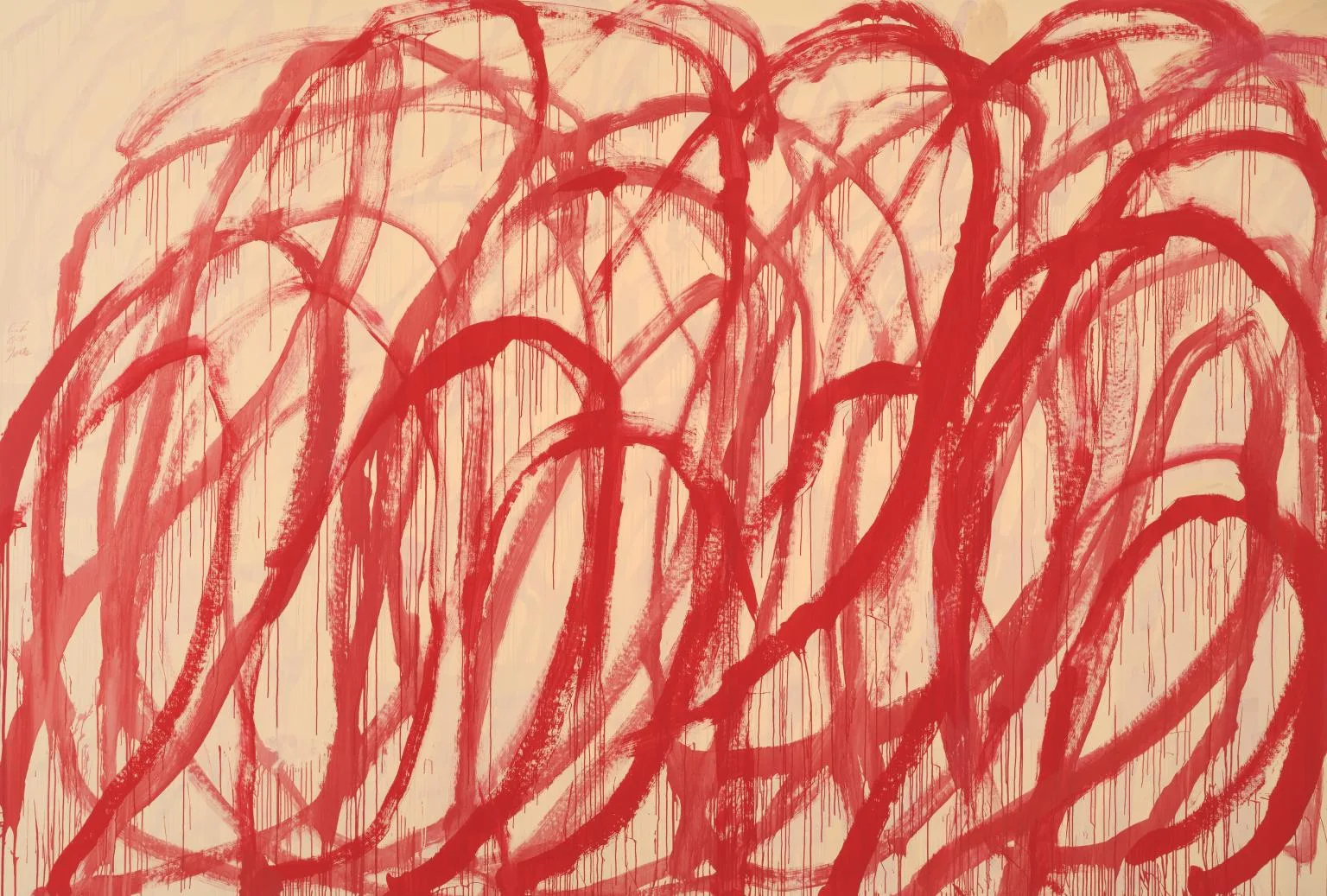
Cy Twombly (1928-2011) built his mature vocabulary out of a refusal of the drawn, resolved line. Early exposure to the New York School stripped the figurative element from his painting, and after he moved to Italy in 1957 he began adding graffiti-like pencil marks to his canvases -- a shift that, as Tate's own account of his work puts it, introduced "elements of hesitancy and fragility into the confident physical gestures of abstract expressionist painting." The result is a hand that reads as writing rather than depiction: looping, scribbled lines in graphite or paint, laid over raw or pale ground, often crossed by fragments of classical text -- a line from Homer, a name from myth.
The physical scale of that gesture is easiest to see in the Bacchus paintings. In the summer of 2005, working from Homer's Iliad, Twombly painted a cycle of eight canvases in vermilion on the ecstasy and violence of the Roman god. Three later paintings, dated 2006-8, extended that first campaign; their unfurling red loops were made, in the same way as Matisse's large drawings for the chapel at Vence, with a brush affixed to the end of a pole, which accounts for their vitality and scale. The Cy Twombly Foundation gave these three paintings to Tate in 2014, together with five bronze sculptures (1979-91), honoring the artist's own wish after his 2011 death and his major 2008 retrospective at Tate Modern.
Black Mountain College: the teachers behind the vocabulary
Twombly's formal training is compact and well documented by his own foundation. He met Robert Rauschenberg at the Art Students League in New York in 1950, and on Rauschenberg's encouragement attended summer and winter semesters at Black Mountain College, North Carolina, in 1951, where Ben Shahn, Robert Motherwell, and the poet Charles Olson were the artists in residence that year. Shahn took a particular interest in the young painter, and Twombly became, by the Foundation's own account, his favourite pupil that year. Motherwell, by contrast, commented little on Twombly's work beyond remarking that he had nothing to teach him. Twombly also studied photography at Black Mountain alongside Rauschenberg. In the fall of 1952 he left New York, sailing for Europe and North Africa with Rauschenberg on a travelling scholarship from the Virginia Museum of Fine Arts -- the trip that set the pattern of a life split between the United States and Italy, where he eventually settled.
Contemporary artists working in comparable gestural, calligraphic territory
Two living painters are named most consistently for building large-scale abstraction out of a comparably physical, writing-like gesture, though each works in a different register from Twombly's classical scrawl. Julie Mehretu (b. 1970, Ethiopia), whose paintings are held by the Whitney Museum of American Art among other institutions, builds the layered depth of her canvases from ink, pigment, and thin acrylic sheets that are overlaid and sanded down, combined with etched lines and chine-collé printmaking that let her embed imagery in thin layers of paper -- a mark-making closer to architectural drafting than to Twombly's loops, but sharing the same commitment to accumulated, gestural layers read at a distance. Christopher Wool (b. 1955), also held by the Whitney, became known for a freehand looping line applied with a spray gun over black enamel on chalky white aluminum panels; in his later work he alternates between drawing and erasing, wiping away sprayed enamel with solvent-soaked rags to build tangled lines and hazy washes. The Solomon R. Guggenheim Museum gave Wool a full retrospective from October 2013 to January 2014.
Where to see Twombly's work today
The single most complete encounter with Twombly's work is a building made for it: the Menil Collection in Houston opened the Cy Twombly Gallery in 1995, a structure the artist helped design with architect Renzo Piano to hold his paintings, drawings, and sculpture under diffused, Mediterranean-toned natural light. In London, Tate Modern permanently displays the three late Bacchus paintings and five bronze sculptures the Cy Twombly Foundation gave the museum in 2014. In the United States, the Art Institute of Chicago also holds several of his paintings across different decades, including Sperlonga (1959) and the two-part Return from Parnassus (1961), searchable through the museum's public collection database.
From the studio
From the studio
What I recognize in Twombly's procedure isn't the classical references -- it's the decision to let a mark stay a mark instead of resolving it into a shape. Celestial Drift, from the Luminous Rebirth series, is built the same way at a much smaller scale: a diagonal current of blue and ivory laid down close to full speed, then a second pass over it while the first was still workable, so the layers stay visible instead of blending into one flat color. I don't work with a brush on a pole the way Twombly did for Bacchus, but the underlying question is one every gestural painter answers by hand -- how much control to give up before the mark stops being yours.
I have no institution behind this comparison, and I'm not claiming kinship with Twombly's stature, only with a working question every painter using gesture has to answer for themselves, piece by piece.
Frequently asked
What makes Cy Twombly's work distinctive?
His mature paintings read as handwriting rather than depiction: looping, scribbled marks in graphite or paint, often crossed by fragments of classical text, laid over raw or pale canvas instead of being resolved into drawn shapes. After early exposure to the New York School stripped the figurative element from his work, Twombly moved to Italy in 1957 and began adding graffiti-like pencil marks, giving the confident physical gesture of Abstract Expressionism a more hesitant, fragile edge -- the tension between control and accident that defines his mature canvases.
Is Cy Twombly considered abstract expressionist?
Not straightforwardly. Twombly trained alongside Abstract Expressionist painters and absorbed their gestural energy, but he is generally placed a step apart from the movement's core generation. Together with Robert Rauschenberg and Jasper Johns, he is regarded as one of the most important artists of a subsequent generation that distanced itself from Abstract Expressionism, folding classical text and drawing into a more fragile, hesitant mark than the confident gesture of earlier Abstract Expressionist painters.
Which contemporary artists use similarly gestural, calligraphic marks?
Two are named most consistently. Julie Mehretu builds layered, architectural mark-making from ink, acrylic, and etched printmaking lines, held by the Whitney Museum of American Art among other institutions. Christopher Wool is known for a freehand looping line applied with a spray gun over black enamel, the subject of a full Guggenheim retrospective from October 2013 to January 2014. Neither works in Twombly's classical, text-inflected vocabulary directly, but both share his commitment to a large-scale mark that reads as gesture rather than as resolved, drawn form.
Where can you see Cy Twombly's work today?
The most complete encounter is the Cy Twombly Gallery at the Menil Collection in Houston, a dedicated building the artist helped design with architect Renzo Piano, which opened in 1995. Tate Modern in London permanently displays the Bacchus paintings and bronze sculptures the Cy Twombly Foundation gave the museum in 2014. In the United States, the Art Institute of Chicago also holds several of his paintings from different decades of his career, searchable through its public collection database.
Are there Brazilian artists working in a comparable gestural language?
Manabu Mabe (1924-1997), a Japanese-Brazilian painter based in São Paulo, is the clearest example: critics describe his mature paintings as combining broad, decisive gestures and passages of color with forms drawn from Japanese calligraphy, a synthesis that won him the best national painter award at the 1959 São Paulo Bienal. His work now belongs to museums including the Museu de Arte Contemporânea in São Paulo and the Museu de Arte Moderna do Rio de Janeiro.
Sources
- Cy Twombly Foundation — 2026-08-21
- Cy Twombly Foundation — 2026-08-21
- Tate — 2026-08-21
- Tate — 2026-08-21
- Tate — 2026-08-21
- Wikipedia — 2026-08-21
- The Menil Collection — 2026-08-21
- Art Institute of Chicago (public collection API) — 2026-08-21
- Whitney Museum of American Art — 2026-08-21
- Whitney Museum of American Art — 2026-08-21
- Wikipedia — 2026-08-21
- Wikipedia — 2026-08-21
- Escritório de Arte — 2026-08-21
Ask the studio directly
Questions about gesture, layering, or a specific piece in the Heart of Chaos or Luminous Rebirth series? Alyne replies personally, in English or Portuguese, and can advise on international shipping and documentation.
Talk to the studio on WhatsApp
Published on