Artists similar to Georgia O'Keeffe
“Similar to Georgia O’Keeffe” is a question about procedure: who else extracts abstract form from a closely observed, magnified natural subject and scales it to fill a wall. Verified names sharing that territory include Arthur Dove, Agnes Pelton, Alma Thomas, and, among living painters, Loie Hollowell.
What makes Georgia O'Keeffe's work distinctive
Georgia O'Keeffe (1887–1986) is widely described, including by the Art Institute of Chicago, as the “Mother of American modernism.” Her best-known body of work is roughly 200 flower paintings rendered at a scale close enough that a single bloom fills the canvas “as if seen through a magnifying lens.” The device was deliberate, not decorative: crop tight, remove the surrounding stem and vase, and force a small, familiar object into a monumental, unavoidable presence. O'Keeffe put the intention in her own words: “I had to create an equivalent for what I felt about what I was looking at – not copy it.”
That single device -- magnification that turns close observation into abstraction without ever losing the object entirely -- carries across a body of work far wider than flowers alone: New York skyscrapers painted from 1925 to 1929, animal bones and skulls gathered off the New Mexico desert floor, the New Mexico landscape itself after she first visited in 1929 and permanently relocated in 1949, a 1939 series made in Hawaiʻi, and, in her seventies, a series of cloud studies painted from what she observed through airplane windows. The largest of these, Sky above Clouds IV (1965), measures 243.8 × 731.5 cm (96 × 288 in.) and hangs at the Art Institute of Chicago -- a single field of white cloud-forms stretching nearly 7.3 meters, the same magnification logic applied to a horizon instead of a flower. O'Keeffe held her first museum retrospective at the Art Institute of Chicago in 1943, the same city where she had received her early art education, and in 1949 she gave the museum a major share of her late husband Alfred Stieglitz's estate.
Real artists in her territory -- historical and contemporary
O'Keeffe worked inside a specific circle and a specific procedure, and both point to real names rather than vague comparisons. Arthur Dove (1880–1946) is often credited as the first American painter to commit fully to abstraction; he showed at Alfred Stieglitz's New York galleries from 1912 onward, in the same circle as O'Keeffe, and described his own method as extraction -- pulling the essential form out of an observed scene rather than inventing one outright. His Wikipedia entry states directly that “his work influenced later abstract landscape painters, such as Georgia O'Keeffe.” Agnes Pelton (1881–1961) worked in near-total isolation, first on Long Island and later near Palm Springs, building compositions of curvilinear, biomorphic forms and shimmering veils of color to depict what she described as spiritual experience. Almost unknown in her own lifetime, her reputation was substantially rebuilt by the Whitney Museum's 2020 survey Agnes Pelton: Desert Transcendentalist -- exactly the kind of lesser-known, verifiable name worth knowing alongside O'Keeffe. Alma Thomas (1891–1978) took up painting full-time only at 69, after thirty-five years as a public-school art teacher, and built a Color Field practice that the Whitney Museum describes as rooted in nature -- “the abstract patterns created by the interaction of light and earth” -- becoming in 1972 the first African American woman to receive a solo exhibition at the Whitney.
Among living painters, Loie Hollowell (b. 1983), represented by Pace Gallery, is the name critics reach for most directly. Her large-scale biomorphic paintings, built from geometric shapes standing in for the body, are explicitly linked to O'Keeffe in her own Wikipedia entry, which situates her work “in lineage with the work of American artists like Agnes Pelton, Georgia O'Keeffe and Judy Chicago.” The comparison is procedural -- organic form pushed toward abstraction, at a scale built for a wall -- not a claim of equal market or institutional standing.
What a collector should look for
Calling a painter “the next O'Keeffe” is a claim about market position that nobody can honestly make. What can actually be checked is procedure -- the handful of decisions that separate work genuinely operating in her territory from a decorative botanical print:
- An extracted, not invented, form. The composition traces back to something actually observed -- a flower, a bone, a landscape, a shoreline -- even once it reads as pure abstraction.
- Tight cropping at a monumental scale. The subject fills the frame with little or no surrounding context, sized for a wall and for the body standing in front of it, not for a thumbnail.
- Color organized around a small number of close, related hues. Restraint that concentrates attention on value and temperature shifts rather than on contrast for its own sake.
- A sustained subject across a body of work, not a one-off. O'Keeffe returned to the same bone, door, or hill for years; procedural depth tends to show up as a series.
None of this depends on provenance or market history -- it is what is actually on the canvas, which is the one thing a first-time collector can verify without an appraiser.
Where to see the work
O'Keeffe's paintings are concentrated in a small number of institutions. Her work is held by the National Gallery of Art, the Museum of Modern Art, the Whitney Museum of American Art, and the Art Institute of Chicago -- the last largely through the Alfred Stieglitz Collection she gave the museum in 1949, following her first museum retrospective there in 1943. The single largest holding is the Georgia O'Keeffe Museum in Santa Fe, New Mexico, founded in 1997, which holds close to 150 of her paintings plus hundreds of works on paper, alongside her two historic homes in Abiquiú and Ghost Ranch.
Her market has moved in step with that institutional profile. In November 2014, Jimson Weed/White Flower No. 1 sold at Sotheby's New York for $44,405,000 -- more than three times the previous auction record for a work by a female artist -- with proceeds directed to the Georgia O'Keeffe Museum's acquisition fund.
From the studio
From the studio
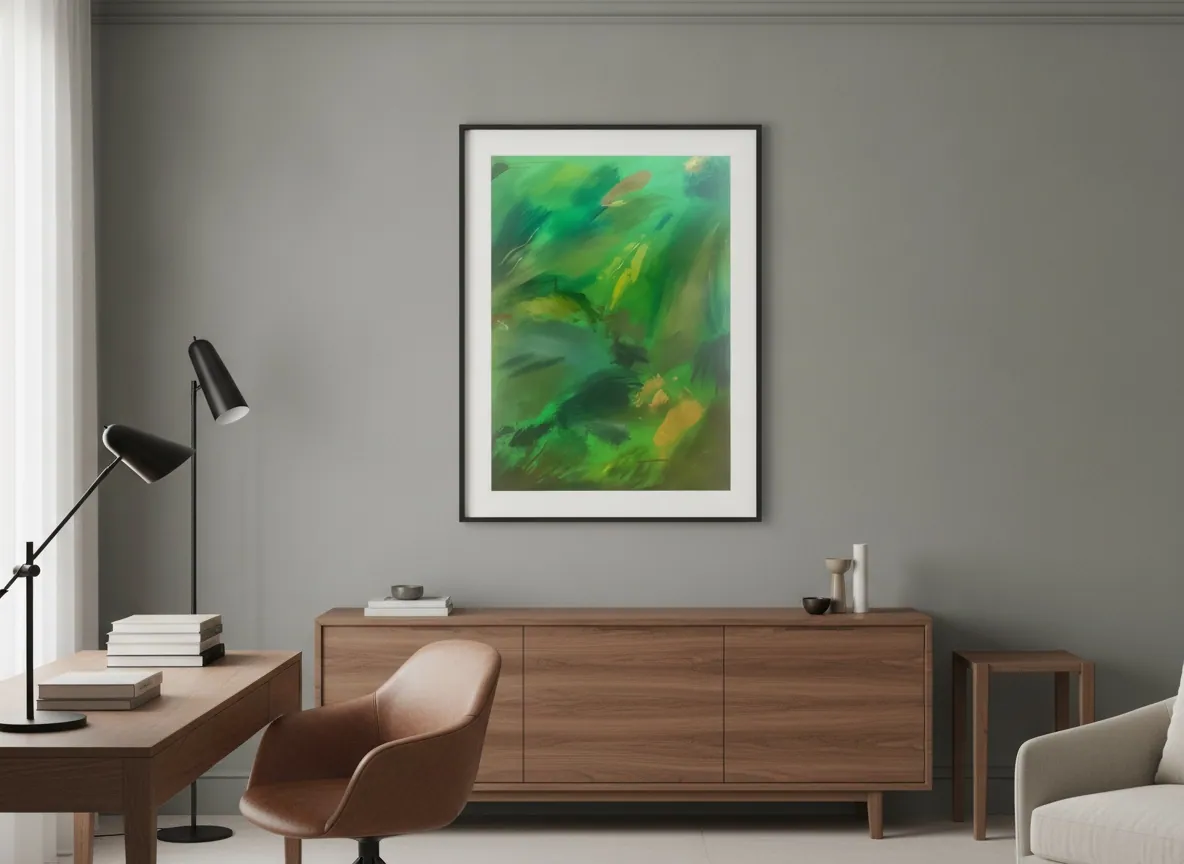
I trained as an architect before I painted, and the habit that stayed with me is reading a wall before I read a canvas -- how a piece behaves at three meters versus at thirty centimeters, what it does to the room around it. That is the question I ask of every large-format piece in Terra & Ether, including Vegetal Dawn: a botanical field built from layers of deep green, malachite, and chartreuse, with fragments of gold leaf catching the light at points that read like clearings in a canopy. It is not a reference to O'Keeffe's flowers -- it started from a very different observation, closer to walking through dense vegetation than looking down at a single bloom -- but the underlying decision is the same territory she worked in: take something actually seen, strip it down through layered color until it sits between landscape and gesture, and scale it for a wall, not a screen.
I am early in this career -- no gallery, no institution, no exhibition history to point to, only the work itself and a record kept from the first piece onward. What I can say honestly is that a painting like this only really argues its case in a room, in front of a body standing at the distance the piece was built for. A photograph flattens the layering into one printed green; the scale collapses to whatever size a screen renders it at. That is true of O'Keeffe's canvases and it is true of mine, at a very different point in the two careers.
Frequently asked
What makes Georgia O'Keeffe's style distinctive?
Her signature device is magnification: taking a small, familiar natural subject -- most famously a flower -- and cropping it tight enough that it fills the canvas at monumental scale, as though seen through a magnifying lens. She described the goal as creating "an equivalent for what I felt about what I was looking at," not a literal copy. The same device of extracted, magnified form carries across her New York skyscraper paintings, her New Mexico landscapes and animal bones, and her later cloud studies.
Did Georgia O'Keeffe only paint flowers?
No. Flowers are her best-known subject -- roughly 200 paintings -- but her range also includes New York skyscrapers (1925-1929), animal bones and skulls found on the New Mexico desert floor, the New Mexico landscape itself after 1929, a 1939 series made in Hawai'i, and, in her seventies, cloud studies painted from what she saw through airplane windows, including the 96-by-288-inch Sky above Clouds IV at the Art Institute of Chicago.
Are there Brazilian artists working in a similar large-scale abstract-organic style?
Two verifiable names sit in adjacent territory, by procedure rather than direct influence. Beatriz Milhazes (b. 1960, Rio de Janeiro) builds large-scale, densely layered color abstraction with botanical references drawn from the view over the Botanical Garden near her studio, and is represented internationally by Pace Gallery and White Cube. Tomie Ohtake (1913-2015), a Japanese-Brazilian painter, was a pioneer of abstraction in Brazil working in bold primary colors and, later, geometric impasto forms. Neither painted in O'Keeffe's specific magnified-flower vocabulary, but both share the large-scale, color-driven, nature-rooted procedure this article describes.
Where can I see Georgia O'Keeffe's work in person?
The largest single collection is the Georgia O'Keeffe Museum in Santa Fe, New Mexico, founded in 1997, which holds close to 150 of her paintings and her two historic homes. Beyond Santa Fe, her work is held by the National Gallery of Art in Washington, DC, the Museum of Modern Art and the Whitney Museum of American Art in New York, and the Art Institute of Chicago, which received a major share of the Alfred Stieglitz Collection from O'Keeffe in 1949.
What should I look for in a painting inspired by O'Keeffe's scale and color?
Look for procedure over resemblance: a composition that traces back to something actually observed rather than an invented pattern, cropped tight and scaled for a wall rather than a screen, built from a small number of closely related colors rather than high-contrast palette, and part of a sustained series rather than a one-off. Those four signals separate work genuinely operating in this territory from a decorative botanical print.
Ask the studio directly
Questions about the Terra & Ether series, about Vegetal Dawn specifically, or about shipping a piece internationally? Alyne replies personally, in English or Portuguese.
Sources
- Wikipedia — 2026-08-01
- Georgia O'Keeffe Museum — 2026-08-01
- Georgia O'Keeffe Museum — 2026-08-01
- Art Institute of Chicago (collection API) — 2026-08-01
- Hyperallergic — 2026-08-01
- Wikipedia — 2026-08-01
- Whitney Museum of American Art — 2026-08-01
- Whitney Museum of American Art — 2026-08-01
- Wikipedia — 2026-08-01
- Wikipedia — 2026-08-01
- Wikipedia — 2026-08-01
Published on