Journal · Technique & materials
Gold leaf vs metallic paint: how to tell which one is in a painting
Gold leaf is a thin sheet of real metal glued onto the surface; metallic paint is pigment — often mica flakes coated in metal oxide — suspended in a binder and brushed on. The leaf reflects light like a mirror off one flat surface; the paint scatters it off countless tiny particles, and that same difference carries into durability and cost.
What each material actually is
Gold leaf is real gold, physically beaten or pressed into sheets so thin they are close to weightless. According to the reference entry on metal leaf, a gold nugget just 5 mm across can be hammered out to about 20,000 times its starting surface area, yielding roughly half a square meter of foil around 0.2–0.3 micrometers thick. That sheet is never painted on — it is laid onto a surface prepared with an adhesive called size, then burnished into place by hand. Gilding specialist John Canning & Co. describes the two standard routes: oil gilding, where the leaf goes down once an oil-based size has become tacky but is no longer wet, and water gilding, where a clay-and-glue “bole” is reactivated with a water size and the leaf is pressed on with a soft brush a few square inches at a time.
Metallic paint starts from a completely different place: it is pigment suspended in a binder, applied with a brush like any other paint. In fine-art acrylics such as Golden Artist Colors’ interference and iridescent lines, that pigment is mica — a mineral that cleaves into extremely thin platelets, 1 to 2 microns thick — coated with a thin layer of titanium dioxide. Decorative “gold paint” products more broadly are simply formulated with metallic-look pigments in a solvent- or water-based medium, according to gold leaf supplier Barnabas Gold. Neither version puts actual sheet metal on the canvas; the metallic look comes entirely from how the suspended particles behave once dry.
Why gold leaf looks like a mirror and metallic paint doesn't
The visual difference traces back to a specific optical mechanism: specular reflection. The Federal Agencies Digitization Guidelines Initiative defines it as what happens when light from a single incoming direction bounces back out in a single corresponding direction — the angle of incidence equals the angle of reflection, the same physics as a mirror — and gives gold gilding on medieval illuminations and gold leaf on fine book bindings as its own examples of surfaces that behave this way, in contrast to the diffuse reflection of the page or binding around them. Because burnished gold leaf is one continuous, flat metal surface, it throws light in that same mirror-like, directional way.
Metallic paint works through a different mechanism entirely: light interference off countless tiny particles rather than one solid reflective plane. Golden Artist Colors explains that its mica-based colors produce their effect because the titanium dioxide coating on each platelet reflects only a narrow band of the light spectrum “in phase,” and that thinner paint applications increase the effect by forcing the flat platelets to lie with their broad side toward the viewer. Coarser mica particles add more sparkle on an uneven surface, while finer particles give a more even sheen — but in every case the shimmer comes from millions of small reflecting surfaces at slightly different angles, not from one uninterrupted metal plane.
Durability: what actually tarnishes, and what doesn't
Purity decides tarnish resistance in gold leaf, not the fact that it's gold. Gold leaf supplier Barnabas Gold states that leaf above roughly 23.5 karat does not tarnish, while lower-karat genuine gold — alloyed with more copper or silver — is more likely to darken over time, and imitation leaf made from brass will tarnish within a few years unless it's sealed, since none of the base metals in brass resist corrosion. Handled correctly, high-karat leaf can hold its surface character for decades.
Mica-based metallic acrylic paint has its own answer to the same question, and it isn't automatically the weaker one. Golden Artist Colors notes that ordinary metal pigments tend to rust or corrode because they keep oxidizing over time, but its Iridescent colors sidestep that specific failure mode: the mica is already in its most stable oxidized state, is insoluble in strong acids or bases, is inherently lightfast, and is unaffected by water. That said, the practical lifespan people report for gold-colored paint in general use is much shorter than for leaf — Barnabas Gold puts ordinary gold paint's realistic performance at around 7 years before it needs attention, against decades for properly applied gold leaf. The gap isn't really about "tarnishing" in the strict chemical sense; it's that a painted metallic finish sits on the surface and wears with handling and light exposure in a way a fused sheet of solid metal does not.
Cost: what the material itself costs
Genuine gold leaf is priced against the gold market, and it shows. Barnabas Gold puts 24-karat gold leaf at around $25 per square foot for architectural-scale work, next to roughly $13.50 per square foot for imitation Dutch metal leaf — about half the price, because it contains no gold at all. At smaller, hobbyist quantities the same supplier lists loose packs running to about $75 for 25 sheets, with pricing shifting alongside the world gold price rather than staying fixed.
Metallic paint is priced like any other artist's paint: by the tube or jar, not by the square foot of coverage or the gram of precious metal inside it. Barnabas Gold is direct about the comparison for gold-colored products specifically — paint is less expensive than leaf, and the gap widens the larger the area being covered, since leaf's cost scales with exactly how much actual metal goes down. For a piece where only fragments of a surface carry gold rather than the whole field, that cost difference is part of why an artist chooses leaf selectively instead of covering a canvas in it.
From the studio
The studio's view: three ways to put metal into a painting
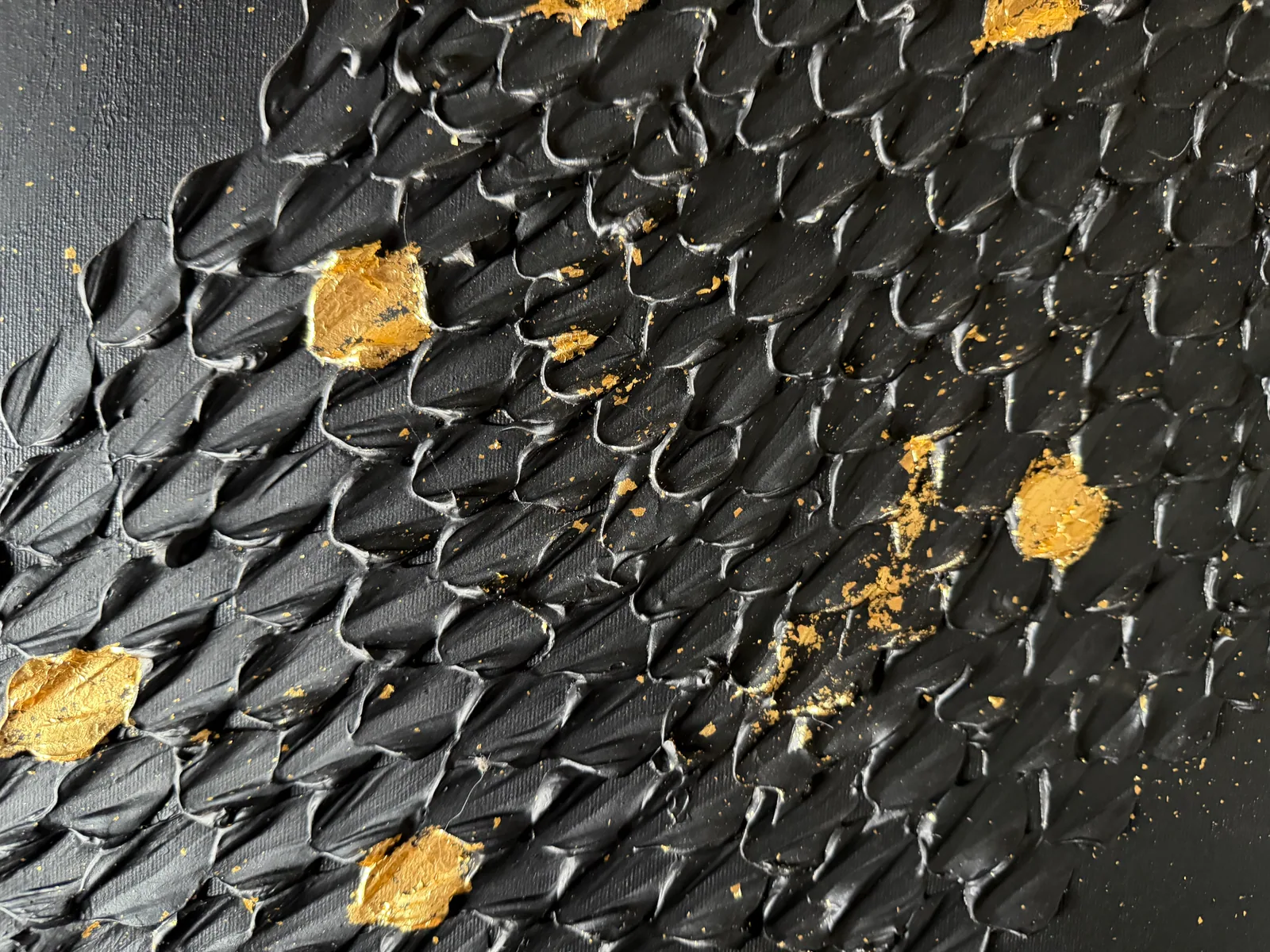
Both materials are in active use here, and they're chosen for different jobs, not used interchangeably. Golden Passage, from the Black & Gold series, carries genuine gold leaf — laid by hand, only where the composition calls for a moment of light, never spread across the full surface. Genesis of Flame, from Heart of Chaos, uses a different tool: metallic pigment worked directly into the acrylic, built up under passages of high gloss and matte so the silver and copper tones sit inside the paint layer itself rather than on top of it.
There's a third approach in the studio that shouldn't be confused with either of the first two: pieces in the Terra & Ether series, like Elemental Veins, fold metallic dust and fragments straight into the mixed-media ground itself — closer to embedding particulate metal in the texture than to either laying a sheet or mixing a pigment. None of the three replaces the others. Choosing between them is a decision about how a specific passage of a painting should catch, or refuse to catch, the light in the room it ends up in — gold leaf for a precise, directional flash; metallic pigment for a more even, all-over shimmer; metallic fragments for something rougher and more geological.
Frequently asked
Is gold leaf real gold?
Yes, genuine gold leaf is real gold beaten or pressed into extremely thin sheets. According to the reference entry on metal leaf, hammering a gold nugget about 5 mm across can expand it to roughly 20,000 times its starting surface area, producing about half a square meter of foil around 0.2 to 0.3 micrometers thick. What is sold as "imitation" or composition leaf is a different material, usually brass, and contains no gold at all.
Does metallic paint contain real metal?
Not in the way gold leaf does. Golden Artist Colors' interference and iridescent acrylics get their metallic look from mica — a mineral, not a metal — platelets coated with a thin layer of titanium dioxide; the shimmer comes from how those coated flakes reflect and refract light, not from suspended metal particles the way older bronzing-powder paints worked.
Which one tarnishes: gold leaf or metallic paint?
Genuine gold leaf above roughly 23.5 karat does not tarnish, according to gold leaf supplier Barnabas Gold; lower-karat genuine gold and imitation brass leaf can darken over time unless sealed. Mica-based metallic acrylic paint is formulated to resist the same problem — Golden Artist Colors states the mica is already in a stable oxidized state and is unaffected by water — though ordinary gold-colored paint's practical lifespan in general use runs closer to 7 years before it needs attention, well short of properly applied leaf.
Is gold leaf more expensive than metallic paint?
Yes, by a wide margin for covering the same area. Genuine 24-karat gold leaf runs around $25 per square foot, according to gold leaf supplier Barnabas Gold, against roughly $13.50 per square foot for imitation Dutch metal leaf. Metallic paint is priced by the tube or jar rather than by the square foot of gold-equivalent coverage, and the same supplier notes the cost gap with leaf widens the larger the surface being covered.
Why does a gold leaf painting look different depending on where you stand?
Because gold leaf reflects light specularly — like a mirror, sending light arriving from one direction back out in a single corresponding direction — rather than scattering it the way a painted surface does, according to the Federal Agencies Digitization Guidelines Initiative. Metallic paint's mica particles behave more like countless tiny mirrors angled slightly differently from one another, which is why its shimmer tends to look more even across a room instead of flashing from one specific spot.
Wondering exactly which material is in a specific piece?
Every work leaves the studio with a Certificate of Authenticity and a technical dossier stating the exact materials used — including precisely where gold leaf ends and metallic pigment begins. Ask before you decide on an acquisition; international shipping and full documentation are included.
Sources
- Wikipedia — 2026-09-26
- John Canning & Co. — 2026-09-26
- Federal Agencies Digitization Guidelines Initiative — 2026-09-26
- Golden Artist Colors — 2026-09-26
- Barnabas Gold — 2026-09-26
- Barnabas Gold — 2026-09-26
- Barnabas Gold — 2026-09-26
Published on