How online art marketplaces actually work
Online art marketplaces make their money by taking a commission from the artist's sale price — 40% at Saatchi Art, for instance — in exchange for handling vetting, shipping, insurance, and buyer returns. Buying directly from an artist's own studio removes that layer: the artist sets the price, provides the documentation, and answers for the sale herself.
How the commission actually works
Most online art marketplaces earn money by keeping a share of what the collector pays, then passing the rest to the artist. The exact mechanism differs by platform. Saatchi Art states plainly that if you sell an original artwork through the site, "Saatchi Art will take a 40% commission on the final sale price" — meaning the artist keeps 60%.
Not every marketplace discloses a number this directly. Singulart's public FAQ does not state a commission percentage; instead, the platform folds delivery, customs, taxes and insurance into the listed price, so the collector never sees a separate shipping line and the artist's payout is calculated after those costs are covered. The practical effect for a buyer is similar either way — the listed price already reflects the platform's cut — but only one of the two publishes the split as a stated rate.
How marketplaces vet what they list
Saatchi Art requires new artists to submit an application with background information and a portfolio of three works before they can sell on the platform, and says uploaded work then gets "attention from our expert curators who review all artworks uploaded daily." A smaller set of artists is additionally hand-picked for the site's Art Advisory program, which curates recommendations for specific collectors.
Singulart's vetting reads differently: its FAQ states "all of our artists are well established in their country of residence," and separately notes the platform moderates content and "it is possible that we may remove a work if its authenticity is questioned." In both cases, vetting happens before or during listing, not continuously — which is different from a gallery, where representation itself is built over years of relationship rather than a one-time application.
Who actually ships and insures the piece
On Saatchi Art, the collector pays for shipping and the artist is responsible only for packaging costs; once a sale is confirmed, the artist schedules a pickup with the platform's courier service, which then manages transit. On Singulart, the arrangement is bundled differently: "the price of your delivery is included in an artwork price," and every shipment is insured — the FAQ states an order is "100% protected in case of any damage or loss" — with customs fees, taxes and paperwork handled by the platform rather than billed separately to the buyer.
Neither model is inherently better; they simply move the same costs to different places in the transaction. A marketplace that itemizes shipping is not necessarily more expensive than one that bundles it — the total a collector pays is what should be compared, not just the line items shown at checkout.
What buyer protection actually covers
Saatchi Art gives collectors 14 days from delivery to return most artworks, with "free return shipping with no hidden costs or restocking fees." Certain final-sale categories and oversized works are excluded from the free-return option, though they still fall under the 14-day satisfaction window.
Singulart's window is longer: its FAQ states buyers may return an order "within 30 days after you received your order" for a "full refund" that includes the original shipping cost, and adds that "all return costs are covered by SINGULART." Damaged or lost pieces are replaced or refunded at no charge. The exception on both platforms is made-to-order or commissioned work, which typically becomes final once production or shipping is confirmed.
From the studio
From the studio: what changes when there's no marketplace between us
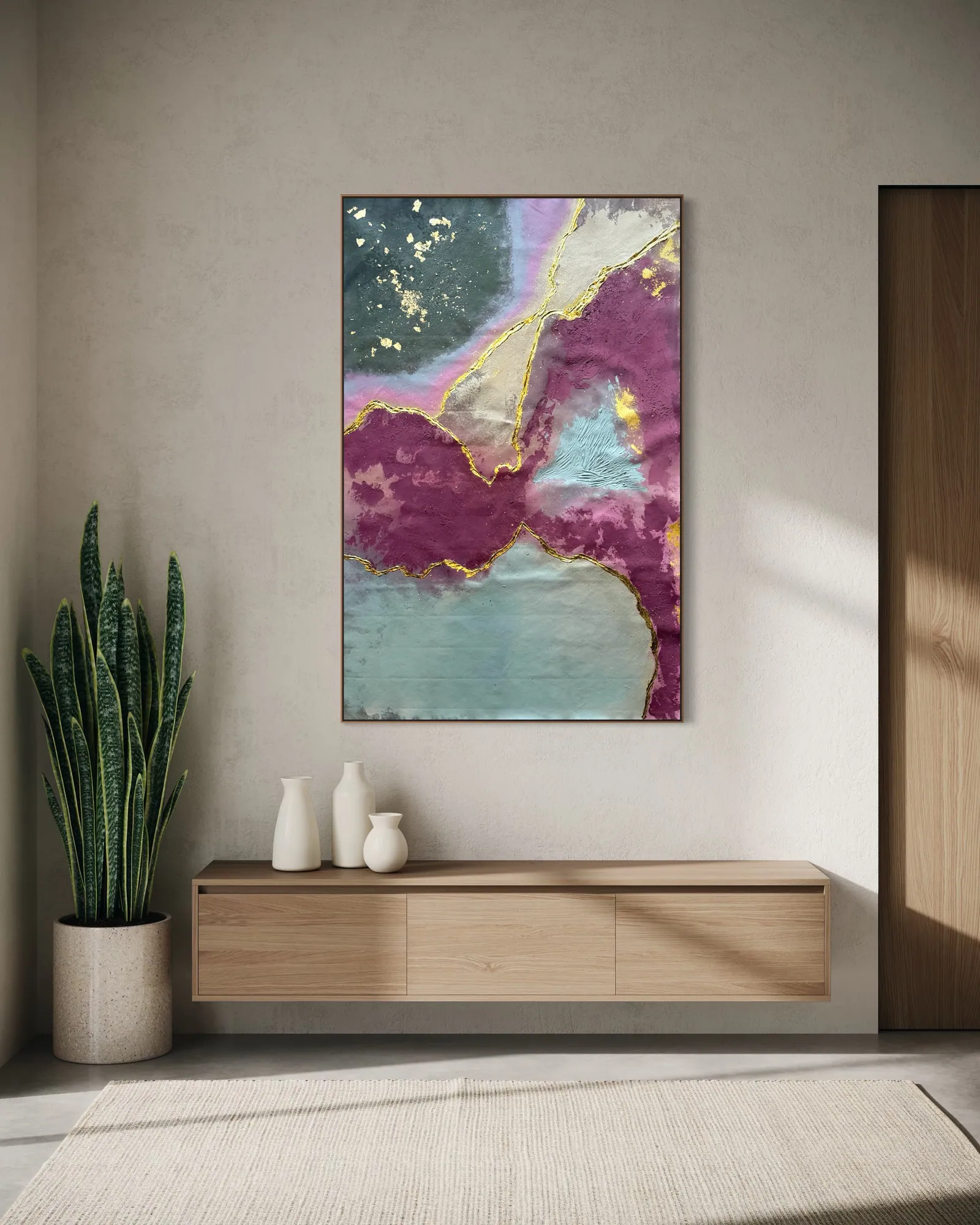
None of this — the commission split, the vetting form, the courier pickup — happens when someone buys a piece directly from me. There's no marketplace taking a cut of the price, which means the number I quote is the number that pays for the canvas, the gold leaf, and the hours the layering took, not a number built to also cover a platform's advertising budget or its logistics team.
What I do instead of a marketplace's vetting form is give every piece an Archive ID before it ever has a buyer, and every acquisition a signed Certificate of Authenticity with the technical data written out — title, year, medium, dimensions — plus a fiscal invoice. I don't have a 14- or 30-day return policy written into a checkout flow; what I have is a WhatsApp conversation before the sale, where I answer directly whatever a collector asks about the piece, the series, or how it should be shipped and installed. It's slower than checking a box on a marketplace, and it's meant to be — the documentation is there because, without a platform standing behind the sale, I'm the one who has to.
Frequently asked
What percentage do online art marketplaces typically keep from a sale?
It depends on the platform and whether the rate is published. Saatchi Art states directly that it keeps 40% of an original artwork's final sale price, leaving the artist 60%. Other marketplaces, including Singulart, do not publish a commission percentage — instead they build shipping, insurance, customs and their own margin into the listed price, so the split is not shown as a separate line item.
Do online art marketplaces check whether the art or the artist is legitimate before listing?
Most run some form of screening, though the depth varies. Saatchi Art requires a short application and a three-piece portfolio, then has curators review new uploads daily. Singulart says its artists are established in their home country and that it moderates listings, removing work if its authenticity is questioned. Neither process is a substitute for the kind of long-term vetting a gallery does through years of representation — it happens once, at intake, rather than continuously.
Who pays for shipping and insurance when you buy through a marketplace?
It depends on the platform's model. On Saatchi Art, the collector pays shipping directly and the artist covers only packaging; the platform's courier handles pickup and transit. On Singulart, delivery, customs, taxes and insurance are already folded into the artwork's listed price, so there is no separate shipping charge at checkout, and shipments are insured against damage or loss.
What happens if a piece bought on a marketplace arrives damaged or turns out to be misrepresented?
Marketplace return policies exist for exactly this. Saatchi Art gives buyers 14 days from delivery for a free return on most artworks, excluding certain final-sale categories and oversized pieces. Singulart offers a 30-day window with a full refund, including original shipping, and covers the cost of the return itself. Damaged or lost shipments are typically replaced or refunded at no charge on either platform.
Is buying directly from an artist's own studio riskier than buying through a marketplace?
Not inherently — it shifts where the diligence happens. A marketplace's commission pays for built-in vetting, logistics and a return policy; buying direct removes that layer, so the documentation the artist provides — certificate of authenticity, archive record, invoice — carries more of the weight that a platform's policy would otherwise carry. It is a normal, legitimate way to acquire original work.
Does an artist selling directly still offer any buyer protection?
It depends entirely on the individual artist or studio, since there is no platform policy standardizing it. A serious studio replaces a marketplace's written return window with direct communication — answering questions before the sale, documenting the work fully, and standing behind what is shipped — but a buyer should ask about shipping, packaging and what happens if a piece arrives damaged before paying, rather than assume a marketplace-style guarantee applies.
Ask the studio directly on WhatsApp
No marketplace commission, no return-policy fine print — just a direct conversation with Alyne about the piece, shipping and documentation.
Sources
- Saatchi Art — 2026-09-17
- Saatchi Art — 2026-09-17
- Saatchi Art — 2026-09-17
- Saatchi Art (Canvas blog) — 2026-09-17
- Singulart — 2026-09-17
- Singulart — 2026-09-17
- Singulart — 2026-09-17
Published on