Will a large painting fit in the lift and up the stairs?
In most cases, yes: a painting travels tilted onto its diagonal, not carried flat, so it passes through an opening narrower than itself. The real limits are the lift's clear door width, the ceiling clearance at stairwell turns, and the turning radius at each landing — measure those before ordering a work larger than your entrance.
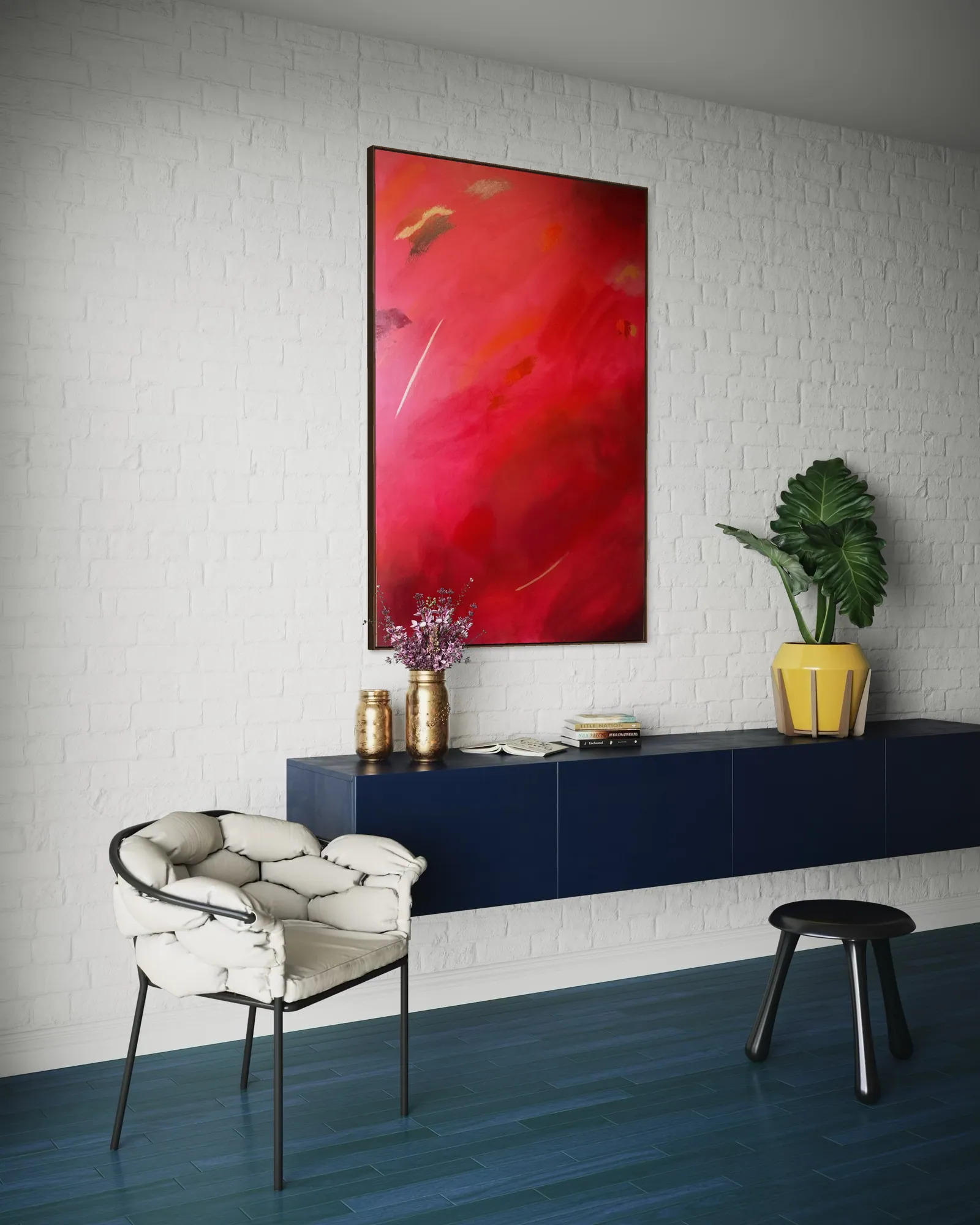
The three measurements that actually stop a painting
Weight is rarely the reason a large canvas gets stuck on delivery day. A stretched painting is light for its size, and two people can carry even a 150 cm canvas without strain. What actually strands a piece halfway to the wall is geometry: the clear width of the lift door, the ceiling or soffit clearance at each stairwell turn, and the turning radius at every landing. A piece that clears the front door with room to spare can still stop dead at a stairwell that doubles back on itself, because the manoeuvre needed to swing the canvas around the corner takes more space than the corridor's width alone suggests.
None of these three assumes the painting travels flat. A rectangular canvas almost never passes through a doorway or lift door narrower than its own width by going through square-on — it goes through tilted onto its diagonal, using the height of the opening to compensate for what the width doesn't give it. That is also why ceiling height at a stairwell landing matters as much as the stairwell's width: a low soffit above a half-landing can block the tilt manoeuvre even when the horizontal measurements look adequate on paper.
What a lift is actually built to let through
Where a residential lift exists, its car and door are usually sized to a recognised accessibility standard rather than to whatever a builder judged convenient at the time. In Europe, that standard is EN 81-70, which sets minimum internal car dimensions and clear door widths for passenger lifts. It defines several car types, from the smallest size still permitted in existing buildings up to the largest car types, which allow a wheelchair to rotate inside the car:
- Type 1 (existing buildings only): 1000 × 1300 mm car, 800 mm clear door width
- Type 2 (minimum for new buildings): 1100 × 1400 mm car, 900 mm clear door width
- Type 3 (stretcher-capable): 1100 × 2100 mm car, 900 mm clear door width
- Type 4: 1400 × 1600 mm car, 900 mm clear door width
- Type 5: 2000 × 1400 mm car, 1100 mm clear door width
A canvas 100 cm wide — a common width for a large-format piece — already exceeds every one of those door widths when carried flat. It has to travel tilted onto its diagonal in every case, and that is entirely normal: lift doors are not designed around large paintings, and tilting is standard practice for professional art handlers and moving crews alike.
Measuring your own building before you order a large work
Four measurements, taken with a tape measure rather than eyeballed from across the room, answer the question before the painting is on a delivery van:
- Clear door width — measured between the door stops, not the outer frame or trim. The finished opening is typically 5–10 cm narrower than the frame looks.
- Door and ceiling height along the path — a painting can be taller than a doorway is wide only if there is enough height to complete the diagonal tilt without hitting a lintel, light fixture, or sloped ceiling.
- Corridor and landing width at every turn, not just the widest run — the tightest point on the route decides the outcome, not the average.
- Obstructions projecting into the passage — handrails, radiators, light switches, and door closers routinely take several centimetres out of a corridor that looks wide enough on a floor plan.
A painting 100 × 150 cm — a common size in the studio's Heart of Chaos and Luminous Rebirth series — has a diagonal of roughly 180 cm. That number, not the 100 cm width, is the real ceiling on what the tilt manoeuvre can achieve: if the door height and the depth of the landing can't accommodate something close to that diagonal, no amount of tilting gets the canvas through, and it is worth planning for a different route before the delivery date rather than on it.
If the painting still won't pass
When the diagonal genuinely doesn't clear — a frequent situation in older buildings with narrow stairwells and low half-landings — there are three realistic paths, roughly in the order they tend to get used:
- Remove what can be removed. Interior doors usually lift off their hinges in minutes, and a non-structural stop or handrail bracket can sometimes come off temporarily, each buying back a few centimetres.
- Bring the canvas in unstretched and stretch it on site. Rolled around a tube, a canvas travels as a cylinder a fraction of the width of the finished, stretched painting, and a professional installer can mount it onto its stretcher bars in the room where it will hang. This is standard practice in fine-art shipping for oversized canvases, and it is worth asking about before assuming a piece is simply too large for a space.
- Use an alternative opening. A ground-floor window, a balcony, or a service stairwell sometimes offers more clearance than the main entrance, particularly in older buildings where the principal stair was designed for people rather than furniture.
None of this needs to be solved alone, and none of it needs to be discovered on delivery day. Raising the question before committing to a size is simpler than finding out the diagonal doesn't clear a half-landing once the piece is already in the building.
From the studio
The architect's view: building access as part of the design conversation
Because Alyne trained as an architect before she trained as a painter, the studio treats a building's access — not only its walls — as part of choosing a work's scale. A floor plan or a few photographs of the corridor, the lift, and the stairwell tell us as much about which piece will actually reach the wall as photographs of the room itself do. It is a habit carried over directly from architectural practice: you don't design for the drawing, you design for how a thing physically arrives and is installed. For a piece near the top of our size range, we would rather ask about the route to the wall before confirming an acquisition than have a collector discover, on delivery day, that the diagonal doesn't clear a half-landing.
Frequently asked
How do I check whether a large painting will fit through my building before I buy it?
Measure the clear width of the doorway or lift door (between the stops, not the outer frame), the height available along the route, and the turning space at every landing or corner — the tightest point decides the outcome, not the average. A rectangular canvas travels tilted on its diagonal rather than flat, so the real limit is usually height and turning space rather than the door's width alone. Perfeito Studio can review a floor plan or a few photos before you commit to a size.
What is the minimum lift door width required by accessibility standards?
Under EN 81-70, the European standard for lift accessibility, the minimum clear door width ranges from 800 mm in the smallest car type permitted in existing buildings up to 1100 mm in the largest types, which allow a wheelchair to rotate inside the car. A width of 900 mm is common in lifts built to the minimum standard for new buildings. These figures describe the door opening itself, not the full width of a canvas travelling tilted through it.
Can a large painting go up a staircase instead of a lift?
Yes, and in many buildings the staircase is the only option. The same three checks apply: the width of the stairway itself, the ceiling or soffit clearance at any turn, and the turning radius at each landing. A tight half-landing with a low ceiling above it is usually the point where a large canvas gets stuck, not the straight run of stairs, so it is worth measuring the corners and landings specifically rather than just the stairwell's width.
What if the painting is bigger than every door and landing in the building?
There are still real options. Interior doors can often be removed temporarily to gain a few centimetres, and for genuinely oversized canvases, shipping the work unstretched — rolled around a tube — and having it stretched onto its frame on site by a professional installer is standard practice in fine-art shipping. A ground-floor window or a service stairwell can also offer more clearance than the main entrance. These are questions worth raising with the studio before ruling out a size.
Does Perfeito Studio help confirm whether a work will fit before purchase?
Yes. Because Alyne Perfeito is a trained architect as well as the artist, the studio treats building access as part of the acquisition conversation for large-format pieces — reviewing a floor plan or photos of the corridor, lift, and stairwell alongside the usual questions about wall and light. Installation guidance, including hanging height, is also available on request as part of every acquisition.
Should I measure the doorframe or the wall opening?
Measure the clear opening between the door stops, not the outer frame or the trim around it — the finished frame is typically five to ten centimetres narrower than it looks from across the room. Also check for handrails, light switches, radiators, or door closers that project into the passage; these routinely take several centimetres out of a corridor that otherwise measures wide enough on a floor plan.
Not sure if a large piece will clear your entrance?
Send Alyne a photo or a few measurements of your lift, stairwell, or doorway — as a trained architect, she can tell you quickly whether a large-format work will travel to your space.
Sources
- iKONIC Lifts — 2026-09-13
- ItemFits — 2026-09-13
Published on