What should your first art purchase be?
Your first art purchase should be one original work that holds your attention across repeated viewings, fits the actual scale of a specific wall, and sits comfortably inside your budget — not the piece that seems safest, most fashionable, or easiest to resell. Buying directly from the artist keeps that decision simple, documented, and reversible in nothing but the choosing.
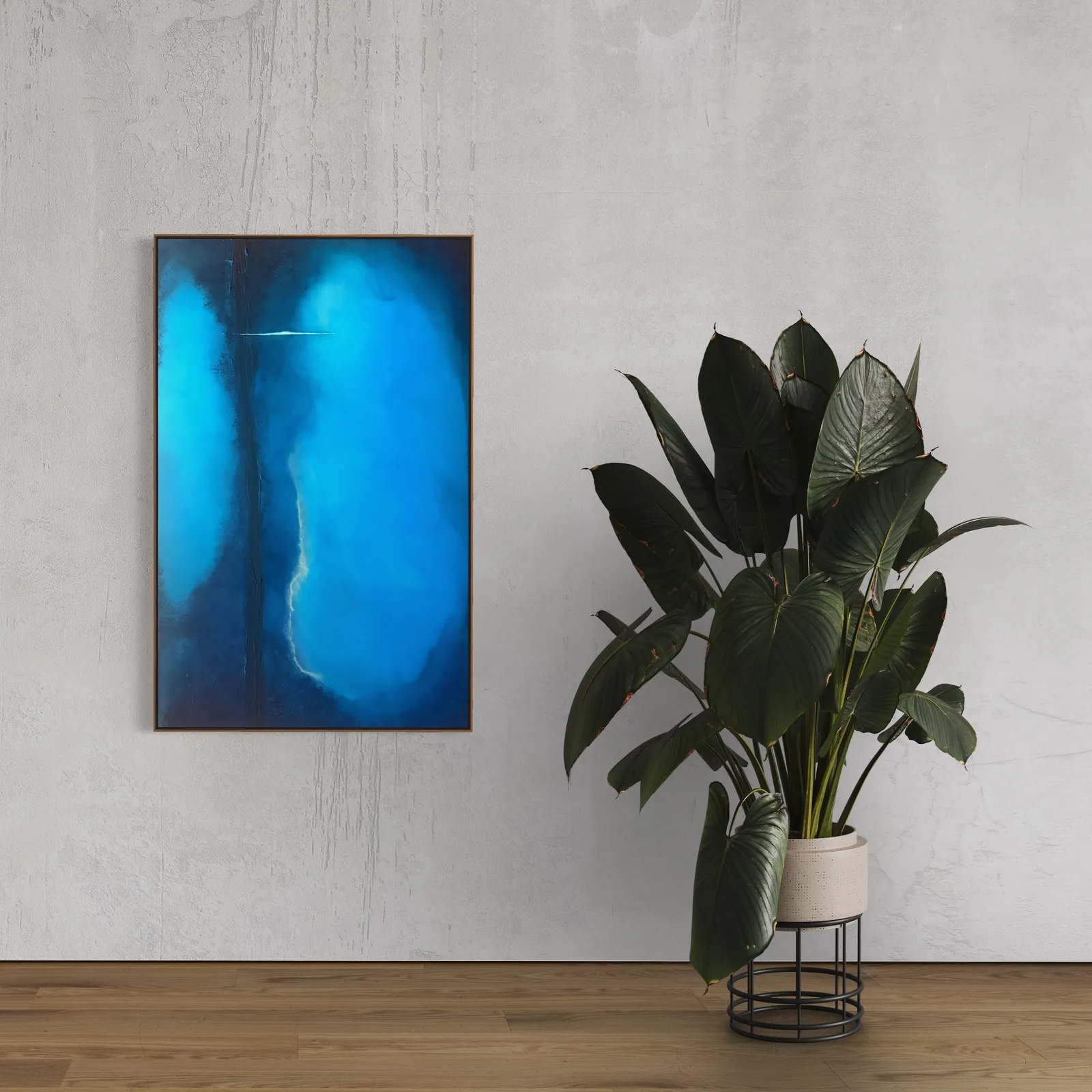
The three things that actually decide a first purchase
Strip away the noise around a first art purchase and three questions do almost all the work: does the piece hold your attention across more than one viewing, does it fit the wall you actually have, and can you pay for it without negotiating with yourself afterward. Everything else — provenance strategy, resale logic, whether you're buying "correctly" — is a later problem, for a later purchase.
Reaction comes first because it's the only criterion you can trust on day one. You don't yet have the eye to judge market position or historical weight, and you don't need to. What you can judge, accurately, is whether a piece keeps pulling your eye back after the initial pull fades — across a second look, a third, a photo you keep re-opening. That reaction is the actual selection mechanism; scale and budget are filters that narrow the field of pieces you'd say yes to.
Let the wall set the scale, not the other way around
The single most common regret with a first piece isn't the image, it's the size. A painting bought too small for its wall reads as an afterthought no matter how strong the composition is; a painting bought at the right scale for the same wall reads as intentional. Before shopping, measure the actual wall — width and height available above furniture, not the room as a whole — and treat that number as a hard constraint, the same way you'd treat a budget.
In the studio's experience, first-time buyers tend to undersize out of caution, choosing a piece that feels safe rather than one that actually occupies the space. A work sized to command a wall, hung at eye level for the room's main sightline, does more for a space than a smaller piece chosen because it felt like the lower-risk decision. If you're unsure how a specific size will read, ask for the piece's dimensions against your wall in centimeters and hold a sheet of paper or painter's tape to the actual spot before deciding — a photo alone can flatten scale in ways that mislead.
Choose the series that matches how you respond, not the one that seems safest
Perfeito Studio's five series aren't different color palettes on the same idea — each one is answering a different question, and a first purchase goes better when it matches the question you're actually drawn to rather than the series that photographs as most "neutral." Heart of Chaos works from an impulsive, almost eruptive gesture. Matter & Silence works the opposite territory — restraint, and the empty space between forms. Luminous Rebirth chases transition, the moment one color is still becoming another. Black & Gold is built on weight and absolute contrast, with no midtone. Terra & Ether stays in mineral territory — strata, sediment, the time a surface carries.
A first-time buyer who picks the series that feels safest for the room, rather than the one they actually keep returning to, tends to be the one who replaces the piece soonest. The series you can name a reason for wanting — beyond "it will match" — is usually the more durable first purchase.
Treat budget as a filter, not a compromise
At Perfeito Studio, signed original works currently run roughly R$ 2,400 to R$ 8,800, depending on scale and series — a spread wide enough that a genuine first purchase and an entry point into a longer collecting habit aren't mutually exclusive.
Inside that range, budget works best as a filter you apply after reaction and scale, not before. Deciding "I have this much to spend" and then picking the piece that best fits the room and pulls your eye within that ceiling produces a better first purchase than starting from price and working backward to whichever piece happens to be cheapest. A smaller, entry-tier piece chosen deliberately for a specific wall outperforms a larger piece bought mainly because the budget stretched to it.
Mistakes that only show up after the piece is on the wall
A few patterns account for most of the regret in first purchases, and all of them are avoidable before you buy. Buying strictly to match existing decor — same tones as the sofa, same palette as the rug — tends to produce a piece that disappears into the room instead of anchoring it; art that merely coordinates rarely holds attention past the first week. Buying the most fashionable or most-discussed style of the moment, rather than the one you actually respond to, produces the same fatigue on a longer timeline. And buying without asking about the piece — materials, how it was made, what documentation comes with it — turns what should be a considered acquisition into an impulse purchase with better packaging.
The corrective for all three is the same: slow down enough to ask questions directly, live with a few candidate images for more than a day before deciding, and choose the piece you'd still want on the wall a year from now, not just the one that solves this week's blank wall.
From the studio
The studio's view
When someone writes to me about a first piece, they almost always start by describing the room, not the art — the height of the ceiling, which wall gets morning light, what's already in the space. That's the right instinct, even if they don't realize it: I trained as an architect before I painted seriously, and I still think about a canvas the way I'd think about a fixture in a room — what it needs to hold, at what distance, under what light — before I think about how it photographs.
What I notice most with first-time buyers is that they under-trust their own reaction. They'll tell me a piece is "maybe too much" and then keep sending me photos of exactly that one over the following days. I'd rather talk someone through the scale and placement of the piece they can't stop looking at than steer them toward a safer option they'll feel lukewarm about in six months. Every piece leaves the studio with its Archive ID, a signed certificate, and a dossier — not to convince a first-time buyer it's real, but because that record is what lets the piece carry its own history forward, regardless of which one they choose.
Frequently asked
What matters most when choosing your first piece of art?
Your own reaction to the piece matters most — whether it holds your attention across more than one viewing, not just on first sight. After that, scale (does it fit the specific wall you have) and budget (can you pay for it without regret) narrow the field. Market position, resale value, and provenance strategy are later considerations that don't need to factor into a first purchase.
How do I know if a piece is the right size for my wall?
Measure the actual wall space available above furniture, not the room as a whole, and compare it against the piece's real dimensions in centimeters — not how it looks cropped in a photo. Holding painter's tape or a sheet of paper to the exact spot gives a far more accurate sense of scale than judging from an image alone. First-time buyers tend to undersize out of caution more often than they oversize.
Should my first piece match my existing decor?
Not as the main criterion. A piece chosen mainly to coordinate with a sofa or rug tends to blend into the room instead of anchoring it, and loses interest faster than a piece chosen because it genuinely held your attention. Color and tone should be compatible with the room, but the deciding factor should be your reaction to the work itself, not how closely it matches what's already there.
Is it safer to start with a small, inexpensive piece?
Not necessarily. A small piece bought mainly to minimize risk often ends up underwhelming the wall it's meant for, which is a common source of first-purchase regret. A deliberately chosen entry-tier piece — sized correctly for its spot, picked because you responded to it — is a better first step than either an oversized impulse buy or an undersized "safe" one.
Do I need to know a lot about art before buying my first piece?
No. Buying directly from an artist or studio means you can ask the questions that matter — materials, process, documentation — in a direct conversation, which covers most of what expertise would otherwise provide. What helps more than prior knowledge is slowing down: living with a few candidate images for a day or two before deciding, rather than buying on the first impulse.
What documentation should come with a first purchase?
At minimum, expect a signed Certificate of Authenticity recording title, series, year, medium, and dimensions, plus a proper invoice or receipt. At Perfeito Studio, every acquisition also includes an Artwork Acquisition Agreement, an artist dossier, a conservation guide, and an individual Archive ID. That documentation is what makes a first purchase behave like a real acquisition rather than an informal favor.
Not sure which piece to start with?
Describe your wall, your budget, and what you're drawn to — the studio replies personally and can talk through scale and series before you decide.
Published on