Questions to ask an artist before buying their work
Before buying directly from an artist's studio, ask about materials and technique, documentation (certificate, dossier, and archive number), return policy, and shipping and delivery timelines — in writing, before you pay. A serious studio answers all four without hesitation; hesitation on any one of them is the signal to slow down.
Materials and technique: what to ask before you commit
A vague description like “mixed media” tells you almost nothing about how a piece will age or how it should be cared for. Ask directly:
- What is the exact medium? Acrylic on canvas is not the same as acrylic combined with texture paste, metallic pigment, or gold leaf — each behaves differently under light and over time.
- Is this a one-of-a-kind original, or part of an edition? A serious studio will state this plainly and confirm it in the certificate, not leave it implied by the price.
- Does the surface have raised texture or relief? Sculpted or heavily textured surfaces need different handling during shipping and different hanging hardware than a flat canvas.
- Is the finish sensitive to direct sunlight or humidity? Ask for care instructions in writing, not just a verbal assurance.
Confirm these details against the studio's own catalog record rather than the photograph alone — a photo can suggest a material it doesn't actually contain, and a studio serious about documentation will defer to its written record over a description of the image.
Documentation: what a certificate, dossier, and Archive ID actually prove
Documentation is what turns a purchase into provenance. Before paying, ask:
- Does every acquisition include a signed Certificate of Authenticity? It should carry the title, dimensions, medium, year, an archive or edition number, the artist's signature, and a date of issue — see the full checklist in our guide to certificates of authenticity.
- Is there a curatorial dossier? A dossier places the work inside a series and a body of practice; it is descriptive, not a legal record, but its absence usually means the studio hasn't built one for any of its work.
- Is there a formal acquisition agreement? This is the document that actually transfers ownership and states the terms of the sale — separate from an invoice, which only records payment.
- Does the work carry an internal archive number? A number assigned at completion, before the sale, is a stronger signal than one improvised afterward at a buyer's request.
A studio that treats documentation as routine will usually offer to show you a sample certificate before you ask for one.
Shipping and delivery: what to confirm before paying
International shipping is where the most expensive surprises happen after a sale, not before. Ask:
- Is shipping quoted per destination, or is there a flat estimate? A studio that quotes shipping honestly will need your address and the work's packed dimensions before giving a number — be wary of a price that sounds too round to be real.
- What packaging is used? Ask whether the piece ships in professional, purpose-built packaging or in whatever box was on hand.
- Who is responsible for customs duties and import taxes? For cross-border purchases this is typically the buyer's responsibility at the destination country — confirm this explicitly so it isn't a surprise at your door.
- Is transport insurance available, and is it included or additional? Ask what happens, procedurally, if the piece arrives damaged.
- What is the estimated delivery window? Get a range in writing rather than a verbal guess, and ask when that clock starts — at payment, or at dispatch.
Return policy: what to ask, since most independent studios don't offer one
Original, one-of-a-kind artworks are commonly sold as final once shipped — this varies by studio, so never assume either way. Ask directly:
- Is there any right of return or exchange, and within what window, if any?
- What happens if the piece arrives damaged in transit? This is different from a return — it's a transport claim, and the answer should reference the insurance question from the shipping section above.
- What happens if the work, in person, doesn't match your expectation from photographs? A studio confident in its documentation should be willing to send additional detail images or a short video before you commit, precisely to reduce this risk.
- Is the return policy written into the acquisition agreement, or only stated verbally? A verbal assurance is not enforceable once the piece has shipped.
Asking this question early is not a sign of distrust — it is a normal part of due diligence, and a studio should answer without hesitation or defensiveness.
Payment and agreement: what should be in writing
The last set of questions closes the loop between the conversation and the actual transaction:
- What payment methods are accepted for international buyers? Bank transfer is common for cross-border art purchases; ask about fees and who absorbs currency conversion costs.
- Is the price fixed in the studio's home currency, with foreign currency only an approximation? A price stated in Brazilian reais (R$) will fluctuate in USD or EUR terms with the exchange rate — a serious studio will say so plainly rather than quote a fixed foreign-currency price that has to be adjusted later.
- Will you receive a fiscal invoice or official receipt, separate from the certificate of authenticity?
- Is the acquisition agreement signed by both parties before or at the same time as payment, not after?
None of these questions should feel confrontational to ask, and none should be met with irritation. A studio that sells directly, without a gallery between it and the buyer, should be used to answering them — it is one of the practical trade-offs of buying direct instead of through an intermediary.
From the studio
From the studio
The question I get most often from a buyer outside Brazil isn't about price — it's whether the documentation exists before they've committed to anything. I understand why: they can't walk into a room and stand in front of the canvas the way a local collector can. So I build the record before the question ever comes: every piece gets its Archive ID the moment it's finished, not when someone asks for one. Vibrant Awakening, the 100 × 150 cm piece from Luminous Rebirth, carries AP-LMR-2025-003 — assigned the week it left the easel.
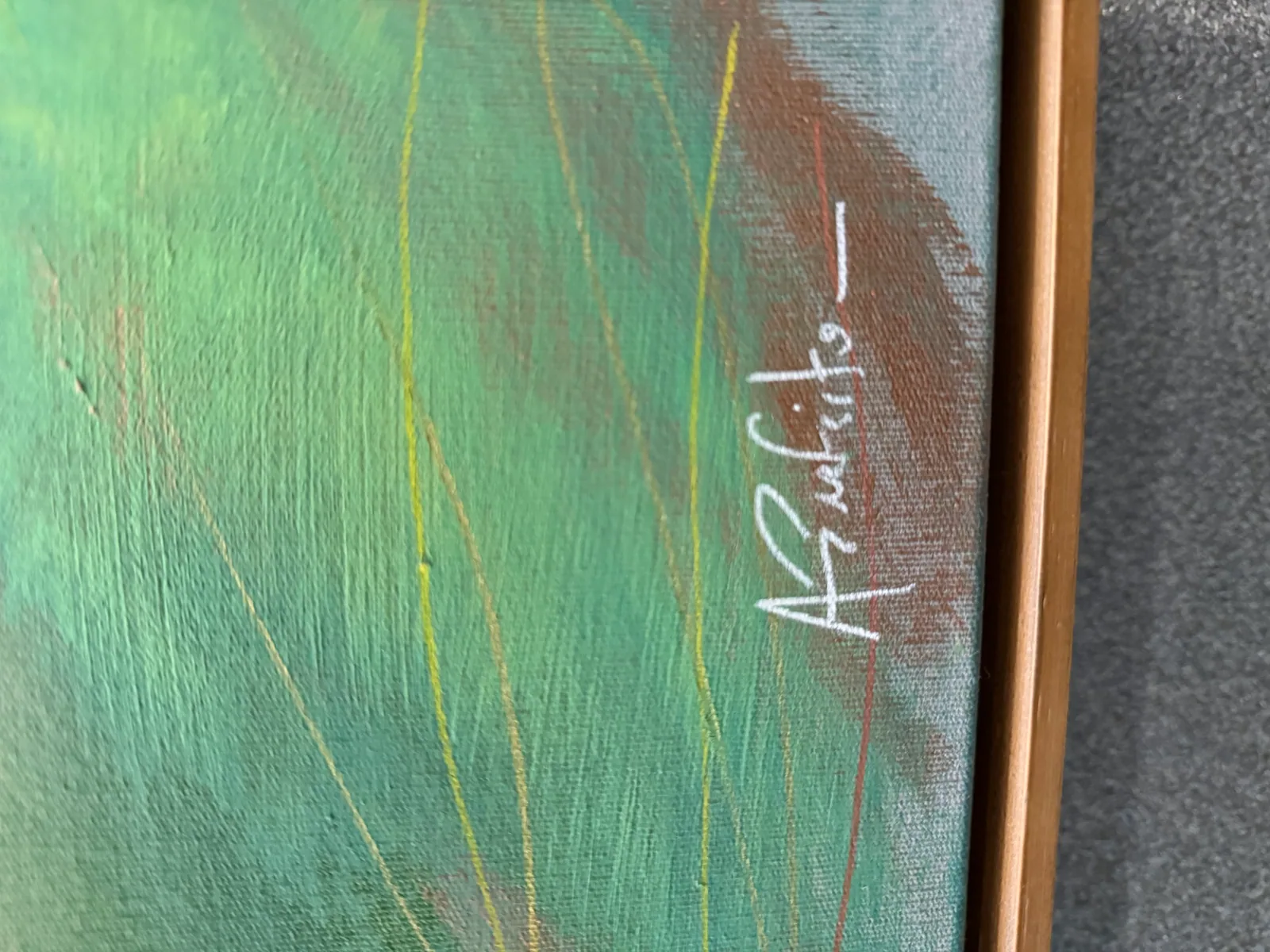
I also photograph the signature on the canvas itself as part of that same record, the way you see it here — not as a marketing image, but because it's the detail a future appraiser, or the buyer's own memory ten years on, will want to check against the certificate. Training as an architect before painting full time changed what I notice first in these conversations: I ask about the wall, the light, and the scale of the room before I talk about the surface finish. Documentation and shipping questions matter, but they only matter once the piece actually belongs in the space.
Frequently asked
What should I ask an artist before buying a piece directly?
Ask about four things before you pay: the exact materials and technique, whether documentation is included (a signed certificate of authenticity, an archive number, and ideally a dossier), the shipping and delivery timeline for your destination, and the return or exchange policy. A studio that sells directly should answer all four clearly and in writing. Vague or reluctant answers to any of these are a more useful signal than the price itself.
Is it normal to ask for documentation before paying for a piece?
Yes. Asking to see a sample certificate of authenticity, or asking exactly what a certificate will include for your specific piece, before you commit is standard due diligence, not an unusual request. A studio confident in its own documentation practice will typically show you an example without hesitation. Treat reluctance or vagueness on this question as a reason to slow down, regardless of how appealing the piece itself looks.
What should I ask about materials and technique?
Ask for the exact medium rather than a vague label like mixed media — whether it's acrylic alone, or combined with texture paste, metallic pigment, or gold leaf, since each affects how the surface should be cared for. Confirm whether the piece is a one-of-a-kind original or part of an edition, and ask whether the surface has raised texture that needs specific handling during shipping and hanging.
Should I ask about return policy before buying?
Yes, and directly. Original one-of-a-kind works are commonly sold as final sale once shipped, but this varies from studio to studio, so never assume. Ask what happens if the piece arrives damaged in transit, whether that is covered by insurance, and whether the return or exchange terms, if any, are written into the acquisition agreement rather than only stated verbally.
What should I ask about shipping and delivery timelines?
Ask whether shipping is quoted specifically for your destination rather than given as a flat, generic estimate, what kind of packaging is used, and who is responsible for customs duties and import taxes at your end — usually the buyer, for cross-border purchases. Ask for a delivery window in writing and confirm whether transport insurance is included or offered separately.
Sources
- Perfeito Studio (self-source — studio's own catalog record) — 2026-08-09
- Perfeito Studio (self-source — documented acquisition process) — 2026-08-09
Ready to ask? Talk to Perfeito Studio directly
Send your questions about materials, documentation, shipping, or return terms — Alyne replies personally on WhatsApp, usually within 48 hours.
Talk to the studio on WhatsApp
Published on