Does buying art for your children to inherit make sense?
Yes, for most collectors it makes sense — but not as a financial strategy. The Art Basel & UBS Survey of Global Collecting 2025 found that 80% of collectors already plan to pass their collections to children or spouses, which means inheritance is already the default outcome of buying art, not a special case requiring extra justification.
What the data says: inheritance is already the default
Most people who buy art assume the question of who gets it later is separate from the decision to buy it now. The data says otherwise. The Art Basel & UBS Survey of Global Collecting 2025 — a study of 3,100 high-net-worth collectors across ten markets, including Brazil — found that 80% of collectors already plan to pass their collections on to their children or a spouse. For most people who buy original art and keep it for any length of time, inheritance isn't a special scenario to plan for separately. It's the default outcome.
The scale of what's moving is large. Deloitte's Art & Finance Report, produced with ArtTactic, estimates that roughly $992 billion in art and collectibles will change hands over the next decade, as part of a broader generational wealth transfer. That figure covers established collections worth far more than a single painting bought today — but the mechanism is the same one that applies to a single piece bought this year: eventually, someone else decides what to do with it.
The gap between buying and planning
The same 2025 survey found something worth sitting with: among Gen Z collectors who had already inherited artwork, nearly 90% chose to keep it rather than sell. Whatever anxiety exists about younger generations not wanting inherited art, at least in this sample, the pieces that already arrived were mostly kept. That's a better signal for anyone buying with an eye on the next generation than most assumptions about taste gaps between generations.
The weaker link isn't sentiment — it's paperwork. Deloitte's Art & Finance Report found that only 24% of surveyed collectors have a long-term plan for their collection. Most people who buy art never write down what they own, why, or what should happen to it. A painting can outlast its owner easily; the informal, undocumented version of 'this will go to my kids' usually doesn't.
What makes a piece worth passing down
Nothing about acquiring a piece can guarantee that a future owner — related to you or not — will want it. What can be controlled is whether the piece and its record hold up. Two things do the work here: material durability and documentation that survives the original buyer.
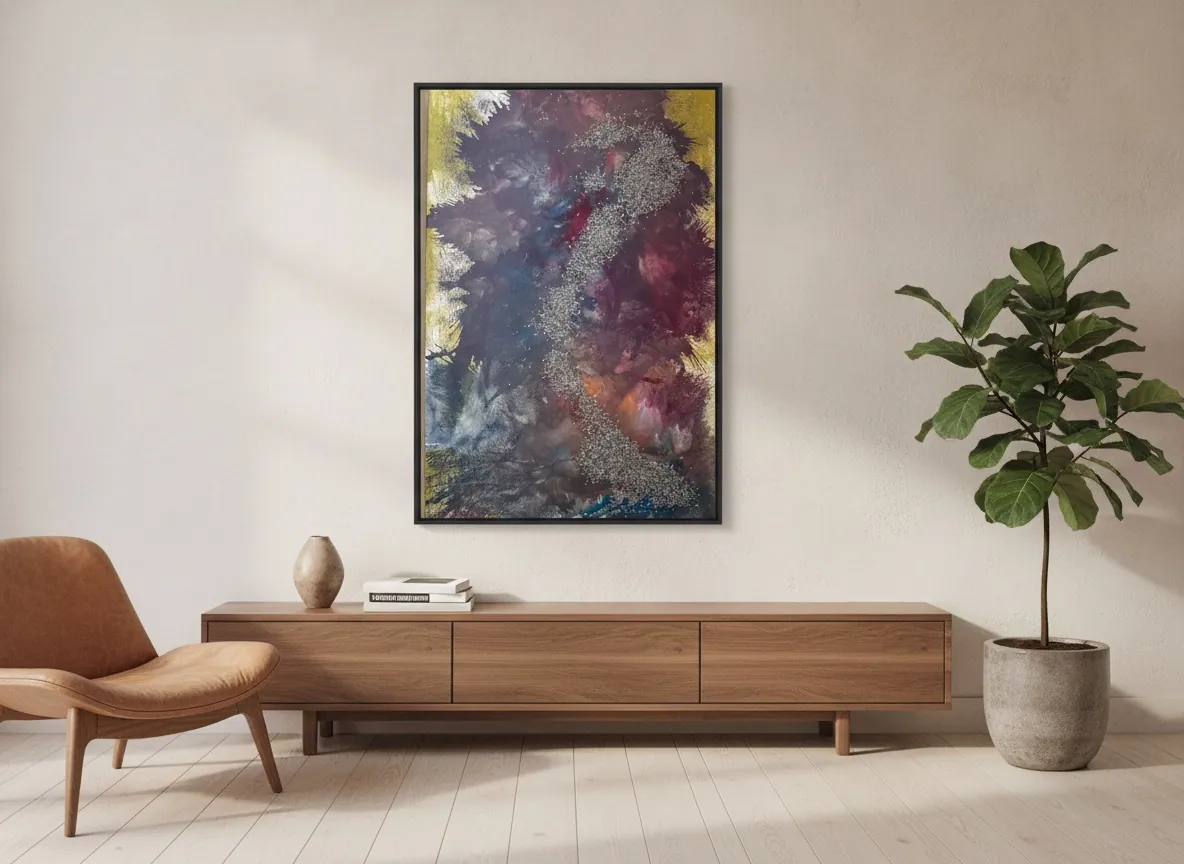
Elemental Veins, a 90 × 140 cm mixed-media piece from Alyne Perfeito's Terra & Ether series (Archive ID AP-TAE-2025-001), is a useful example of the first. Built in layered pigment, metallic dust and organic texture over canvas, its structure is closer to a geological cross-section than a single gesture — the kind of surface that doesn't depend on one trend in color or subject staying in fashion, because it was never built around one. That's not a claim about future value; it's a description of why some abstract, texture-built work tends to age as an object better than a piece keyed to one season's palette.
The second half is administrative, not aesthetic. Every original acquired through Perfeito Studio ships with a signed Certificate of Authenticity, an internal Archive ID, and a QR code linking back to the piece's official page — details that mean nothing to the eye and everything to whoever has to establish, years later, what the work is, when it was made, and that it's genuine.
What to put in place now, not later
Buying a piece you'd be glad to pass on is only half the exercise. The other half is making sure whoever inherits it doesn't have to reconstruct its story from memory. Three things are worth doing at the time of purchase, not after: keep the Certificate of Authenticity and invoice somewhere your family knows to look, not only in an inbox; tell at least one likely heir that the piece exists and roughly what it's worth, so it isn't discovered later and undervalued in an estate inventory; and note where you bought it and from whom, since a traceable point of origin is what separates a documented piece from an anonymous one decades later.
What this article can't do is tell you how inheritance tax, forced heirship, or estate procedure will treat the piece where you live — those rules vary by country and even by state, and they change. That part is a conversation for your own lawyer or accountant, not a general guide. What buying and documenting well can do is make sure that conversation, whenever it happens, starts from a clear record instead of a guess.
From the studio
The view from the studio
Every piece that leaves this studio gets its Archive ID and Certificate of Authenticity before it ever meets a collector — Elemental Veins carried AP-TAE-2025-001 from the day it was finished, not from the day someone asked about its history. I don't build a painting thinking about whose living room it will hang in fifty years, or whose hands it will pass through. But I do think about the version of me that isn't available to answer questions about it — which is most of the time, and eventually, permanently. Writing the technical sheet, dating the piece, keeping the archive current: that's not decoration on top of the work, it's the part of the work that outlasts the conversation we're having about it right now.
Frequently asked
Does buying art specifically as an inheritance for my children make financial sense?
That's the wrong lead question. The Art Basel & UBS Survey of Global Collecting 2025 found 80% of collectors already plan to pass their collections to children or a spouse — inheritance is the default outcome of collecting art, not a separate investment thesis. A piece bought only because it might be worth more later carries the same uncertainty as the art market generally. A piece bought because you want to live with it, well documented and built to last physically, is the version worth defending regardless of what it's worth later.
Will my children actually want the art I leave them?
There's reassurance in the data, with a caveat. The same 2025 survey found that among Gen Z collectors who had already inherited artwork, close to 90% chose to keep it rather than sell — younger heirs mostly hold on to what arrives. The bigger risk isn't rejection; it's disorganization. Deloitte's Art & Finance Report found only 24% of collectors have any long-term plan for their collection, so the piece is rarely the problem. The missing certificate, invoice, and conversation about it usually are.
How much of a piece's value to an heir depends on paperwork rather than the art itself?
A lot, in practical terms. A signed Certificate of Authenticity, a dated invoice, and a traceable Archive ID don't change what a painting looks like, but they're what let an heir prove what they own to an insurer, an appraiser, or a future buyer without reconstructing the story from memory. Every original from Perfeito Studio ships with these as standard, including a QR code on the certificate linking to the piece's official page — a record meant to still make sense in thirty years.
What should I actually do now, beyond buying the piece?
Keep the Certificate of Authenticity and purchase invoice somewhere your family will actually find, not buried in an old inbox. Tell at least one likely heir the piece exists and roughly what it cost, so it isn't discovered later and undervalued in an estate inventory. Note where and from whom you bought it — a traceable origin is what separates a documented piece from an anonymous one after a few decades. None of this takes more than an afternoon, and all of it is harder to do retroactively.
Is this legal or tax advice about inheriting art?
No. Inheritance tax, forced heirship rules, and estate procedure for artwork vary by country and by state, and they change over time — this article describes general patterns in how collectors plan (or don't), not a legal strategy for any specific jurisdiction. For the tax mechanics themselves, talk to your own lawyer or accountant, or see our companion article on how inherited art tends to be taxed in different countries.
Does the piece need to be expensive to be worth passing down?
No. What tends to matter more to an heir than the purchase price is whether the piece is documented, whether it holds up physically, and whether it means something within a coherent group of things you collected — not whether it was the most expensive object in the house. A well-documented piece bought for a few thousand reais can be easier to value, insure, and want to keep than an expensive one with no paperwork and no story attached.
Buying a piece meant to stay in the family?
Ask about Elemental Veins, or how documentation and the Certificate of Authenticity work — replies come directly from Alyne.
Published on