Can original art be specified for a room before the building is finished?
Yes. Original art is commonly specified against a floor plan, elevation, or render long before drywall and paint are done — the studio only needs the wall dimensions, orientation, and light exposure of the intended space. What cannot be finalized early is the final in-person reservation, which is normally confirmed once the room, or at least the wall, physically exists.
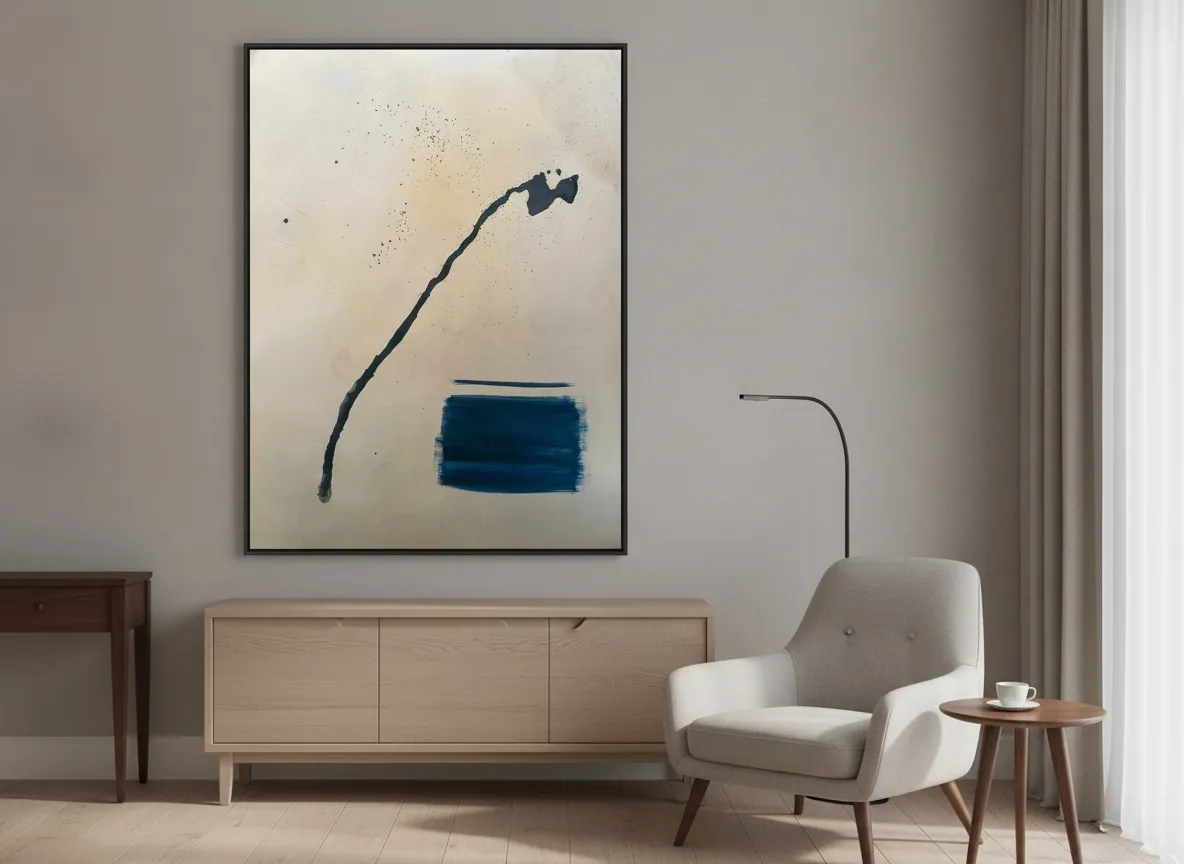
Why art gets specified before the walls are finished
On a renovation or a new build, the wall that will hold the artwork is often the last surface to exist — but the decision about what goes on it is made much earlier, usually at the same stage as flooring, lighting, and furniture. An architect or designer works from the floor plan and elevation drawings, not from a finished room, so specifying art at that stage is standard practice rather than an exception. The artwork becomes one more dimensioned element on the drawing set: a rectangle with a width, a height, and a wall it belongs to.
For a piece like Genesis of Flame, at 120 x 200 cm, that rectangle occupies a real amount of wall — closer to a fixed architectural feature than to a decorative object added at the end. Treating it that way from the render stage avoids the common mismatch where a wall is built, painted, and lit for a piece that turns out to be the wrong scale for it.
What the studio needs from you at the plan or render stage
To specify a piece before the room is finished, the studio works from information you already have on hand at that point in a project: the wall's width and height (or the render's implied proportions), the wall's orientation and light source, ceiling height, and the general mood of adjacent finishes. None of this requires a finished space — it is the same information an architect already carries in the drawing set.
From there, the studio helps match scale and palette against the current catalog, listed with exact dimensions and technique on each artwork page (see the gallery). A piece is not custom-made to fit a wall; the match is made between the room's dimensions and an existing work, or, if nothing fits, the conversation is held directly with the artist about what could.
Turning a placeholder into a confirmed piece
A render or a floor plan is useful for narrowing down scale, series, and palette, but it is not the same as a confirmed acquisition. Per the studio's own published terms, works can be reserved during an acquisition conversation, with reservation terms aligned individually rather than fixed in advance — so a specific hold period, deposit, or cancellation policy should be confirmed directly with the studio for your project rather than assumed from a general rule.
What is documented is the shape of the process once a work is confirmed: a signed Certificate of Authenticity, an official invoice or receipt, an Artwork Acquisition Agreement, an artist dossier, and preservation guidance accompany every acquisition, regardless of when in the build the piece was first chosen.
What can still change once the room actually exists
Even with careful early specification, a few things are only confirmed once the wall is physically there: exact hanging height, how daylight actually falls across the surface at different hours, and whether the piece's texture (many works in the Terra & Ether and Heart of Chaos series use raised mixed media, not flat paint) reads the way the render suggested. Installation guidance — hanging height, lighting, and conservation — is available on request once the space is ready, and is treated as a separate step from the specification decision made earlier.
Shipping is quoted once a destination is known: domestically it is quoted by postcode and can take up to 15 business days depending on destination, and internationally it is quoted per destination on request, with the buyer responsible for shipping cost and any import duties or taxes in the destination country. Exact customs figures for a given country should be confirmed with the studio or a customs broker rather than assumed from a general figure.
From the studio
The studio's view
Reading a room from a drawing before it exists is not a stretch for this studio — Alyne trained as an architect before she trained as a painter, and she still looks at a floor plan the way most people look at a finished photograph. When an architect sends a plan with a wall marked out, the questions that matter are the same ones she would ask on any site visit: which way does the light come from, how tall is the ceiling, what else is competing for attention on that wall. A render answers most of that. What it cannot answer — texture under real daylight, how a piece with raised surface catches a lamp at night — only gets settled once the wall is real.
Frequently asked
Can original art be specified for a room before the building is finished?
Yes. Specifying original art from a floor plan, elevation, or render is standard practice on a build or renovation — the studio needs the wall's dimensions, orientation, and light exposure, not a finished room. What typically waits until the space exists is the final confirmed reservation and the exact hanging installation.
What should a foreign buyer know before acting on this?
The process runs the same way regardless of where the buyer is based: dimensions and a render are enough to start the conversation on WhatsApp. International shipping is quoted per destination on request, professional packaging is included, and the buyer is responsible for shipping cost plus any import duties or taxes charged by the destination country — confirm the specifics for your country with the studio or your customs broker before committing to a timeline.
Does this differ for a US buyer vs a European buyer?
The specification step itself — sharing a plan or render and getting a scale and palette recommendation — does not differ by country. What differs is logistics: shipping cost, transit time, and import duties vary by destination and are quoted individually rather than as a fixed international rate. Confirm current shipping and customs terms for your specific country directly with the studio.
Who handles this in practice — the artist, a shipper, or the buyer?
The artist (or the studio on her behalf) handles the scale, palette, and specification conversation directly with the architect, designer, or buyer over WhatsApp. Shipping itself — quoting, packaging, and transit — is arranged by the studio once a destination is confirmed, but it is paid by the buyer. There is no separate specification fee: it is part of the same conversation that leads to acquisition.
What could go wrong if this step is skipped?
The most common mismatch is scale: a wall gets built, painted, and lit for a piece chosen without checking real dimensions against the room, and the work either overwhelms the wall or reads as too small once furniture and lighting are in. Texture is the second risk — a piece with raised mixed media can look flatter in a render than it does under real daylight, so confirming technique and photos of the actual surface avoids a surprise at installation.
Specifying art for a project still under construction?
Share the floor plan or render and the wall's dimensions — the studio will help match scale, palette, and series before the space is finished.
Published on