Art for interior designers in Brazil
Sourcing original art in Brazil for a project follows the same logic wherever you practice: specify by scale and sightline before palette, confirm lead time against the install date in writing, and buy direct from the studio — no gallery markup, documented with a certificate, a dossier, and an Archive ID for the client file.
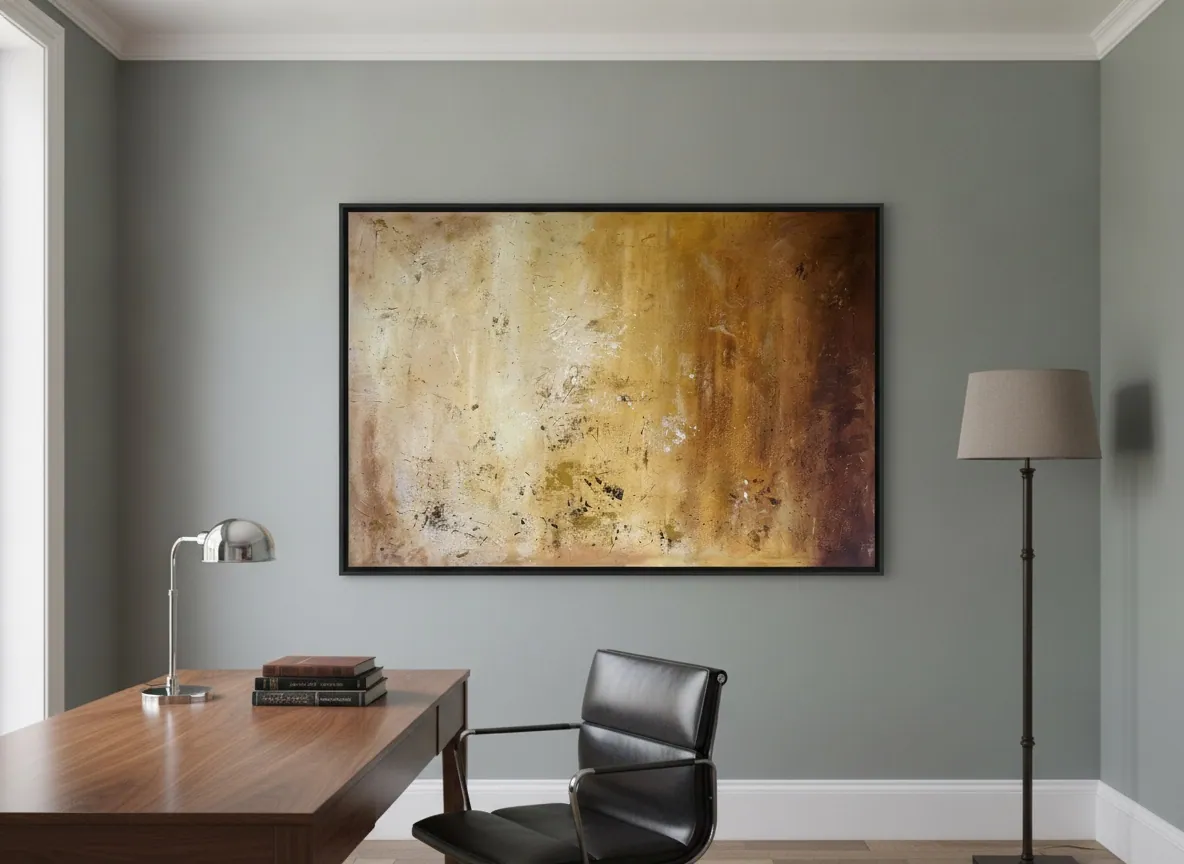
Specify by scale and sightline before palette
Art enters a project brief as a spec, not a mood-board choice, and it works best specified in the same order an architect specifies anything else: scale and sightline first, palette second. A wall's dimensions, the viewing distance from where a client actually stands or sits, and whether the space reads a horizontal or vertical field determine which pieces are even candidates — before color is on the table.
This matters more with mixed-media and textured surfaces than with flat prints, because scale changes how the surface itself reads. Amber Strata, a 150 × 100 cm horizontal work from the Terra & Ether series, holds a wide console wall or a low sightline the way a vertical piece from a series like Heart of Chaos holds a stairwell or a narrow hall — the same palette in the wrong orientation reads as a mismatch no color adjustment fixes.
Sending a floor plan, ceiling height, and the fixed elements already in the room — cabinetry, furniture, adjoining sightlines — gets a faster, more accurate response from a studio than a reference image alone. That is the information a piece is actually specified from.
Lead time versus your install date
The single most common failure point in specifying art for a project is timing, not taste. Melissa Grove, COO of Laura U Design Collective, has argued that art sourcing in the design world is "severely lacking," pointing in part to designers treating it as a final step in a project rather than confirming it early — the same gap shows up in commissioned work, where unclear briefs and short lead times are what most often cause friction between a designer and an artist.
The practical fix is sequencing, not urgency: confirm the piece — reserved from an existing catalogue, or agreed as a commission — as soon as the art line enters the brief, and treat the install date as the delivery deadline, not the deadline to start looking. A piece already finished and photographed can usually be reserved and confirmed within days. Anything that needs to be made, packed for a specific destination, or documented for a client file needs real runway, not a week.
Working from an existing catalogue vs. commissioning
Perfeito Studio's current catalogue holds 18 available originals across five series — Heart of Chaos, Matter & Silence, Luminous Rebirth, Black & Gold, and Terra & Ether — each already photographed, measured, and priced, from roughly R$ 1,800 to R$ 6,600. Specifying from the catalogue removes the biggest project risk: what you see is what ships, once availability is confirmed.
A commission trades that certainty for fit — an exact size, a palette pulled from your material board, a piece made to answer a specific wall. It also adds the risk the design trade keeps pointing back to: commissioned work is where "lead times, unclear expectations, and lack of communication" most often derail a project. A commission is worth asking for when the space genuinely needs a custom size or palette the catalogue doesn't have — not as the default, since it is slower and depends on where the artist is in her current series and studio calendar.
What a designer needs in writing for a client
Designers who work with reliable art sources typically confirm two things before reaching out to acquire a piece: the client's budget, and the artwork's exact spatial requirements — an approach echoed by firms like Jackson Warren Interiors, who describe reaching out to trusted sources only "once we have an idea of the client's budget, a direction for the design and spatial requirements for the artwork." The same discipline applies when buying direct from a studio: know the wall before you ask.
For the client file itself, ask for four things in writing before payment changes hands: exact dimensions and medium (not every mixed-media surface uses the same materials), year, documentation — a signed certificate of authenticity with the piece's Archive ID, plus a dossier covering the artist's background and the series context — and condition, including any marks or handling history worth disclosing to the client. Perfeito Studio issues all of this with every acquisition, and a project-level version of the dossier is available specifically for client decks and project archives.
Buying direct from a studio in Brazil: price, payment and delivery
Buying straight from the artist's studio removes the gallery's margin from the price — there is no consignment split built in, because there is no consignment. Alyne Perfeito's current available works run roughly R$ 1,800 to R$ 6,600, single original pieces with no editions or reproductions; an approximate reference in another currency is available on request, since exchange rates move and any figure quoted today would be stale by the time a project closes.
Payment terms, reservation windows, and delivery scheduling get worked out in the conversation itself, timed against your project's install date rather than a fixed storefront checkout — the same case-by-case process any direct acquisition runs on, with your client's calendar as the constraint. What protects the project is the paperwork: a signed acquisition agreement transferring ownership, an official invoice or receipt, and the certificate described above, all issued before or at delivery. Domestic delivery is arranged from Brasília; for a project outside Brazil, international shipping is quoted per destination — covered in full in the studio's guide to shipping original art internationally from Brazil, so it isn't repeated here.
What a single original changes on a specified wall is not negotiable the way a print is: it carries the artist's hand and a unique, documented surface a reproduction cannot claim — which is why most projects reserve it for the wall that matters most, rather than every wall in the brief.
From the studio
From the studio
When a designer sends me a floor plan instead of just a photo, the conversation changes. I trained as an architect before I trained as a painter, so I read a wall the way I'd read an elevation — where the sightline lands walking into the room, how the light moves across it through the day, what the piece needs to hold at that distance. A horizontal field like Amber Strata behaves differently over a low console than a vertical piece stacked into a stairwell, and that isn't a style question to me, it's a scale question I answer before we ever talk palette.
I ask for the same information every time: room dimensions, ceiling height, where the main light source sits, and what's already fixed in the space — furniture, cabinetry, sightlines from adjoining rooms. What I can't work from well is a mood board alone. A series like Terra & Ether reads as sediment and horizon up close and as a single warm mass from across a room, and knowing which distance your client will actually stand at changes which piece I'd point you toward.
Frequently asked
Do you offer trade terms for architects and designers who bring repeat clients?
<p>Yes — commercial terms for recurring collaborations are available on request, for studios and firms that specify original work across multiple projects a year. There is no published trade discount schedule, since it depends on the relationship; share an outline of your typical project volume and Alyne will work out terms with you directly.</p>
How far in advance should I contact the studio before a client's install date?
<p>As early as the art line item enters the brief, ideally before the space itself is finished. Designers who source art professionally are generally advised to start the conversation early rather than treat it as a last step, since a commission or reservation needs time to confirm, document, and ship. For a piece already in the catalogue, timing is simpler: confirm availability, then agree delivery against your install date.</p>
Can I commission a piece to fit an exact space and palette?
<p>Yes — commissions are considered based on where Alyne is in her current series and the studio's calendar, and a decline is a legitimate answer if the timing or idea doesn't fit. Bring the wall's dimensions, a palette reference, and any hard deadline; scope, timeline, and price are agreed in writing before work starts. A clear written brief protects the project as much as it protects the studio.</p>
What documentation do I get to include in a client presentation or project archive?
<p>A dossier covering the artist's background, series context, and technical sheet, plus, once a piece is confirmed, a signed certificate of authenticity with dimensions, medium, year, and the work's Archive ID. High-resolution images, and — when reference photography of the room is provided — a mockup of the piece in the actual space, are available for client decks.</p>
Do you ship internationally for projects outside Brazil?
<p>Yes — international shipping is quoted per destination once a piece is confirmed, since the process depends on the piece itself, the packing it needs, and where it's going. See the studio's guide to shipping original art internationally from Brazil for how packing, transit, and paperwork are typically handled for a project outside the country. Domestic delivery is arranged from Brasília, and collection in person is also welcome.</p>
Is a single original worth specifying over a print or reproduction?
<p>That's a project decision, not a rule — budget and scale sometimes call for reproduction. What a single original changes is what the wall is doing: it carries the artist's hand, a unique surface, and documented provenance a print cannot, which is part of why projects tend to reserve it for the wall that matters most rather than every wall in the brief.</p>
Sources
- Design Dash — 2026-07-27
- Business of Home — 2026-07-27
Bring a project to the studio
Send a floor plan, a wall's dimensions, or just the piece that caught your eye — Alyne answers project inquiries herself, in English or Portuguese.
Talk to the studio on WhatsApp
Published on