Art for an indoor pool house: chlorine, heat and reflected glare
An indoor pool room commonly runs 50–60% relative humidity and around 86°F (30°C) air — humidity that overlaps the safe range for canvas, heat well above it — plus continuous chlorine or bromine off-gassing that corrodes metal. The wall that works is set back from the water’s edge, out of direct splash, and away from reflected glare.
How humid and warm does an indoor pool room actually run?
The number worth checking first isn't a single "indoor pool" humidity figure — it's two numbers, since a natatorium (the technical term for an indoor pool room) has its air temperature and its relative humidity set separately, and both matter for a canvas. ASHRAE-based design guidance for natatoriums, as summarized by Chloramine Consulting, an indoor-pool air-quality consultancy, puts the target at 50–60% relative humidity, with 55% as the ideal set point — a band chosen to limit evaporation from the pool surface without dropping so low that swimmers feel a chill on wet skin. Air temperature commonly runs close to 86°F (30°C), kept a few degrees above the pool water itself (often cited near 84°F/28.9°C), to slow that evaporation further.
Line that against the Canadian Conservation Institute's guidance for paintings: "the safest RH for paintings on canvas or wood is a stable level between 40 and 60%," with a recommended temperature range of 16–25°C (61–77°F). The humidity bands actually overlap — a pool room held at 55% RH sits comfortably inside the range conservation guidance treats as safe for canvas. The real mismatch is temperature: 30°C sits roughly 5°C above the top of that recommended range, and the gap holds year-round, because a natatorium is kept warm continuously to keep water and air close in temperature — not only during a swim.
Chlorine, bromine and the chemistry a spa or a humid villa doesn't have
An indoor pool room carries a risk a spa's steam room and a humid villa don't: continuous chemical off-gassing from whatever sanitizes the water. Disinfection byproducts — chloramines in a chlorinated pool, bromamines in a brominated one — leave the water and disperse through the room's air. According to Chloramine Consulting, "the bromamine and THM byproducts that off-gas from bromine pools behave similarly to chloramine vapor, in that they are heavier than oxygen," which means both settle low, concentrating near the water surface rather than rising and dispersing on their own; the same source notes this is why natatorium HVAC design calls for source-capture exhaust regardless of whether the pool uses chlorine or bromine.
The corrosion mechanism this creates is specific to metal, not to canvas or paint film directly. Off-gassed byproducts condense on cooler surfaces, and Chloramine Consulting explains that the resulting HOCl "oxidizes metals and leaves behind chlorides," and that "chlorides break down the passive oxide layer that protects specific metals (i.e. the chromium oxide layer on stainless steel), exposing the steel so it can rust." That is part of why pool ladders, deck hardware and HVAC ductwork in a natatorium corrode faster than the same materials elsewhere in a house: moisture "condenses on metal surfaces… making condensation more likely than on other surfaces like brick," giving that corrosive chloride solution somewhere to sit.
Splash zone and glare: the two risks that are about placement, not chemistry
Distance from the water matters for a more literal reason than off-gassing: splash. Fine artist Dani Abbott, writing about placing art near pools, draws a sharp line between an outdoor pool at a distance and an indoor one: "a pool twenty feet away across an open patio is not doing meaningful damage to a painting inside your house," but "where it does matter is an enclosed or partly enclosed pool room, or a spa indoors. That is a genuinely corrosive environment and I would not put original work in it." A wall directly beside the pool edge, in the path of splash and pool-toy spray, is a different placement question than a wall set back across the room.
Glare is the other pool-specific factor a spa or a villa interior doesn't have in quite the same way: a large, flat, reflective water surface throwing light upward and around the room for most of the day. Abbott notes that "water bounces a surprising amount of light upward," and that framing choices matter more here than in an ordinary room: "unglazed textured work handles this much better than anything framed under glass, which turns into a mirror in these conditions. If a piece must be under glass, non reflective conservation glazing is worth every dollar here." A painting with real surface texture and no glazing keeps the light moving across it instead of bouncing it straight back at the viewer.
Where a painting actually holds up in an indoor pool house
Put the three factors together and the placement logic is straightforward, even where the underlying chemistry isn't: the wall that works is the one furthest from the water's edge, out of direct splash, on a surface that isn't cold enough to attract condensation, and away from the pool's own reflected glare where possible — a corridor leading to the pool room, a seating area set back from the water, or an interior wall perpendicular to the pool rather than one that faces it directly.
What doesn't belong on that wall, regardless of the piece: anything hung inside the pool room's wettest zone or directly over a spa built into the same enclosure, anything framed under ordinary reflective glass where the pool sits in the sightline, and — echoing Abbott's caution about metal leaf specifically near an indoor spa — a piece whose finish depends on exposed metal, positioned where it takes the chemical exposure first. None of this rules out original work in a pool house; it rules out treating the wall closest to the water like any other wall in the house.
From the studio
From the atelier
Brasília has more of these rooms than people expect — an indoor pool built into a house designed for year-round heat, not seasonal use, which means the room runs warm and gently humid every month of the year, not just in summer. When someone asks me about a piece for that room, my first question isn't about the painting, it's about the wall: how far it sits from the water, whether it catches direct splash, and whether the light off the pool hits it for most of the day.
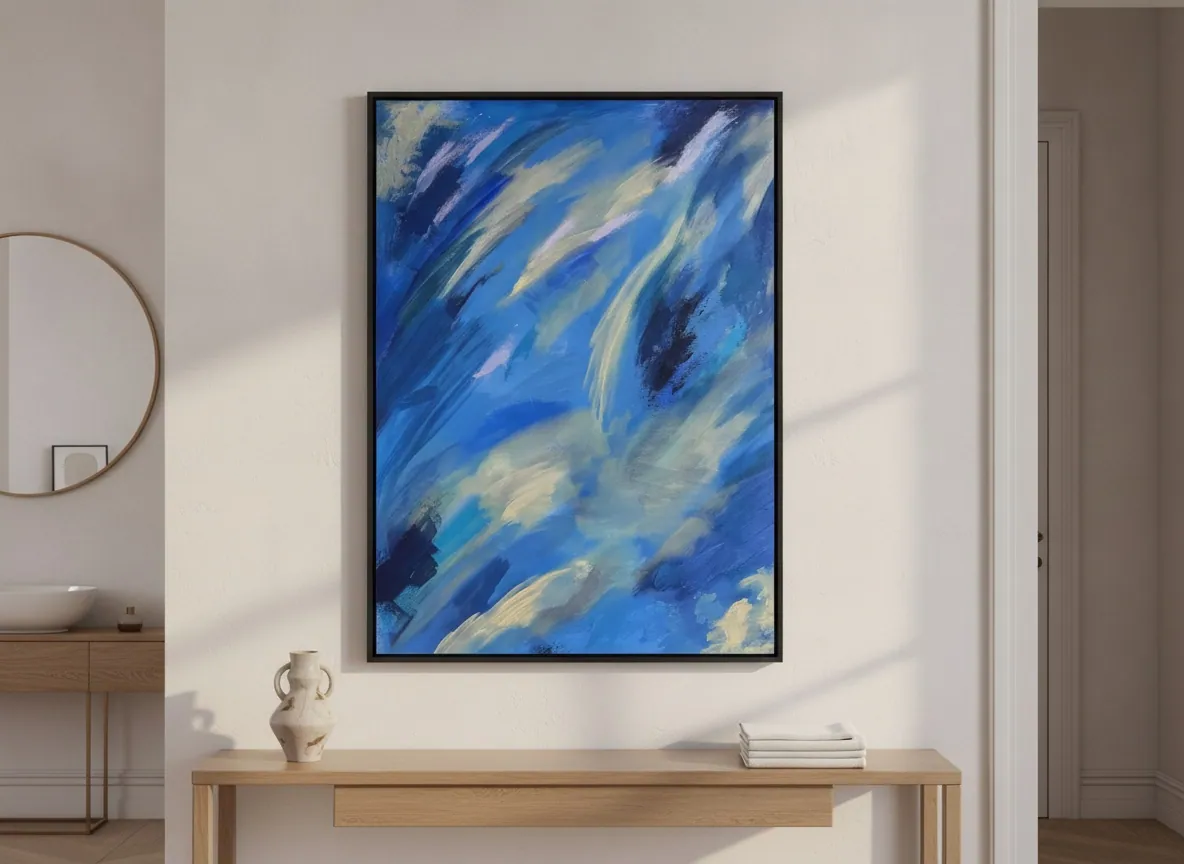
Every piece I make is acrylic-based mixed media on canvas, and for a room with continuous chlorine or bromine exposure, I steer a client first toward work without metallic leaf or fragments — not because I have a documented result on how gold leaf specifically responds to pool off-gas, I don't, but because it removes a variable neither of us needs to test. A piece like Celestial Drift, worked entirely in acrylic with real surface movement and no metal in it, is the simpler choice for a room like that. Texture does real work here too: a painting with genuine relief keeps changing as the light off the water moves across it through the day, instead of sitting flat under a glare that a smooth, glazed surface would just throw back.
Frequently asked
Can you hang a painting in an indoor pool house?
Yes, with attention to which wall. An indoor pool room (a natatorium) commonly runs 50–60% relative humidity and around 86°F (30°C) air temperature, and it also carries continuous chlorine or bromine off-gassing that a normal room doesn't have. The wall that works best is set back from the water's edge, out of direct splash, and away from the pool's reflected glare — not the wall directly beside the water.
What humidity level does an indoor pool room run at, and is that safe for a canvas?
ASHRAE-based design guidance for natatoriums targets 50–60% relative humidity, ideally 55%, which actually falls inside the 40–60% RH range the Canadian Conservation Institute treats as safe for paintings on canvas. The bigger mismatch is temperature: a natatorium commonly runs air around 86°F (30°C), well above the 16–25°C (61–77°F) range conservation guidance recommends for paintings, and that warmth holds year-round rather than only during a swim.
Does chlorine or bromine off-gassing actually damage a painting?
The documented damage from chloramine and bromamine off-gassing is to metal, not to canvas or paint film directly. According to Chloramine Consulting, the HOCl that forms when these byproducts condense on cool surfaces oxidizes metals and leaves behind chlorides, which break down the protective oxide layer on metals like stainless steel. That mechanism is why pool ladders, deck hardware and HVAC ductwork corrode faster in a natatorium — and why a painting with exposed metal leaf or metallic elements carries a real question mark in that environment, even without a documented study on gold leaf specifically.
How is an indoor pool room different from a spa or a humid villa, for art purposes?
The mechanisms differ even though all three involve moisture. A spa's steam room runs close to 100% relative humidity in short, intense cycles; a humid villa is about ambient climate with no water body or added chemistry; an indoor pool room sits in a moderate, stable 50–60% RH band but adds continuous chlorine or bromine off-gassing, direct splash risk, and glare bouncing off a large flat water surface — three factors a steam room and a humid villa don't combine in the same way.
Which Perfeito Studio pieces suit an indoor pool house best?
For a wall set back from the water and its glare, a piece without metallic leaf or fragments is the simpler choice given the continuous chemical off-gassing an indoor pool room carries. Celestial Drift, from the Luminous Rebirth series, works entirely in acrylic with a blue-and-ivory palette that echoes water and daylight, and its surface movement keeps responding to the shifting light off the pool rather than sitting flat under the glare.
Thinking about a piece for your indoor pool house?
Tell the studio about the room — how close the wall sits to the water, how it's ventilated, whether it's chlorinated or brominated — and we'll help you find a piece and a placement that actually holds up.
Sources
- Chloramine Consulting — 2026-09-26
- Chloramine Consulting — 2026-09-26
- Canadian Conservation Institute / Government of Canada — 2026-09-26
- Chloramine Consulting — 2026-09-26
- Chloramine Consulting — 2026-09-26
- Chloramine Consulting — 2026-09-26
- Dani Abbott Fine Art — 2026-09-26
Published on