Art for a High-End Tattoo Studio
A high-end tattoo studio calls for abstract art with strong physical texture, in a dark or earthy palette — never figurative illustration that competes with the tattoo work itself — sized large enough to hold a reception wall on its own. The piece works best placed away from the workstation, where ink and disinfectant never reach it.
Why the art on the wall matters as much as the work on the chair
A high-end tattoo studio already competes with its own imagery — reference walls, flash sheets, healed-work photos, a portfolio screen running on loop. In that saturated visual field, the art in the reception has a different job than ordinary decor: it does not need to add more image, it needs to give the client one place to rest their eyes before or after the session.
It is also one of the fastest signals a first-time client reads. A studio that hangs an original, signed, documented piece is communicating the same kind of care as sterile instruments and a clean floor — a different signal, aimed at the same decision the client is making: whether to trust that space with their skin.
Should it be abstract or figurative?
The most common mistake is choosing art that echoes the studio's own subject matter — a skull illustration, an enlarged flash design, a framed old-school reference. That turns the reception into an extension of the design catalog instead of offering the client something new to look at, when they are about to spend the next hours surrounded by exactly that kind of imagery on their own skin.
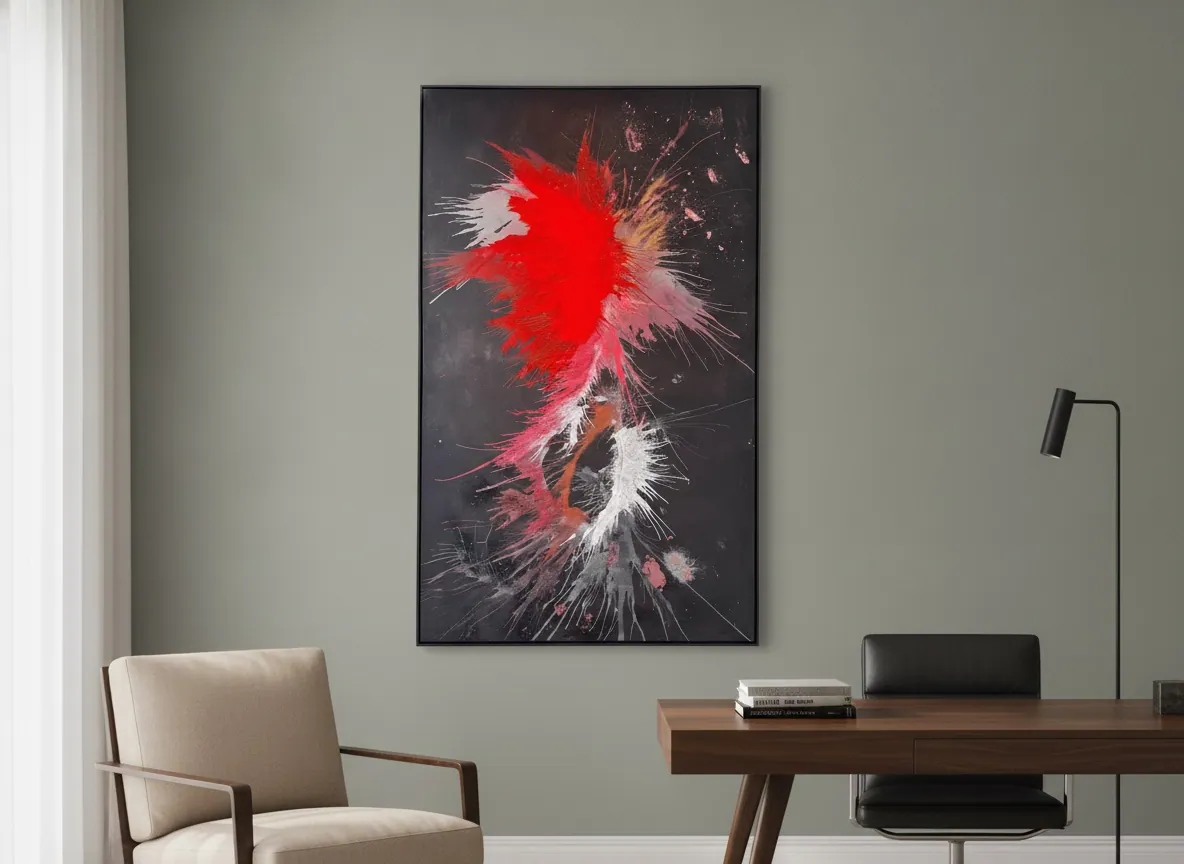
Abstract work with dense, physical texture tends to solve this better. In the Perfeito Studio collection, a piece like Genesis of Flame (120 x 200 cm, mixed media on canvas with acrylic, metallic pigment, and a high-gloss and matte finish) sits between deep red and near-black tones with a surface built in visible layers — close to the high-contrast, textured visual language tattoo clients already respond to, without repeating its figurative vocabulary.
Does a tattoo studio need original art at all?
It does not need it the way it needs a sterilizer or a licensed artist — a studio can operate perfectly well with a bare wall or a framed print. What original art adds is differentiation in a category where most studios look alike: exposed brick, black walls, the same three plants, a print from the same stock source as the studio two blocks away.
An original, one-of-a-kind piece — bought directly from the artist rather than reproduced — is a harder thing to copy than a tattoo design, and it reads that way to a client who is comparing studios before booking. It is a discretionary upgrade, not a requirement, and it pays off most in studios that already position themselves as premium on price and clientele.
What about disinfectant and ink exposure?
Tattoo studios routinely handle ink, isopropyl alcohol, antiseptic soap and other cleaning products — none of which should, under normal use, ever touch the artwork, but the risk is real if a piece is hung too close to the workstation or the sink. In the studio's own practice, the simplest safeguard is physical distance: place the piece in the reception, the waiting area, or a circulation hallway — never in the procedure room itself or mounted right above the station where ink and products are handled.
This applies to framed and unframed canvas alike. Neither surface is meant to be wiped with alcohol or solvent, and neither should be treated as part of the cleaning routine for the room.
What size fits a tattoo studio wall
Tattoo studio receptions tend to be tight footprints — a front desk, one or two waiting chairs, sometimes a wall already carrying licenses and healed-work photos. In that kind of square footage, one medium-to-large piece, given room to breathe, reads better than two or three smaller ones competing with each other and with everything else on the wall.
Square formats between 80 x 80 cm and 100 x 100 cm work well on a short wall segment. For a wider wall behind the front desk, a large horizontal or vertical piece above 120 cm on its long side — the scale of Genesis of Flame at 120 x 200 cm — holds that span without looking lost. Either way, the practical rule is the same one that applies to any commercial space: one piece with real presence beats a cluster of small ones.
From the studio
The studio's perspective
Working across large-format, high-contrast pieces with built-up metallic layers is a direct extension of thinking as an architect first — reading a wall for scale, sightline and the amount of ambient light it actually receives before deciding how a piece should sit on it. A tattoo studio's reception is one of the more demanding rooms to place work in: tight footprint, mixed lighting, a public already trained to scrutinize surface and detail up close. Pieces built with a high-gloss and matte contrast in the same surface tend to hold up best in that kind of scrutiny, because there is always a new layer to find on a second look, the same quality that keeps a well-designed tattoo interesting years after it heals.
Frequently asked
What art fits a tattoo studio?
Abstract, large-format work with visible physical texture — layered pigment, metallic finish, sculpted paste — in a dark, earthy or high-contrast palette. It reads as intentional and premium without repeating the figurative imagery already on the studio's own walls.
Should it be abstract or figurative?
Abstract, in almost every case. Figurative art that echoes tattoo subject matter (skulls, old-school illustration, enlarged flash art) tends to make the reception feel like an extension of the design catalog rather than a distinct space for the client to rest their eyes.
Does a tattoo studio need original art at all?
No — a studio can run without it. What original, one-of-a-kind art adds is differentiation in a category where most studios use the same stock prints and the same three plants. It is a discretionary investment in how the space is perceived, not an operational requirement.
What about disinfectant and ink exposure?
Ink, alcohol and antiseptic products should never contact the artwork directly, so the practical safeguard is placement: keep the piece in the reception, waiting area or a hallway, away from the procedure room and the station where products are handled and cleaned.
What size for a studio wall?
For a short wall segment, a square piece between 80 x 80 cm and 100 x 100 cm works well. For a wider wall behind a front desk, a large piece above 120 cm on its long side — such as a 120 x 200 cm format — holds the space better than several smaller pieces.
Can I buy art directly from the artist as an international buyer?
Yes — Perfeito Studio sells directly from the artist's studio in Brasília, Brazil, with no gallery intermediary. Every piece ships with a certificate of authenticity, a curatorial dossier and a unique Archive ID. Reach out over WhatsApp to discuss a specific piece and delivery to your location.
Looking for an original piece for your studio?
Talk directly with the artist's studio about scale, palette and delivery.
Published on