Art for a restaurant: what survives grease, steam and a full room
A restaurant dining room puts three things on a painting that a living room does not: airborne grease from the kitchen, steam and temperature swings near an open pass, and a room that is full and warm for hours at a stretch. The practical answer is a mixed-media or acrylic piece with a sealed surface, hung away from vents and the pass, and cleaned only by dry methods — never wiped with a damp cloth or cleaner.
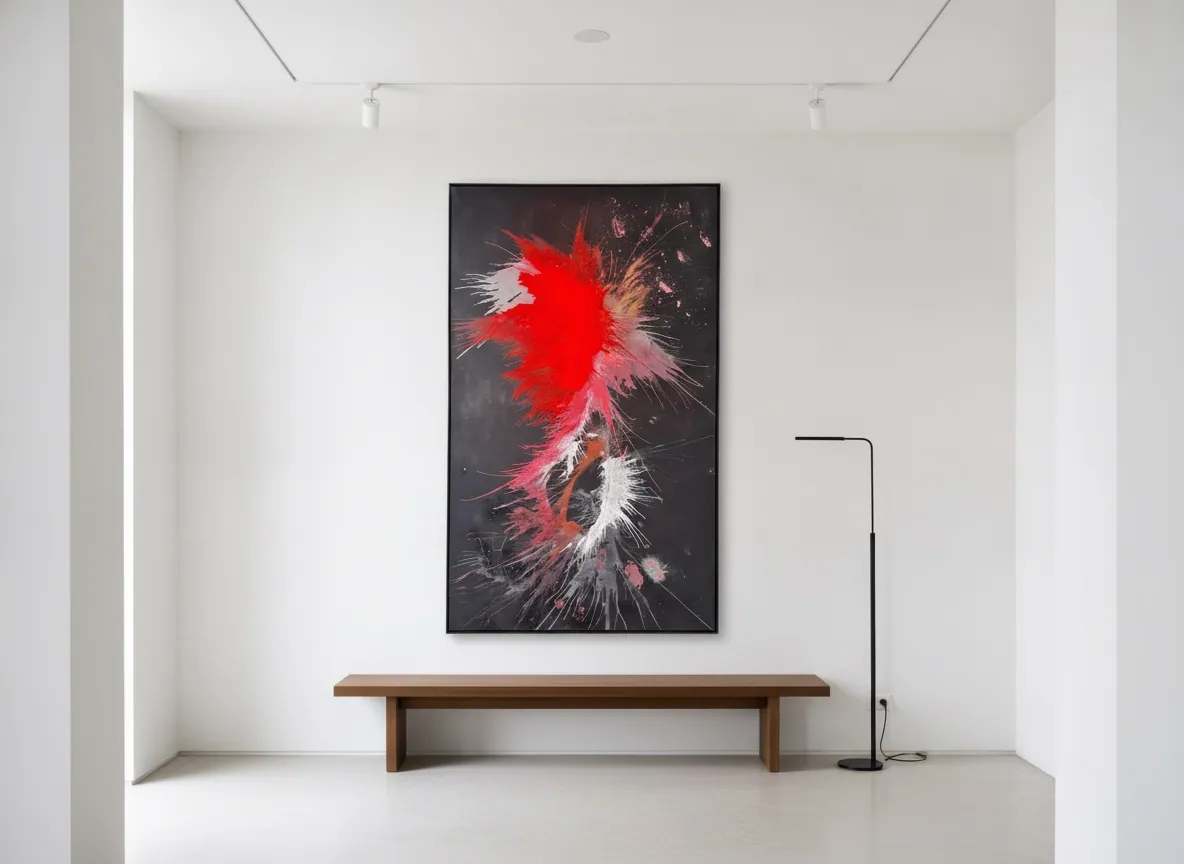
What a dining room does to a painting that a living room does not
Three conditions separate a restaurant dining room from a residential wall. First, airborne grease: any kitchen that fries, grills or sears releases fine oil particles into the air, and over months those particles settle on nearby surfaces as a thin, sticky film — the same film that leaves a tacky residue on a range hood or a glass partition near the pass. Second, steam and heat spikes: an open kitchen or a pass-through window pushes bursts of warm, humid air into the room every time an order comes up, which is a sharper swing than the slow, even climate of a house. Third, a full room for hours: body heat, cooking heat and a packed dining room during service raise both temperature and humidity for the length of a shift, then the room cools again after close.
None of this makes a painting a bad fit for a restaurant — it changes which piece, and where it goes.
Where to hang it: away from the pass, the vents and the direct line of the kitchen
The wall that takes the least airborne grease and the fewest heat swings is the one furthest from the kitchen pass, the exhaust hood and any HVAC vent that cycles frequently. A wall at the back of the dining room, away from the direct sightline into an open kitchen, sees a fraction of the particulate and humidity that a wall right next to the pass does. If the layout puts every wall within reach of the kitchen — common in a small or open-plan restaurant — the next best move is distance and airflow: further from the heat source, and not directly in the path of the exhaust fan's intake.
A painting with a varnished or sealed surface tolerates this environment better than a raw canvas or an unsealed watercolor, because the sealed surface gives grease and dust less to bond to.
Cleaning: dry only, and less often than you'd think a painting needs
The Canadian Conservation Institute's guidelines on caring for paintings are direct about the risk of casual cleaning: "even dusting can be hazardous on a sensitive or damaged surface, and aqueous or solvent cleaning when done in an uninformed manner can have major negative consequences." That applies to a restaurant wall exactly as it applies to a museum wall — a damp cloth, a glass cleaner or an all-purpose degreaser should never touch the painted surface, even when the rest of the dining room gets a wipe-down every night.
In the studio's own practice, routine care for a painting in any commercial space is dry only: a soft, dry cloth or brush to remove surface dust, no liquid, no solvent, no pressure. If a visible film of grease builds up over months near a kitchen, that is a job for a professional conservator, not a nightly cleaning crew — the same CCI guidance is clear that cleaning beyond light dusting needs to be done by someone trained to do it.
Climate and light: the same stability rules, applied to a working room
The CCI notes that a stable relative humidity in the vicinity of a painting matters because canvas and wood supports are hygroscopic — they respond to humidity changes, and repeated swings show up over time as cracking and eventual paint loss. A restaurant kitchen is one of the more variable climates a painting will see day to day, which is another argument for hanging it away from the pass and the exhaust path rather than trying to fully climate-control a working dining room.
Light matters too: the same guidance recommends against direct sunlight and against a spotlight or picture lamp aimed directly at the surface. In a dining room this usually means positioning the piece away from a west-facing window and choosing ambient or indirect lighting over a hot spotlight trained on the canvas for hours during service.
From the studio
The studio's view: reading the kitchen before reading the wall
Trained as an architect before turning to painting, the first thing I look at in a restaurant is not the wall that needs art — it's where the heat and the grease in that room actually travel. A dining room with the kitchen tucked behind a closed door gives far more freedom than one built around an open pass, and the piece I'd suggest for each is different before we even talk about color.
Genesis of Flame, from the Heart of Chaos series, is worked in acrylic and metallic pigment with a high-gloss and matte finish, and it reads from across a room rather than up close — which happens to suit a dining room, where guests see the piece from their table, not from six inches away. For a restaurant with real kitchen exposure, that durability matters as much as the palette.
Frequently asked
What art works in a restaurant?
A sealed, durable surface reads best over time — a sealed painted surface generally holds up better to airborne grease and handling than raw canvas, unsealed watercolor or unprotected paper. Bold, large-scale pieces also work well because most guests view the art from across the room rather than up close.
Does kitchen grease and steam damage a painting?
Over months, airborne grease from cooking can settle as a thin film on any nearby surface, including a painting, and repeated steam or heat spikes near an open kitchen add stress that a stable residential room does not have. The practical fix is distance from the pass and exhaust path, not avoiding art altogether — a sealed surface hung away from the kitchen's direct line holds up well.
What finish holds up best in a dining room?
A sealed or varnished surface gives grease and dust less to bond to than an unsealed or matte-absorbent surface. It also makes dry cleaning, the only cleaning method recommended for a painted surface, more effective.
Should art be behind glass in a restaurant?
It is generally not required for a painting on canvas, and glazing changes how the piece reads under restaurant lighting by adding reflection. Glazing is more often used for works on paper or watercolor, which are more vulnerable to airborne soiling and humidity than a painting on canvas.
What size fits above a banquette?
A single large-format piece — in the 100 x 150 cm to 120 x 200 cm range — usually reads better above a banquette than a cluster of small frames, because it holds up against the visual noise of a full dining room and is legible from across the space rather than only up close.
Choosing art for your restaurant's dining room?
The studio can help match a piece to your space, factoring in kitchen exposure, scale and lighting.
Sources
- Canadian Conservation Institute (Government of Canada) — 2026-09-27
- Canadian Conservation Institute (Government of Canada) — 2026-09-27
- Canadian Conservation Institute (Government of Canada) — 2026-09-27
Published on