Art for a fertility clinic
A fertility clinic reception is seen repeatedly by the same patient over months of treatment, not once. The safest choice is abstract, sober, and free of any pregnancy, baby, or family imagery — avoiding both the picture that could wound someone mid-cycle and the implied promise the clinic cannot make.
Why this waiting room is not like a general clinic's
A fertility clinic's reception is read by the same person many times over a treatment cycle that can run for months — not by a single first-time visitor. Every return brings a different emotional register: hope before a transfer, anxiety before results, grief after a cycle that did not work, or simply exhaustion from a process that has already gone on longer than expected. Art on that wall is not decoration seen once; it is a fixed presence across a period the patient did not choose to be in.
That is why a general guide to waiting-room art — built around a broad public and a short visit — does not transfer cleanly here. A fertility clinic needs a content filter first: what the image must never suggest, before any question of scale or palette.
What to rule out, without exception
No piece with a figurative reference to pregnancy, a baby, a family with a child, or an associated symbol (a stork, a nest, a seed sprouting, a cocoon) belongs in a room where part of the public is there precisely because a pregnancy has not happened yet, is uncertain, or was recently lost. The intent behind such imagery may be hopeful — celebrating new life, a fresh start — and it can still wound the specific person sitting there that day.
For the same reason, this guide does not suggest, and no clinic should imply, that any artwork or environment influences a fertility treatment's outcome, clinically reduces stress, or substitutes for medical guidance. Choosing art here is an interior-design decision about what a wall will not communicate by accident — never a claim about a patient's result.
Palette and composition: sober, abstract, without a storyline
An abstract composition with no identifiable subject is the safest register for this room: it cannot be misread as a family scene, a fertile landscape, or any image onto which a patient might project unintended meaning. Series built on contained palettes and resolved, earth-toned gesture — Terra & Ether or Matter & Silence — tend to work better here than pieces with saturated color or expansive, fire-and-origin gesture (Heart of Chaos, for instance, is a series to avoid in this specific context — not for lack of quality, but because of its thematic naming and composition).
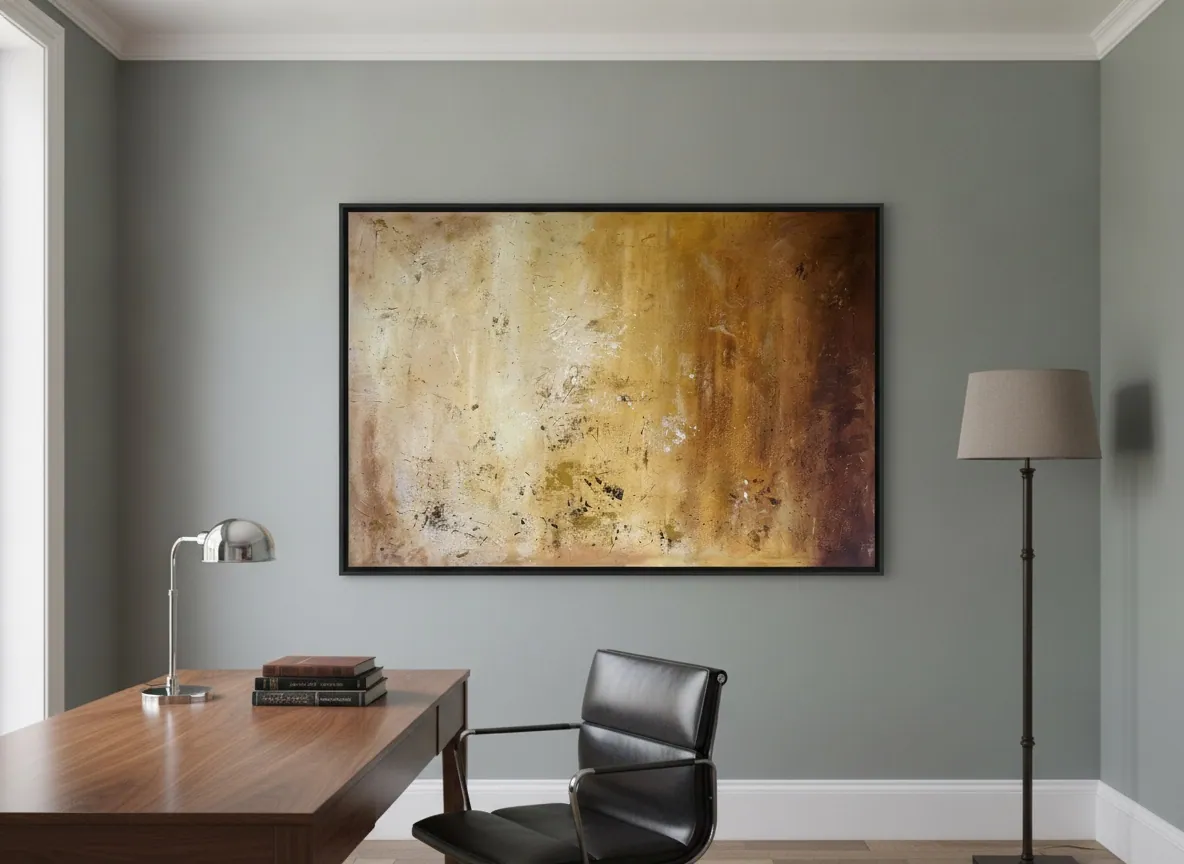
Amber Strata, 150 × 100 cm (Terra & Ether, mixed media with acrylic and textured paste on canvas), is representative of what works: horizontal bands of warm, earthen color that cross without forming a scene, with no narrative point of entry and nothing that invites a story to be read into it.
Scale by room: reception, waiting area, and consultation rooms
The main reception and waiting area — where a patient sits longest and views the piece from some distance — can carry a medium-to-large presence, such as Amber Strata itself (150 × 100 cm, BRL 6,700) or, on a taller wall, Silent Interval (120 × 160 cm, Matter & Silence, BRL 7,900). Smaller consultation or procedure rooms call for an entry-scale piece — Echo of Silence (50 × 70 cm, Matter & Silence, BRL 2,400), close-read and textured, sized to sit quietly beside clinical equipment rather than compete with it.
The same rule applies across any clinical environment: measure the actual free wall before choosing scale, and in this specialty in particular, less is safer — a single sober piece signals care without leaving room for a reading no one intended.
International purchase: shipping, documentation, buying direct
Clinics outside Brazil buying from Perfeito Studio purchase directly from the artist's studio in Brasília, without a gallery markup, and receive an Archive ID, a certificate of authenticity, and a dossier documenting the piece for the clinic's own records. Framing and international shipping are quoted per piece and per destination once dimensions and country are confirmed; pricing is listed in BRL, with foreign-currency figures given only as an approximate, non-binding conversion at the time of inquiry.
From the studio
The studio's view
Before I am a painter, I trained as an architect, and that habit does not turn off when a request comes from a clinical space that carries this much emotional weight. For a fertility clinic, the first question I ask is not about style — it is about who sits in that room and for how long. It changes which series I will even show: anything with a name or gesture that reads as birth, dawn, or new light comes off the list, and I stay with the work that is about matter, earth, and quiet — a surface that occupies a wall without narrating a story that is not mine to tell.
This is not a precaution I apply once and forget. It is a standing editorial choice for the studio: no piece in this catalog is sold, recommended, or described as having any relationship to fertility or pregnancy, in a fertility clinic or anywhere else — the work stays abstract, and the silence around that subject is deliberate.
Frequently asked
What art works in a fertility clinic?
Abstract, sober compositions with no identifiable subject work best — pieces from contained-palette series such as Terra & Ether or Matter & Silence, where color and texture read as landscape or material rather than a scene. Avoid anything figurative or symbolic, and avoid saturated, high-energy compositions that can feel at odds with a room where patients are often anxious.
Should the art avoid imagery of children or families?
Yes, without exception. A fertility clinic serves patients who may be mid-treatment, uncertain of the outcome, or grieving a recent loss. Any figurative reference to pregnancy, babies, or families with children — or symbols like a stork, nest, or sprouting seed — risks wounding exactly the person the room is meant to put at ease.
What palette feels hopeful without being clinical?
Warm, earthen tones in an abstract, non-narrative composition tend to read as calm and grounded rather than sterile, without tipping into a message the clinic cannot back up. A series like Terra & Ether uses ochre, rust, and metallic fragment against a contained palette — present and warm, but with no scene to interpret.
What size fits a small, intimate waiting room?
For a compact consultation or procedure room, an entry-scale piece around 50 × 70 cm sits well without competing with clinical equipment or furniture. Reserve larger formats, from 100 × 100 cm up to roughly 150 × 100 cm, for the main reception or waiting area, where the piece is viewed from a greater distance.
Original art or print for a specialty reproductive clinic?
An original carries texture, an Archive ID, and a certificate of authenticity that a print cannot — details that matter for a clinic building a considered, professional environment for a sensitive specialty. A print is a reasonable interim step for a smaller room or budget, but it should be disclosed as such rather than presented as an original piece.
Can the art claim to reduce patient stress or help treatment outcomes?
No. Sober, well-chosen art can make a waiting room feel calmer, but no clinic or artist should claim it reduces stress in a clinically measurable way or affects a fertility treatment's outcome. Any such claim overstates what interior design can honestly promise a patient.
Sourcing art for a fertility clinic abroad?
We ship internationally and can advise on scale and palette for reception and consultation rooms.
Published on