Art for a double-height wall: how big, how high, and how it gets up there
A painting for a double-height wall should be sized to about two-thirds of the usable wall height, hung with its center near standard eye level (about 57 in / 145 cm) rather than pushed upward to fill the space, and installed with hardware anchored into studs — a French cleat is the standard choice for anything at real scale.
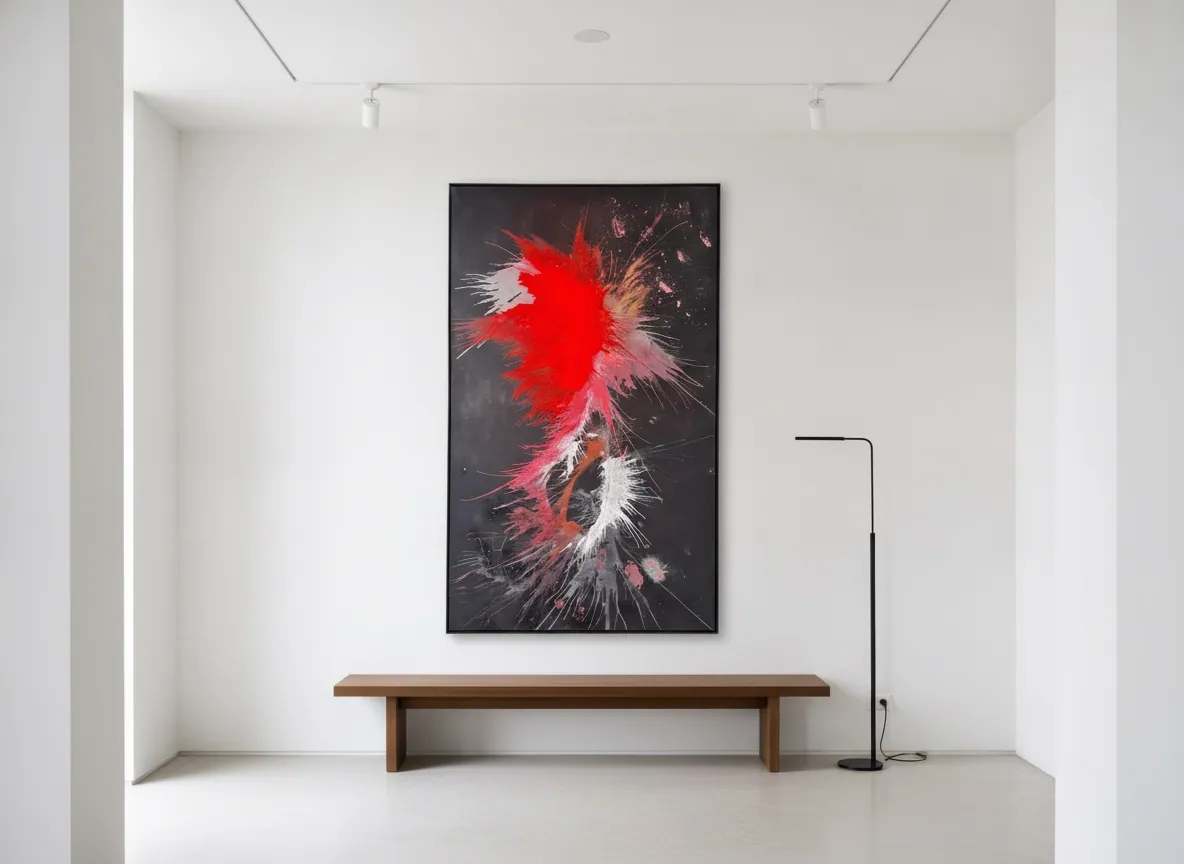
How big should the painting be?
A double-height wall does not require the largest painting the market makes — it requires the largest painting the wall can hold without the empty space around it reading as absence. The standard reference used for tall or staircase walls is to measure the usable wall height — from where furniture, wainscoting, or the floor itself ends up to the ceiling — and treat roughly two-thirds of that span as the practical ceiling for a single piece, with a vertical orientation reading better than a horizontal one on a wall taller than it is wide [1].
In practice, very few single canvases reach floor-to-ceiling scale, and that is not a failure of ambition. A painting sized to command its own field of wall, with generous bare wall left above and around it, reads as more deliberate than one stretched thin to try to abolish the empty space entirely. Within the Perfeito Studio collection, Genesis of Flame (120 × 200 cm / 47 × 79 in, mixed media on canvas, Heart of Chaos series, R$ 8,800) is the largest vertical work currently available, and it was built at that scale specifically to hold its own on an architectural wall rather than a domestic one.
Where the center of the painting should sit
The instinct on a double-height wall is to raise the painting to meet the ceiling. The eye-level rule argues against that: the most widely used reference for gallery and residential hanging places the center of the artwork at 57 inches (about 145 cm) from the floor, matching the average standing eye level of an adult in the room [2]. That number is anchored to the person looking, not to the architecture — a taller wall does not move it.
A wall seen straight-on as you enter a room — as opposed to the angled wall running alongside a staircase — is the configuration that suits one confident, large-scale piece rather than a stepped sequence of smaller works [1]. If the double-height wall in question does run beside a stair, the same source recommends keeping each piece's center at a consistent height above the stair nosing directly below it — commonly around 60 inches — so the line of the artwork follows the rake of the stair rather than a flat horizontal.
How it physically gets up there: hardware and installation
Weight, not height, is what should decide the hardware — but height changes what happens if the hardware fails, which is why professional installers are the standard recommendation for artwork going up on vaulted ceilings or in stairwells, particularly above roughly 100 lbs (45 kg), where the job calls for proper scaffolding or ladder setup rather than one person on a step stool [3].
The anchor point matters more than the fastener. Wall studs, typically spaced 16 to 24 inches apart, take the load far more reliably than drywall alone; the same guidance recommends choosing hardware rated for at least double the piece's actual weight, moving from molly bolts (roughly 20–50 lbs) to toggle bolts and, above about 100 lbs, to a French cleat secured across multiple studs [3]. A French cleat is two interlocking angled bars — one on the wall, one on the back of the piece — that distribute weight along their whole length instead of concentrating it on a single hook; standard cleats carry 100–200 lbs, and heavy-duty versions rated up to about 500 lbs are routinely used by galleries and installers for large-format work [4].
Every acquisition from Perfeito Studio ships unframed and ready to hang, with gallery-finished edges, and installation guidance — hanging height, hardware, lighting angle — is available on request as part of the acquisition process, worked out directly with the studio rather than handed off as a printed instruction sheet.
Single grand-scale piece, or a stacked arrangement?
For a wall that reads as a single volume the moment you walk into the room — an entry, a living space open to a mezzanine, a double-height dining wall — the more confident choice is usually one grand-scale painting rather than a cluster: the advice from gallerists working with exactly this kind of space is to size the piece with real scale in mind and resist the instinct to go smaller because the wall feels intimidating [5]. A single work also keeps the eye-level logic simple — one center point, one measurement — where a grid or stepped sequence forces a decision about which piece anchors the height.
The exception is a wall that is narrow as well as tall, most often a stair run rather than an open double-height space: there, a set of vertical works stacked toward the tallest section of wall — usually near a landing — can read better than a single canvas struggling to cover width it doesn't have [1]. Silent Interval (120 × 160 cm / 47.2 × 63 in, mixed media on canvas, Matter & Silence series, R$ 7,900) is close in scale to Genesis of Flame but reads quieter — a useful second reference for a tall wall in a room meant for calm rather than intensity.
From the studio
From the studio
I trained as an architect before I trained as a painter, and a double-height wall is the kind of problem I still think about the way I would think about a section drawing. The temptation with a very tall wall is to make the painting answer the ceiling — to chase the extra meters with more canvas. I don't. Genesis of Flame is 200 cm tall, which is large by most rooms' standards and still modest against a real double-height volume, and I built it to hold that scale through density and contrast rather than sheer size: the black field has to be dark enough, and the red ignition at its center concentrated enough, that the piece reads with authority from the far side of a room two floors tall. A painting on a wall like that isn't competing with the architecture. It's the one still point the architecture gets to organize itself around.
Frequently asked
How tall does a painting need to be for a double-height wall?
There is no fixed minimum. The useful reference is roughly two-thirds of the usable wall height, measured from where furniture or the floor ends up to the ceiling, with a vertical orientation reading better than a horizontal one on a wall taller than it is wide. In the current Perfeito Studio collection, the largest available vertical work is Genesis of Flame at 120 x 200 cm; most double-height walls have room for a piece at that scale with generous bare wall left above and around it, rather than needing something floor-to-ceiling.
Should I hang the painting higher because the ceiling is higher?
No. The standard eye-level rule places the center of the artwork at about 57 inches (145 cm) from the floor, matching where an adult standing in the room naturally looks. That measurement is set by the person, not by the ceiling height. Raising the piece to visually meet a tall ceiling usually just moves it out of the sightline of anyone standing at a normal viewing distance from the wall.
Can one painting fill a double-height wall on its own, or do I need several?
For a wall that reads as one open volume as you walk into the room, a single large-scale painting is usually the stronger choice, sized with confidence rather than kept small because the wall feels intimidating. Grouping or stacking several pieces tends to work better on a wall that is narrow as well as tall, most often a staircase, where a set of vertical works stacked toward the tallest section near a landing reads more naturally than one canvas trying to cover width it doesn't have.
What hardware does a large painting need at that height?
Weight decides the hardware, and hardware should be rated for at least double the piece's actual weight. Wall studs, usually spaced 16 to 24 inches apart, are the anchor point that matters most. Lighter pieces can use molly bolts, but anything moving into serious weight is better served by toggle bolts or, past roughly 100 lbs, a French cleat secured across multiple studs. A French cleat is two interlocking angled bars, one on the wall and one on the back of the piece, that spread the load along their length instead of concentrating it on a single hook.
Should I hire a professional installer for a double-height wall?
For anything going up on a vaulted ceiling, a stairwell, or another hard-to-reach tall wall, professional installation is the standard recommendation, particularly once the piece is heavy enough to need proper scaffolding or a ladder setup rather than one person on a step stool. It is as much a safety question for the installer as a protection question for the painting.
Does a painting from Perfeito Studio arrive ready to hang on a wall like this?
Yes. Works ship unframed with gallery-finished edges, so no additional framing is required before installation. Installation guidance covering hanging height, hardware, and lighting angle for the specific space is available on request as part of the acquisition process, worked out directly with the studio rather than left to a generic instruction sheet.
Sources
- Park West Gallery — 2026-08-28
- Tiaracle — 2026-08-28
- Colorado Art Services — 2026-08-28
- KellerKunst — 2026-08-28
- UGallery — 2026-08-28
Talk to the studio about a wall this size
Send a photo or a few measurements of the space, and the studio will help identify which work — and which scale — actually fits.
Talk to the studio on WhatsApp
Published on