Journal · Exhibitions & museums
What to see at the Guggenheim Bilbao
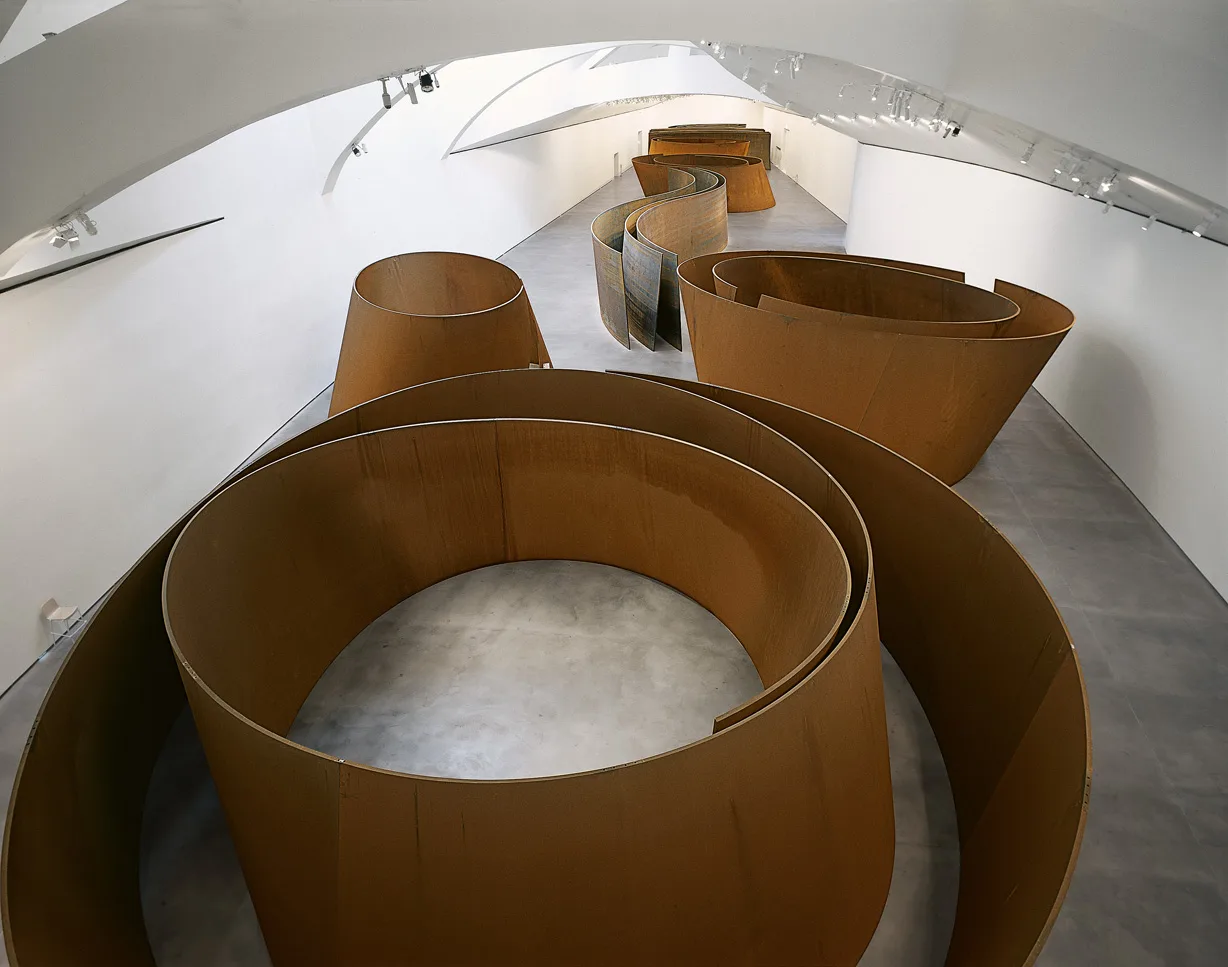
The Guggenheim Bilbao's collection is built around a small number of monumental permanent works — Richard Serra's steel installation The Matter of Time, Louise Bourgeois's bronze spider Maman, and Jeff Koons's flower-covered Puppy — each large enough to hold its own against Frank Gehry's building. These, not the architecture, are what repeat visitors come back for.
The building opens the door; the collection is the reason to stay
Frank Gehry's titanium-clad building opened in 1997 and did more to put Bilbao on a map for international visitors than almost any single building of its era — the curving, ship-like volumes along the Nervión have become shorthand for the city itself. It is easy to arrive, photograph the exterior, and leave having engaged with the architecture and almost nothing else.
That would mean missing the point of the collection inside. The museum's permanent holdings run toward large-scale postwar and contemporary sculpture and installation, several pieces made specifically for these rooms rather than acquired and then fitted in. The clearest case is Richard Serra's The Matter of Time, but the logic extends to the works stationed outside the building as well, which is where most visitors meet the collection before they have even bought a ticket.
Richard Serra's The Matter of Time is the collection's center of gravity
The Matter of Time (1994-2005) is a permanent installation of eight sculptures in weathering (COR-TEN) steel, occupying one of the museum's largest galleries. The pieces move from a relatively simple double ellipse through increasingly complex torqued spirals, toruses, and spheres, and the museum's own collection notes describe the effect deliberately: as visitors walk through and around the forms, the corridors between them shift unpredictably — wide, narrow, compressed, high, low — producing what the museum calls "an unforgettable, dizzying feeling of space in motion."
The work is credited to the Guggenheim Bilbao Museoa collection and has been on permanent view since 2005, extending a language Serra developed earlier in his Torqued Ellipses series. It rewards more than one pass — the installation is built around chronological time, how long it takes to walk it, and a second, slower kind of time built from the visual and physical memory of the forms already passed.
Before the door: Maman and Puppy
Two of the collection's most recognized works are not inside the building at all. Maman (1999, cast 2001), Louise Bourgeois's bronze, marble, and stainless-steel spider, stands over 9 meters tall and is displayed at the rear of the museum building — part of the permanent collection, not a touring loan. Bourgeois conceived the spider as a tribute to her mother, a weaver; the piece plays protector and predator against each other, its legs forming an arch that is also a cage around the egg sac beneath the body.
Puppy (1992), Jeff Koons's 12.4-meter West Highland terrier carpeted in flowering plants, stands in the square just outside the museum entrance and has been part of the permanent collection since 1997, the year the museum itself opened. Its planting is horticultural rather than static, which keeps it visibly alive in a way stone or steel sculpture cannot be — a deliberate collision, in Koons's own terms, of sentimental mass imagery with the formal language of an 18th-century garden.
A collection of scale, not a survey of art history
It helps to know what the Guggenheim Bilbao's collection is not. It is not an encyclopedic survey moving chronologically through movements and masters — that is a different kind of museum, the kind built around depth of period coverage rather than a small number of monumental statements. The Bilbao collection also includes significant painting — Mark Rothko, Anselm Kiefer, and light-based installation by Jenny Holzer are part of the same holdings as the Serra, Bourgeois, and Koons works — but the sculptures are what the building itself was shaped to hold, and what most visitors are describing when they say the museum "was worth it" beyond the architecture.
From the studio
From the studio
I have never stood inside Richard Serra's The Matter of Time, but I recognize exactly the problem he is solving, because it is the same one I face at a much smaller scale in my own studio: what does a body have to do, physically, to take in a piece too large to see from one position? Serra doesn't let you have the sculpture in a single look — he makes you walk for it, the same way a building makes you move through a sequence of rooms before it makes its argument. That is architecture thinking applied to steel instead of walls.
My canvases work at a completely different order of magnitude, but the reasoning underneath is the one I trained in: where does a surface stop being image and start being a physical thing a person has to account for in the room? A gold-leaf panel from Black & Gold does, at under two meters, a smaller version of what eight curling steel walls many times its height do — it insists on being read as weight and presence before it is read as image. Scale is a decision, not a byproduct, whether the piece is a torqued ellipse in Bilbao or a canvas finished in Brasília.
Frequently asked
Is the Guggenheim Bilbao more about the building or the art inside?
Both, for different reasons. Frank Gehry's building, completed in 1997, is why Bilbao appears on itineraries for people who might otherwise never visit the city, and it holds up as architecture on its own. But the permanent collection contains works significant in their own right — Richard Serra's The Matter of Time, Louise Bourgeois's Maman, Jeff Koons's Puppy — independent of the building around them. Visiting only for the exterior misses most of what the museum actually holds.
What kind of art does the Guggenheim Bilbao's permanent collection focus on?
The permanent collection leans toward large-scale postwar and contemporary work, especially sculpture and site-specific installation — Richard Serra's steel forms, Louise Bourgeois's bronze spider, Jeff Koons's flower sculpture, alongside painting by Mark Rothko and Anselm Kiefer and light-based installation by Jenny Holzer. It is not a chronological survey of art history the way an encyclopedic museum is; it is a smaller number of monumental, deliberately chosen works, several conceived with the building's own scale in mind.
How much time do you need to see the Guggenheim Bilbao properly?
Budget at least two to three hours if the permanent collection is the goal: enough time to walk the length of The Matter of Time more than once, since the installation is built around walking speed and changes as you move through it, plus time outside for Maman and Puppy and a slower pass through the building's other galleries. Rushing the Serra installation defeats its purpose — it rewards repeated viewing, not a glance from the doorway.
Is the Guggenheim Bilbao connected to the Guggenheim in New York?
Yes. The Solomon R. Guggenheim Foundation, founded in 1937, owns and operates the Solomon R. Guggenheim Museum in New York and the Peggy Guggenheim Collection in Venice, and provides programming and management for the Guggenheim Museum Bilbao. Bilbao is not a branch showing traveling New York exhibitions — it maintains its own permanent collection and its own program, within a foundation-wide network.
Are there permanent large-scale installations at the Guggenheim Bilbao?
Yes — the collection is built around them. Richard Serra's The Matter of Time (1994-2005) is a permanent installation of eight weathering-steel sculptures in one of the museum's largest galleries. Outside, Louise Bourgeois's bronze Maman and Jeff Koons's flower-covered Puppy are both part of the permanent collection as well, sited at the rear of the building and just outside the entrance respectively — none of the three is a temporary loan.
Sources
- Guggenheim Museum Bilbao — 2026-08-15
- Guggenheim Museum Bilbao — 2026-08-15
- Bilbao Turismo (official tourism board) — 2026-08-15
- Guggenheim Museum Bilbao — 2026-08-15
- Smithsonian Magazine — 2026-08-15
- Guggenheim Museum Bilbao — 2026-08-15
- Guggenheim Museum Bilbao — 2026-08-15
- Smithsonian Magazine — 2026-08-15
Thinking about scale and space?
If Serra's steel or Bourgeois's spider changed how you think about a room, the studio is glad to talk through the Perfeito Studio collection and how a work this scale reads in an architectural interior.
Talk to the studio on WhatsApp
Published on