What contemporary artists work in Willem de Kooning's territory?
Painters carrying Willem de Kooning's physical, gestural abstraction into contemporary practice include Jenny Saville, Cecily Brown, Amy Sillman, and George Condo — each reworking his built-up, scraped surfaces and unresolved figure-ground tension into distinct, independent bodies of work, not imitation.
What defines de Kooning's gestural territory
Willem de Kooning's paintings, in the words of the critical reference TheArtStory, "typify the vigorous, gestural style" of Abstract Expressionism — but with a twist that set him apart from the movement's purely abstract wing. "While many of his colleagues moved from figuration to abstraction, de Kooning always painted figures, most notably women, and abstractions concurrently, making no distinction between the art historical categories." His paint handling was never settled: the Willem de Kooning Foundation's own account of his studio process describes a cycle of "sanding, drawing, layering, scraping, rotating the canvas and repeatedly stepping back to consider each change" — a working method built on revision rather than a single decisive gesture. That refusal to separate figure from abstraction, and paint from process, is the territory the artists below keep returning to.
Jenny Saville: the figure rebuilt in paint
Jenny Saville paints monumental, distorted bodies in oil, and critics have repeatedly placed her within de Kooning's lineage. TheArtStory's critical analysis of her work describes her as borrowing "conventions from a long tradition in figure painting," citing as one example "the gestural painting of Willem de Kooning in his Woman series" — a description of her technique offered by the critic, not a claim made by Saville herself. The same source frames de Kooning's own line "Flesh was the reason oil paint was created" as a touchstone for how Saville's critics read her handling of the body: paint that behaves like tissue under pressure, built and reworked rather than laid down once.
Cecily Brown: bravura brushwork, major collections
Cecily Brown's paintings dissolve figures into swirling, high-velocity brushwork that critics consistently trace back to de Kooning's mid-century canvases. Her work now sits in institutional collections that measure that reputation directly: according to her representing gallery, Berggruen, her paintings are held in the permanent collections of the Museum of Modern Art, Tate, the Whitney Museum of American Art, the Centre Pompidou, the Solomon R. Guggenheim Museum, and the National Gallery of Art, among others. The Whitney Museum's own collection records confirm its holdings of her work, first acquired in 2003.
Amy Sillman and George Condo: two ways of recalibrating the gesture
Amy Sillman works the same painterly vocabulary from a different angle. Hyperallergic describes her as "borrowing colors and brushstrokes from Abstract Expressionist painters like Willem De Kooning and Hans Hoffman," while TheArtStory notes that she "has also recalibrated the macho histrionics associated with Abstract Expressionism in her contemporary paintings" — pairing his inherited palette and gesture with a different, less bravura-driven register.
George Condo takes a more direct route back to the Woman series. TheArtStory's account of his work identifies "traces of the caricatural figures found in Willem de Kooning's Woman series of the late 1940s and 1950s, the dynamic gestural abstraction of Jackson Pollock, and the tribal masks of Paul Cézanne" running through his compositions — de Kooning's fractured, aggressive figuration folded into Condo's own cast of invented characters.
Where to see de Kooning's own paintings today
De Kooning's most consequential works remain in public collections open to the same audience discovering the artists above. Woman I (1950–52) — the painting most identified with his palette-knife-and-brush attack on the canvas — is in the permanent collection of the Museum of Modern Art in New York. The Whitney Museum of American Art holds nineteen works by de Kooning spanning roughly 1937 to 1987, including Woman and Bicycle, with its first acquisition of his work dated to 1955.
From the studio
The Atelier's View
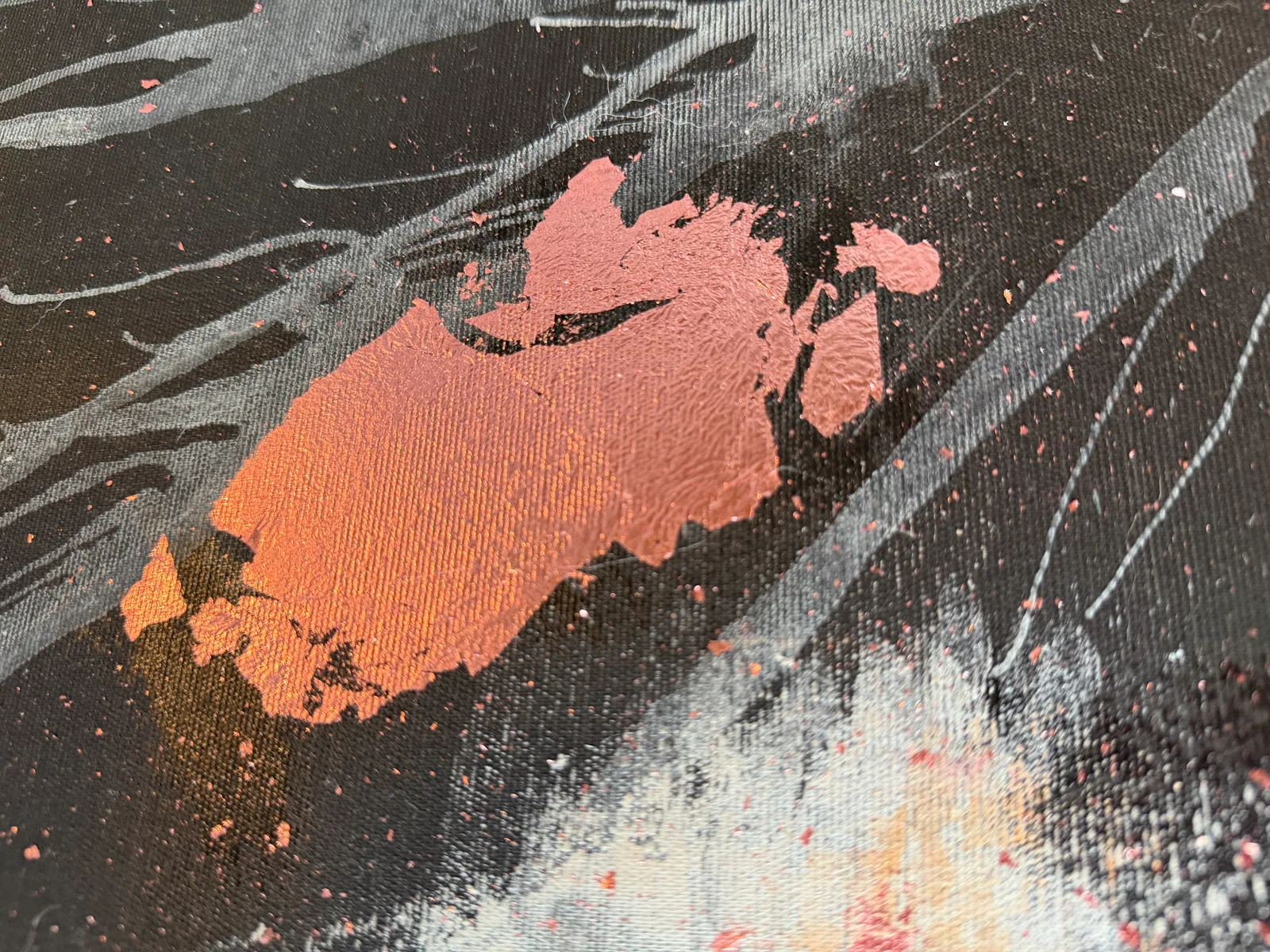
I don't put Alyne Perfeito's work anywhere near de Kooning's stature — that comparison isn't the point here. What I recognize, reading how critics describe his built-up, scraped, reworked surfaces, is a working logic that also shows up in her own canvases: layers laid down, then cut into by gesture. Genesis of Flame, from the Heart of Chaos series, is built the same way in principle — acrylic and metallic pigment applied in passes, high-gloss and matte finishes set against each other, the surface worked until the tension between control and accident holds. It's a much younger, much smaller practice than the one this page is about. But the questions are related: how much of a painting is decided in advance, and how much is found by working the paint until it resists you.
Frequently asked
What defines Willem de Kooning's style within Abstract Expressionism?
His paintings typify the vigorous, gestural style associated with the movement, but with one key difference from many peers: he painted figures — especially women — and abstract compositions concurrently throughout his career, treating the two as a continuous investigation rather than separate categories or a linear progression from one to the other.
Which contemporary artists continue his physical, gestural approach to paint?
Jenny Saville, Cecily Brown, Amy Sillman, and George Condo are each discussed in art criticism as working in territory de Kooning opened: Saville's paint-as-flesh figuration, Brown's dissolving bravura brushwork, Sillman's inherited color and gesture recalibrated away from Abstract Expressionism's macho posture, and Condo's direct reworking of his Woman-series figures.
Is de Kooning better known for abstract or figurative work, or both?
Both, by design. Unlike colleagues who moved from figuration toward pure abstraction, de Kooning painted figures and abstractions side by side for decades and, according to critical accounts of his career, made no distinction between the two as art-historical categories — his figures are often as abstracted as his non-figurative canvases.
What did de Kooning's studio process actually involve?
According to the Willem de Kooning Foundation's own account of his working method, a painting moved through repeated cycles of sanding, drawing, layering, scraping, and rotating the canvas, with the artist stepping back after each change to reconsider it — a process built on continuous revision rather than a single pass.
Where can you see major Willem de Kooning paintings today?
Woman I (1950–52), one of his most significant works, is in the Museum of Modern Art's permanent collection in New York. The Whitney Museum of American Art holds nineteen of his works, including Woman and Bicycle, with its first de Kooning acquisition dating to 1955.
Sources
- Willem de Kooning Foundation — 2026-08-22
- TheArtStory — 2026-08-22
- TheArtStory — 2026-08-22
- TheArtStory — 2026-08-22
- Berggruen Gallery — 2026-08-22
- Whitney Museum of American Art — 2026-08-22
- Hyperallergic — 2026-08-22
- TheArtStory — 2026-08-22
- TheArtStory — 2026-08-22
- Museum of Modern Art (MoMA) — 2026-08-22
- Whitney Museum of American Art — 2026-08-22
- Perfeito Studio (internal catalog data, src/data/obras.json) — 2026-08-22
Interested in a work built the same way — layer by layer, gesture against control?
Genesis of Flame (Heart of Chaos, 2025) is available for private acquisition. Talk directly with the studio on WhatsApp.
Talk to the studio on WhatsApp
Published on