Artists similar to Helen Frankenthaler
Artists close to Helen Frankenthaler share a procedure, not just an era: pouring thinned, translucent pigment onto raw, unprimed canvas so color soaks into the weave rather than sitting on the surface. Verified names working in that soak-stain, Color Field territory include Morris Louis, Kenneth Noland, Sam Gilliam, and, among living artists, Katharina Grosse.
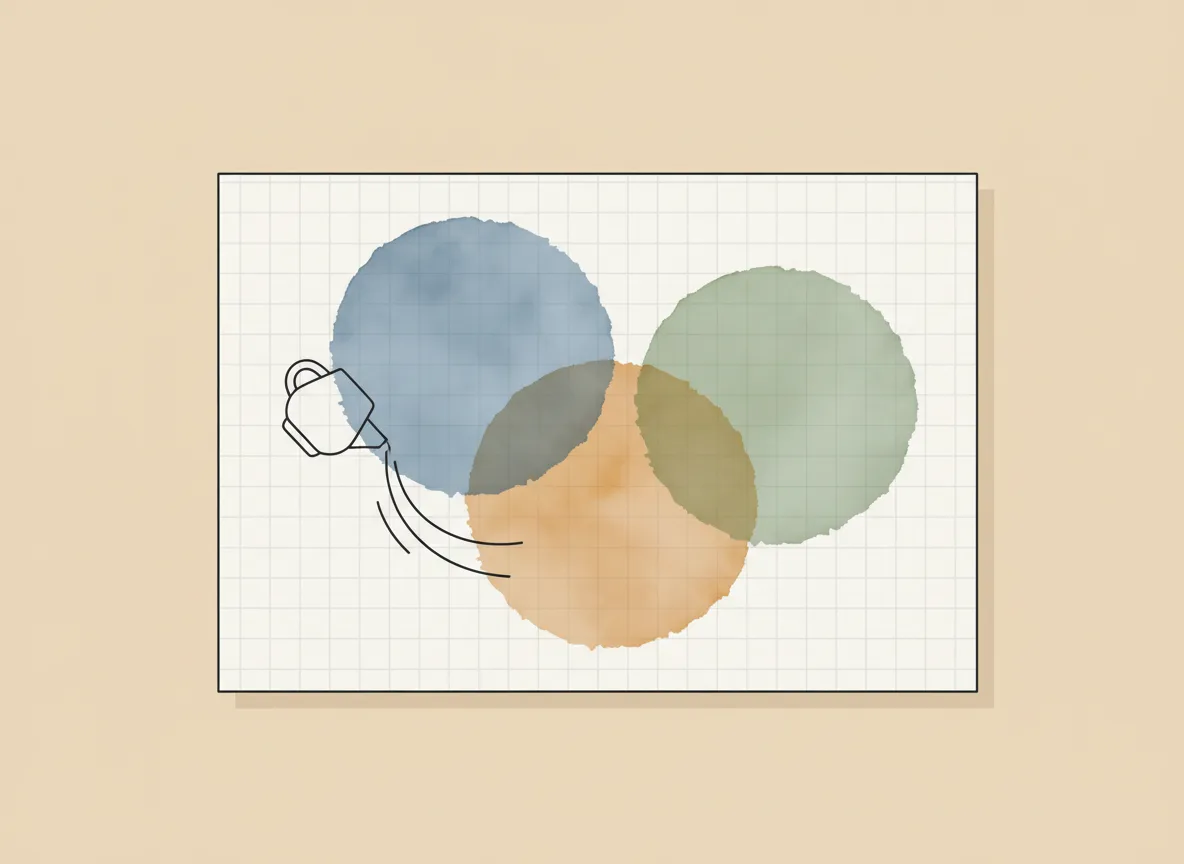
What makes Helen Frankenthaler's soak-stain technique distinctive
Helen Frankenthaler (1928–2011) developed the technique now called “soak-stain” in 1952, after seeing Jackson Pollock's floor-laid canvases at the Betty Parsons Gallery in 1950. Working on unprimed, unsized canvas laid flat on the floor, she thinned oil paint with turpentine until it moved like watercolor, then poured and guided it across the raw fabric with sponges, window wipers, and charcoal outlines -- letting the pigment soak directly into the weave instead of sitting on a primed surface.
The breakthrough work, Mountains and Sea (1952, oil and charcoal on canvas, 220 × 297.8 cm), was inspired by a trip to the Nova Scotia coast and remains on extended loan to the National Gallery of Art in Washington, D.C., from the Helen Frankenthaler Foundation. Morris Louis, who saw the painting in Frankenthaler's studio during a 1953 visit to New York with Kenneth Noland, called it “the bridge between Pollock and what was possible.” Because raw canvas soaked in oil paint deteriorates over time, Frankenthaler later switched to acrylic for better long-term preservation, without abandoning the pouring method itself.
Frankenthaler and the Color Field movement
Color Field painting emerged in New York in the 1940s and 1950s as a distinct current within Abstract Expressionism -- one built on large, flat, stained or soaked fields of color rather than on visible gesture. Critic Clement Greenberg was the first to separate this “color field” tendency from the gestural “action painting” of artists like Jackson Pollock and Willem de Kooning, whose marks stay legible as physical brushwork and movement on the canvas.
Frankenthaler is credited with originating the staining technique that gave the movement its second generation: Morris Louis and Kenneth Noland, both based in Washington, D.C., saw her work directly and adopted the method in the late 1950s, alongside earlier color-field figures such as Mark Rothko, Barnett Newman, and Clyfford Still. What unites them against the gesture painters is intent -- color is left to spread and settle on its own terms, so the paint's behavior becomes the subject rather than the trace of the hand that applied it.
Real artists in her territory -- historical and contemporary
Two Washington-based painters carried Frankenthaler's method furthest in her own lifetime: Morris Louis (1912–1962), whose thinned acrylic “Veils” and “Unfurleds” pour color down raw canvas in continuous sheets, and Kenneth Noland (1924–2010), who used the stain technique to build concentric-circle and chevron compositions where color, not drawing, carries the structure.
Sam Gilliam (1933–2022) learned soak-stain methods from his mentor Thomas Downing, working through the techniques the Washington Color School had adopted from Frankenthaler. By the late 1960s he pushed the stained canvas further than any of them: removing the stretcher bars entirely and draping the stained fabric from walls and ceilings, a move that earned him recognition as the “father of the draped canvas” and a place in collections including the Smithsonian American Art Museum and the Phillips Collection.
Among living artists, Katharina Grosse (b. 1961, Freiburg, Germany) is the clearest heir to the underlying idea, even though her tool is an industrial spray gun rather than a poured can. Since the late 1990s she has applied bright, unmixed acrylic across walls, floors, sculptural forms, and entire landscapes -- letting color behave as an atmospheric field that ignores the boundary between canvas and architecture. Her work is held by the Museum of Modern Art and the Centre Pompidou, and in 2016 she sprayed an abandoned Army bathhouse and the surrounding beach at Fort Tilden, New York, for MoMA PS1.
Where to see Helen Frankenthaler's work
Frankenthaler's paintings are held across major American collections, including the Museum of Modern Art, the Metropolitan Museum of Art, the Guggenheim, the Whitney Museum of American Art, and the Los Angeles County Museum of Art. Mountains and Sea itself is on extended loan to the National Gallery of Art in Washington, D.C., where it remains one of the most-cited paintings in the transition from Abstract Expressionism to Color Field painting -- a single canvas most collectors will only ever encounter in a museum, never on the market.
From the studio
From the studio
I did not train as a painter -- I trained as an architect -- and the habit that carried over is caring more about what a material actually does than about controlling every inch of it. That is the territory where I recognize Frankenthaler's decision, even though my own materials behave nothing like raw canvas soaking up thinned oil. In Veil of Light, from the Luminous Rebirth series, I built the blue as climate rather than as color choosing to sit in one place: a single sculpted ridge across the canvas, letting a paler figure of light seem to rise through the deeper indigo instead of being drawn on top of it. I did not pour it onto raw fabric the way she did -- my surface is worked, textured, built up with acrylic and relief rather than soaked in a single pass -- but the governing question is the same one: how much do you let the material find its own edge before you step back in.
Solar Rain, in the same series, is the piece where that question is most literal. The yellow field is built slowly and evenly, but the red-copper marks are allowed to descend, gather, and pool toward the canvas edge under something close to their own weight -- gravity doing part of the composition's work, the way it does in every stain painting since 1952. I am early in this career, with no institution or exhibition history behind the work yet, only the pieces themselves and the record I keep of each one. What I can say honestly is that neither painting reproduces well as a photograph -- the way pigment settles, the exact place gravity stopped it, only really argues its case on a wall, at the distance the piece was built for.
Frequently asked
What is the soak-stain technique Helen Frankenthaler pioneered?
Soak-stain is a method Frankenthaler developed in 1952: oil paint thinned with turpentine until it moves like watercolor, poured onto raw, unprimed canvas laid flat on the floor, and guided with sponges and window wipers so the pigment soaks directly into the weave instead of sitting on a primed surface. Her breakthrough painting using the method, Mountains and Sea (1952), is on extended loan to the National Gallery of Art in Washington, D.C. Because oil-soaked raw canvas deteriorates over time, she later moved to acrylic while keeping the same pouring approach.
Is Frankenthaler part of the Color Field movement?
Yes. Frankenthaler is credited with originating the staining technique that defined Color Field painting's second generation. Color Field emerged in New York in the 1940s-50s as a current within Abstract Expressionism built on large, flat, soaked areas of color rather than visible gesture -- a distinction critic Clement Greenberg made explicit. Morris Louis and Kenneth Noland saw Frankenthaler's work directly and adopted her method in the late 1950s, extending the movement she helped originate.
Which contemporary artists use a similar fluid, poured approach?
Sam Gilliam (1933-2022) learned soak-stain methods from his mentor Thomas Downing, working through techniques the Washington Color School had adopted from Frankenthaler, before removing the stretcher bars entirely and draping stained canvas from walls and ceilings. Among living artists, Katharina Grosse (b. 1961) works the same underlying idea with an industrial spray gun, applying unmixed acrylic across canvas, architecture, and landscape as a continuous atmospheric field. Her work is held by MoMA and the Centre Pompidou.
Where can you see Helen Frankenthaler's work?
Her paintings are held by the Museum of Modern Art, the Metropolitan Museum of Art, the Guggenheim, the Whitney Museum of American Art, and the Los Angeles County Museum of Art, among other institutions. Mountains and Sea (1952), the painting that introduced the soak-stain technique, is on extended loan to the National Gallery of Art in Washington, D.C., from the Helen Frankenthaler Foundation.
How does Frankenthaler's approach differ from Abstract Expressionist gesture painters?
Gesture, or action, painters such as Jackson Pollock and Willem de Kooning left the physical trace of movement and brushwork visible as the subject of the painting. Frankenthaler and the Color Field painters who followed her worked in the opposite direction: paint is thinned and poured so it spreads and settles on its own terms, and the hand that guided it recedes behind the resulting field of color. Frankenthaler herself developed the method directly after seeing Pollock's floor-laid canvases in 1950, then moved his physical, gestural process toward a quieter, color-first result.
Ask the studio directly
Questions about the Luminous Rebirth series, about Veil of Light or Solar Rain specifically, or about shipping a piece internationally? Alyne replies personally, in English or Portuguese.
Talk to the studio on WhatsApp
Published on